
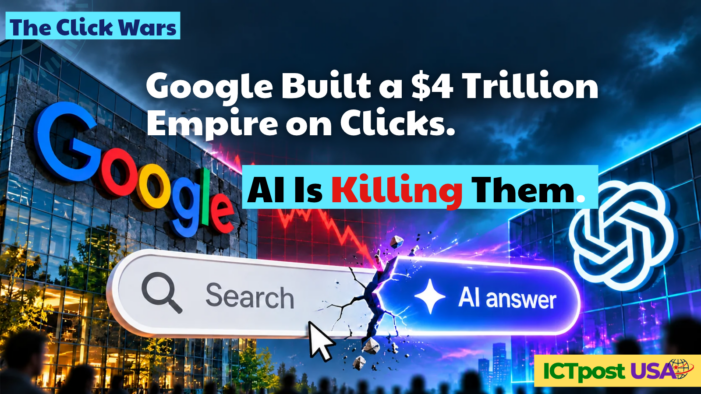
For 25 years, Google sold one thing: the click. Now it is dismantling the click itself — and a cash-burning rival wants the remains.
By K. Neelu, ICTpost Intelligence Unit
For two decades, Google had a simple bargain with advertisers: when a customer showed intent, you paid to be seen, and when they clicked, you paid again. That click, repeated billions of times a day, built the most profitable product in business history.
On October 28, Alphabet’s chief business officer, Philipp Schindler, told investors the bargain is fraying. Explaining why search revenue grew more slowly than queries, he named, after currency and soft Asian retail, a third factor: AI Mode queries had hurt, “because of the lower monetization we were seeing in AI Mode.” (Investing.com transcript) The stock fell more than 10% after hours.
Five days later, at a dinner in New York, ChatGPT’s consumer product lead, Adam Fry, supplied the other half: ChatGPT’s search-like queries now run at roughly one-fifth of Google’s volume. (24/7 Wall St., 9to5Google)
Google is not losing search. Search is losing the click — and the click is what made Google Google.
The fastest-growing, flattest quarter
Alphabet’s third quarter was, on its face, a triumph: revenue up 25% to $127.6 billion, Cloud up 103%, the fastest search-query growth in five years. (Alphabet Q3 2026 release, SEC) Yet search revenue was flat quarter on quarter at $63.4 billion, when the same seasonal step added 4.4% a year earlier. Growth has slid from 19% in Q1 to 12%, and finance chief Anat Ashkenazi warned of more pressure in Q4. (Alphabet Q1 2026 release, SEC; Q2/Q3 comparison)
The reason is mechanical. The old results page was an auction floor: ten blue links, a few paid ones on top, and a user who had to click. AI Mode, used by more than a billion people a month, answers instead. Google argues these queries are longer and mostly incremental — more intent to sell against, eventually — but has not sized the gap. Its fix, announced the same day, is to push ads into AI Overviews and AI Mode worldwide. (Carbon Finance; AIO Copilot)
The answer box ate the click. So Google is putting the ads inside the answer box.
Why OpenAI can afford this fight
OpenAI’s 20% claim deserves the skepticism it is getting. OpenAI counts any prompt that triggers a web lookup; independent estimates from Ahrefs and seoClarity put the figure at 12% and 7.5%. (24/7 Wall St.) Even discounted, that is historic; Microsoft spent a decade and billions getting Bing to about 3%.
The harder question is how OpenAI pays for it. It burned roughly $8 billion in 2025, does not expect positive cash flow until 2029, and has committed about $1.4 trillion to computing infrastructure. (Fintool) Deutsche Bank puts its cumulative cash shortfall through 2029 at $143 billion; HSBC thinks it may need another $207 billion by 2030. (Invezz — secondary; verify against the bank notes)
Read together, those numbers explain the business model. OpenAI has bought compute on a scale only a Google-sized revenue stream can service, and subscriptions will not get there. Advertising is the only business that has ever produced that margin on a free consumer product. So OpenAI, which once called ads a last resort, began testing them in ChatGPT’s free and $8-a-month tiers in February. (Implicator.ai; Parameter) By August ads had reportedly hit a $1 billion run rate; OpenAI projects $2.5 billion this year and $100 billion by 2030, ahead of an IPO that could come this quarter at a valuation above $850 billion. (eMarketer; Business Insider via AllMind — secondary; verify)
That is the financing contradiction at the heart of the AI race: OpenAI needs an IPO to fund the compute and an ad business to justify the IPO. Every incentive points toward monetizing every answer; Fry says “we could be doing this more, actually.” A challenger that must sell ads to survive is a far more direct threat to Google than one that merely could.
Google’s counterattack, and its bill
If this were only a wounded-incumbent story, Alphabet would not be worth $4 trillion. Google has chosen to disrupt itself first, with distribution no startup can buy: the Gemini app passed 1 billion monthly users in August, AI Overviews reach 2.5 billion, (Alphabet Q3 release) and in January Apple agreed to run a custom Gemini model inside Siri on more than two billion devices, reportedly for about $1 billion a year. (SEO Sherpa; Stan Ventures — $1B figure is secondary; verify) Google once paid Apple to be the default search engine. Apple now pays Google to be the default intelligence.
The bill is what Wall Street is only now pricing. Capex guidance for 2026 is $175 billion to $185 billion, roughly double last year; free cash flow turned negative in Q2 for the first time in Alphabet’s public history; the company has sold a 100-year bond. (FinanceBuzz — verify against the Q2 10-Q; Implicator.ai) Its own filings warn generative AI could reduce search usage and ad revenue — the engine funding the bet.
The visibility economy
Five years ago businesses fought for Google’s first page; today they fight to be the one name an AI mentions. Shopify’s data shows why. Across its merchant platform in the first quarter, shoppers arriving from ChatGPT, Gemini, Perplexity and Claude converted at nearly 50% higher rates on product pages and spent 14% more than organic-search visitors, and AI-referred orders grew almost 13-fold year over year. (Shopify Q1 2026 data via Shopifreaks) Two caveats: organic Google still sends Shopify merchants more sessions than every AI platform combined, and the figure is a platform-wide average, not a promise to any one store. High-intent referrals prove AI can sell; they do not prove it can replace a $250 billion-a-year ad business. “When AI sends a customer to a seller, they arrive with much higher intent,” said Josip Begić, chief executive of the analytics firm Lebesgue. “For brands, this should be a wake-up call.” (eCommerceNews)
The wake-up call has a catch. Peec’s analysis of 30 million AI citations found the most-cited domain across ChatGPT, Gemini, Perplexity and Google’s AI surfaces is not a brand or a newspaper but Reddit, followed by YouTube, LinkedIn and Wikipedia. ChatGPT leans on Wikipedia and Forbes; Google’s engines on YouTube and Yelp. (Peec) The rules differ by engine and shift within weeks, and a new discipline, answer-engine optimization, has sprung up to game them.
The regulators are fighting the last war
Two federal judges have found Google an illegal monopolist — Amit Mehta on search in 2024, Leonie Brinkema on ad tech in 2025 — and neither broke it up. Mehta let Google keep Chrome and Android and ordered data-sharing; on September 2 Brinkema refused to force a sale of Google’s ad exchange, imposing interoperability rules and six years of monitoring. All of it is under appeal. (Silicon UK; The Current; Goodwin)
A central reason the courts went easy was Google’s own trial argument: that AI was a real disruptor and ChatGPT poised to compete. Fry’s announcement is the market agreeing with Google’s lawyers. The competition that spared Google a breakup is now compressing its margins.
Precision matters here. The courts found a monopoly in the old search market and in ad-tech plumbing; they made no finding about AI. Google’s position there rests on three distinct things: distribution (Gemini inside Android, Chrome, Workspace and now Siri), scale, and a growing say over which sources an AI answer cites. None has been ruled unlawful — and the default-placement deals Mehta restricted in search are exactly what Google is now signing in AI. Whether existing remedies reach that market is open. The risk is not that Google has won AI. It is that it could win it by the route it won search, while the rulebook is still on appeal.
The open web pays
The casualties are already visible. Pew tracked nearly 69,000 real searches and found users clicked a result 8% of the time when an AI summary appeared, versus 15% without; a 2026 field study put the cut in outbound clicks at 38%, with no gain in satisfaction. (Pew via SEJ; field study, SEJ) Digital Trends went from 8.5 million monthly Google clicks to under 300,000. (WebProNews — secondary; verify) The Verge’s decline “lined up pretty clearly with the rise of AI Overviews,” its publisher has said. (WAMC/NPR) Publishers call the endpoint Google Zero.
Google disputes the methods and says it still sends billions of clicks a day. The economics are simple: publisher revenue is a function of page views, and an AI summary turns a page view into a sentence nobody pays for. A Reuters Institute survey of 280 media leaders found most now plan to put less effort into Google search. (via SEO-Day — secondary; verify against the Reuters Institute report) The web Google indexed was built by people paid in traffic. Stop the traffic and the supply of things to summarize dries up — for Google and OpenAI alike.
What to watch
Investors: whether ads inside answers can match ads beside links, and how long the gap lasts while $180 billion a year goes out the door. OpenAI’s IPO prospectus will be the first audited look at a rival search engine. Executives: distribution, not technology, is the moat, and Google just bought the biggest one left. Regulators: the remedies on appeal belong to a world of blue links, and that world is ending.
Google was never in the search business. It was in the click business. Search is doing fine; the click is not. The question for the next decade is whether anyone — Google included — has found a way to make an answer worth as much as a click.
K. Neelu writes for ICTpost AI Intelligence. editor@ictpost.com