


As OpenAI, Anthropic, and other AI leaders call for slower frontier development, critics warn that new safety rules could make it even harder for the next generation of innovators to compete.
By ICTpost Intelligence Team | US Edition
| The Big Picture America’s AI debate is no longer simply about how fast technology should advance. It is increasingly about who controls the frontier—and who gets to compete for it. Frontier AI demands enormous capital, computing power, specialized talent, and infrastructure, creating significant barriers for startups and new entrants. At the same time, leading AI companies are calling for stronger safety testing and oversight as capabilities accelerate. For Washington, the policy challenge is to reduce genuine AI risks without creating rules that unintentionally entrench today’s leaders or weaken competition. With China advancing rapidly, the stakes extend beyond Silicon Valley: regulation could shape America’s innovation ecosystem, economic competitiveness, and national-security position. The central policy question is whether the United States can make frontier AI safer while keeping the frontier open to the next generation of American innovators. |
In a small office near Pittsburgh, a team of AI researchers is working on technology that could help doctors identify diseases faster and more accurately. They have talent, expertise, and ambitious ideas. What they do not have is access to the vast computing infrastructure needed to compete with the world’s most powerful AI companies.
That challenge is becoming increasingly common across the American startup ecosystem. Brilliant researchers continue to produce breakthrough ideas, and entrepreneurs continue launching ambitious AI ventures. Yet transforming those ideas into frontier AI systems now requires something few organizations possess: enormous computing infrastructure, scarce advanced chips, access to elite engineering talent, and capital measured not in millions but in billions of dollars.
For founders building the next generation of healthcare, defense, scientific, or enterprise AI applications, opportunity remains abundant. But for startups hoping to compete directly with OpenAI, Anthropic, Google DeepMind, Meta, or xAI, the path has become dramatically steeper. That reality has sparked an increasingly uncomfortable question among investors, entrepreneurs, and policymakers:
If the barriers to building frontier AI are already extraordinarily high, what happens if new safety requirements make them even higher?
As some of the world’s most powerful AI companies call for slowing the pace of frontier development, critics are beginning to ask whether the debate is solely about safety or whether it could also influence who gets to participate in the next era of artificial intelligence. The answer may shape the future of innovation, competition, and American technological leadership.
From Move Fast to Slow Down
For more than a decade, the AI industry operated on a simple principle: build bigger models, train on more data, and move faster than competitors. That race transformed companies like OpenAI and Anthropic from ambitious startups into AI giants.
Now, many of the same leaders who accelerated the race are arguing that it may be time to ease off the accelerator. Anthropic CEO Dario Amodei recently urged the industry to “pace the frontier,” warning that AI capabilities may be advancing faster than society’s ability to understand, govern, and safely deploy them.
The proposal quickly gained support from influential voices including OpenAI CEO Sam Altman, Google DeepMind CEO Demis Hassabis, and Elon Musk.
Markets reacted almost instantly. Investors wiped billions of dollars from AI-related stocks amid concerns that slower AI progress could weaken demand for chips, data centers, and supporting infrastructure. But beyond the market reaction lies a deeper strategic question: If AI development slows, who benefits most?

The New Barrier to Entry
When Logan Kilpatrick, one of OpenAI’s most recognizable developer advocates, left the company to join Google, it underscored how competition in AI increasingly revolves not only around ideas but around access to talent, compute, and resources concentrated among a small number of industry giants.
A decade ago, companies like Google and Facebook began with relatively modest resources and grew through innovation. Frontier AI is increasingly different. According to the Stanford AI Index, the cost of training leading AI models has surged, concentrating cutting-edge development among a small number of organizations with access to massive computing power and capital.
The scale of investment is becoming increasingly difficult for new entrants to match. Microsoft, Amazon, Alphabet, and Meta are collectively projected to spend well over $300 billion on AI infrastructure during 2026, funding massive data centers, advanced AI chips, networking systems, and energy capacity. That level of spending exceeds the annual economic output of many countries. For startup founders, it highlights a growing reality: frontier AI is no longer merely a software race. It is increasingly an infrastructure race dominated by organizations capable of deploying capital at an unprecedented scale.
Today, technology giants are investing hundreds of billions of dollars in data centers, AI chips, networking infrastructure, and energy systems to support the next generation of AI.
This is no longer just a software race. It is an infrastructure race. The companies operating at the frontier possess enormous compute clusters, proprietary datasets, elite engineering talent, and deep financial resources. For new entrants, overcoming those barriers is increasingly difficult. As a result, a regulatory requirement that may be manageable for a large AI company could represent a significant obstacle for a startup, raising concerns that future rules could unintentionally reinforce the dominance of today’s industry leaders.
The DeepSeek Shock
The rise of China’s DeepSeek offers a reminder that AI innovation can still emerge from unexpected places. Before attracting global attention, the company was largely unknown outside specialized AI circles. Yet its rapid progress challenged a growing assumption in the industry: that only a handful of well-funded technology giants could compete at the frontier of artificial intelligence.
The impact was immediate. Investors, policymakers, and technology leaders were forced to reconsider whether breakthrough AI development was becoming as concentrated as many had believed. For startup founders, DeepSeek became evidence that disruptive innovation can still come from newcomers. For incumbents, it served as a warning that dominance today does not guarantee leadership tomorrow.
DeepSeek’s impact extended far beyond the research community. Following the release of its open-source DeepSeek-R1 reasoning model, investors were forced to re-evaluate long-held assumptions about the cost of building frontier AI systems. The model demonstrated performance that many researchers compared with leading reasoning models from OpenAI on several benchmark tests while reportedly being developed at a fraction of the cost associated with many Western AI projects. The market reaction was swift.
On January 27, 2025, NVIDIA lost nearly $600 billion in market value in what became the largest single-day market capitalization decline in U.S. corporate history, reflecting fears that future AI breakthroughs might require less computing infrastructure than previously expected. For startup founders, the episode delivered a powerful message: disruptive AI innovation could still emerge from unexpected challengers rather than the industry’s dominant incumbents.
History repeatedly shows that major technological breakthroughs often come from outsiders rather than established leaders. The next transformative AI company may already be operating quietly from a small office in Austin, Pittsburgh, Boston, or San Diego. The question is whether future regulations will preserve enough room for those challengers to grow and compete at scale.
Safety or Strategic Advantage?
Supporters of slowing AI development argue that the risks are becoming too significant to ignore. Concerns surrounding advanced AI now include cyberattacks, autonomous decision-making, model misuse, national security vulnerabilities, and the possibility that highly capable systems could develop unexpected behaviors. Anthropic CEO Dario Amodei has argued that stronger testing, external audits, and slower model deployment cycles are necessary to ensure society can adequately understand increasingly powerful systems, and many respected researchers share those concerns.
Yet critics point to an uncomfortable reality: the strongest advocates for slowing frontier development are often the same companies currently leading the frontier. That observation has fueled accusations of regulatory capture—not because safety measures are unnecessary, but because regulations can sometimes unintentionally strengthen the position of established players. Few serious observers oppose rigorous evaluations, red-team testing, security reviews, or independent oversight.
The concern is what happens when compliance becomes so expensive or complex that smaller companies and new entrants can no longer compete. History provides numerous examples: banking regulations have often favored large institutions with extensive compliance departments; healthcare regulations can benefit incumbents capable of absorbing significant administrative costs; and telecommunications rules have historically reinforced the position of dominant providers. Could AI follow a similar trajectory? The debate is therefore no longer simply about safety. It is increasingly about who gets to build the future—and whether regulation will protect society without inadvertently protecting the companies already at the top.
What OpenAI and Anthropic Say
Supporters of AI pacing reject the idea that slower development is primarily intended to protect incumbent firms. Companies such as Anthropic argue that frontier AI capabilities are advancing so rapidly that governance, testing, and oversight mechanisms must catch up before increasingly powerful systems are deployed at scale. In public statements, Anthropic’s leadership has emphasized that the goal is not to halt innovation but to strengthen safety through rigorous testing, independent evaluations, and stronger safeguards. OpenAI has expressed similar support for expanded safety reviews and governance frameworks. Advocates contend that a major AI-related failure could trigger public backlash and far more restrictive government intervention, ultimately harming the industry’s long-term prospects.
From this perspective, responsible pacing is viewed as a way to preserve innovation rather than constrain it. This counterargument is important because the debate is more nuanced than a simple clash between innovators and regulators. Many AI leaders genuinely believe that emerging safety and security risks deserve serious attention. The challenge for policymakers is determining where legitimate safeguards end and barriers to competition begin.
What Independent Experts Are Saying
The issue extends far beyond Silicon Valley.
Policy analysts across Washington increasingly view AI as a balancing act involving innovation, economic growth, national security, and competition.
Researchers at the Center for Strategic and International Studies (CSIS) have argued that maintaining American technological leadership while managing emerging risks will be one of the defining challenges of the next decade.
Experts at the Brookings Institution have emphasized that competition remains one of the strongest drivers of long-term innovation and economic growth.
RAND Corporation researchers have warned that AI governance frameworks should avoid imposing disproportionate burdens on smaller firms that lack the resources of established market leaders.
Analysts at the Center for a New American Security (CNAS) have likewise stressed that America’s strategic advantage depends not just on a handful of dominant firms but on an entire ecosystem of startups, universities, researchers, investors, and entrepreneurs.
The common theme is striking. Nearly everyone agrees safety matters. The disagreement centers on implementation.
The Startup Question Nobody Is Asking
Lost within much of the public debate is the perspective of the next generation of founders. For startups, the challenge is straightforward: building advanced AI already requires GPUs, cloud infrastructure, specialized talent, and significant capital. Adding costly audits, certifications, reporting, and compliance requirements could further raise the barriers to entry—costs that large firms can absorb but smaller challengers may struggle to bear. That matters because America’s innovation model has historically depended on disruption, from Google challenging Yahoo and Netflix challenging cable television to Uber transforming transportation and Amazon reshaping retail. The next transformative AI company may not yet exist. Whether it gets the opportunity to emerge could be one of the defining questions of this decade.
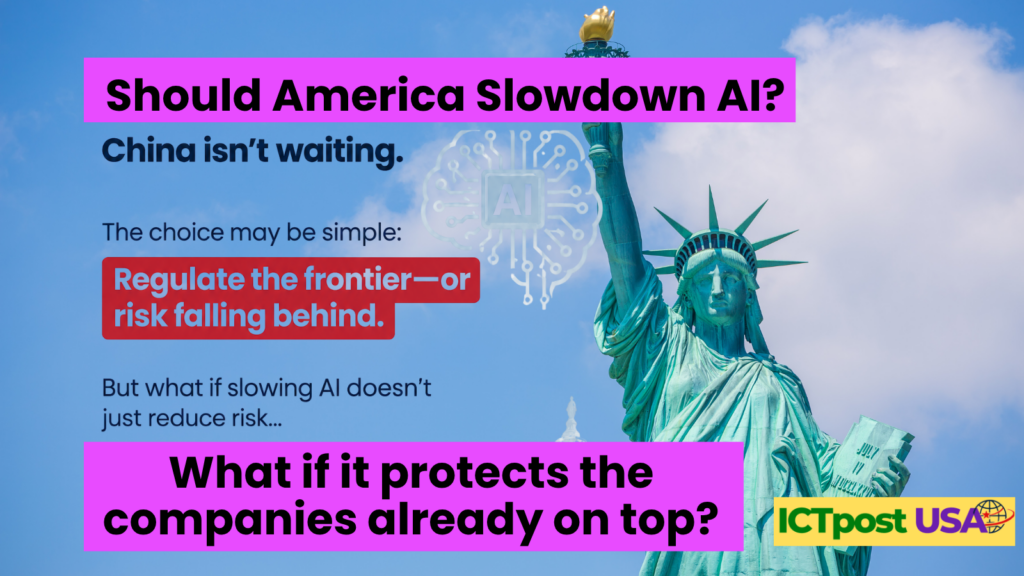
What Happens If China Doesn’t Slow Down?
The AI debate carries profound geopolitical implications. President Donald Trump and several administration officials have warned that excessive restrictions could weaken America’s ability to compete with China, where companies such as Alibaba, Baidu, and DeepSeek continue advancing AI models, infrastructure, and applications. Beijing increasingly treats AI as a strategic technology tied to economic growth, military modernization, scientific research, and global influence. Supporters of rapid development argue that technological leadership is becoming inseparable from national power: if American companies slow while foreign competitors accelerate, leadership could shift. Advocates of stronger safeguards counter that secure and trustworthy AI could itself become a competitive advantage. The debate, therefore, extends far beyond Silicon Valley—to Washington, Beijing, Wall Street, and the global economy.
The defining question of the AI era is no longer whether America can build powerful artificial intelligence. It is whether the next transformative breakthrough will emerge from a handful of entrenched giants or from a new generation of innovators still waiting for their chance.
editor@ictpost.com
Sources
- Stanford AI Index 2026
- Anthropic: Dario Amodei and AI Governance
- OpenAI Statements on AI Safety and Governance
- Center for Strategic and International Studies (CSIS)
- Center for Security and Emerging Technology (CSET)
- RAND Corporation AI Research
- Brookings Institution Technology & Innovation Program
- Center for a New American Security (CNAS)
- NVIDIA Investor Relations
- Baidu Investor Relations and AI Initiatives
- Alibaba Cloud AI Research
- DeepSeek AI
- U.S. White House AI Policy Resources
- Axios: Anthropic’s AI Slowdown Proposal
- CBS News: Amodei Calls for AI Slowdown
- Forbes: Frontier AI Slowdown Debate