

As GPU rental prices fluctuate and AI infrastructure attracts enormous capital commitments, a new market is emerging to measure, benchmark and potentially hedge the cost of computing. Ornn and ICE Futures US are testing whether the economics of AI can support a financial market of their own.
By Dhirendra Pratap Singh | ICTpostUSA
On October 5, a new instrument appeared in the contract listings of ICE Futures U.S., the Atlanta-based exchange group that owns the New York Stock Exchange. Contract symbol: BKL. Underlying: the hourly rental price of an Nvidia B200, the chip at the center of the current generation of AI data centers. Settlement: cash, in dollars, with no chips changing hands. The exchange’s calendar shows 14 monthly expiries with that first-trade date (ICE Futures U.S.).
No one rang a bell, and it is not yet clear how much, if anything, has traded. But the listing is among the first times a major U.S. exchange has offered a standardized way to hedge the cost of the computing capacity that every AI model consumes.
The index behind the contract comes from Ornn, a startup that has built what it calls the Ornn Compute Price Index, or OCPI. Wayne Nelms, Ornn’s chief technology officer, frames the problem bluntly.
“Without a reliable benchmark, you cannot price risk, hedge exposure, or attract institutional capital into compute infrastructure,” Nelms said in an interview.
That sentence captures a gap that trillions in AI investment have papered over. Hyperscalers, sovereign funds and private credit have poured money into data centers filled with graphics processing units, or GPUs. Yet the hourly rental price those chips command—the number that decides whether the investment pays off—has never had a benchmark lenders, buyers and traders agree on.
The missing number
Every AI company without its own data centers rents computing time, and the bill depends on which chip, where, for how long, and from whom. A posted rate is rarely the rate anyone pays. A large customer on a six-month commitment gets a discount; a startup renting on demand pays full freight.
The result is a shifting mosaic of prices. For an AI lab budgeting a training run, that is an inconvenience. For a bank underwriting a $2 billion data-center loan, it is an unquantified risk.
Ornn’s answer is to build the index only from completed transactions rather than advertised rates. Its published methodology describes OCPI as a volume-weighted, winsorized mean of anonymized executed rental trades, expressed in dollars per GPU-hour (Ornn methodology). In plain terms: bigger trades count more, outliers are trimmed, and the figure reflects what buyers and sellers actually paid.
Ornn publishes separate indices for each major chip family—Nvidia’s A100, H100, H200 and B200—because the generations are not interchangeable. Nelms says the market is moving from a single price for “compute” toward rates that vary by chip, geography, contract length and provider.
The data supplied to me by Ornn for this column shows why that matters.
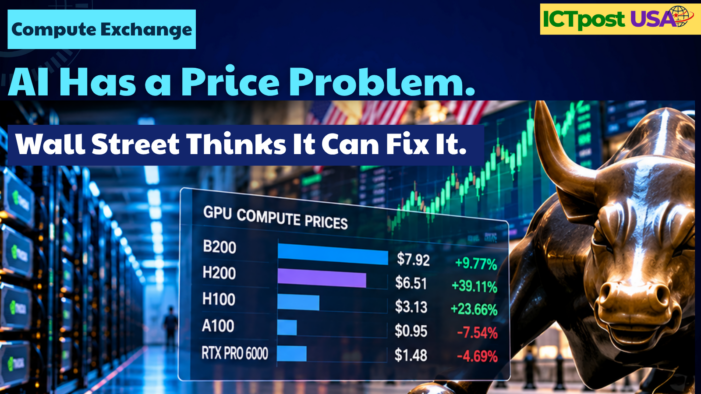
| GPU | Rental-price index | One-month change |
|---|---|---|
| Nvidia B200 | $7.92 per GPU-hour | +9.77% |
| Nvidia H200 | $6.51 per GPU-hour | +39.11% |
| Nvidia H100 | $3.13 per GPU-hour | +23.66% |
| Nvidia A100 | $0.95 per GPU-hour | −7.54% |
| Nvidia RTX PRO 6000 | $1.48 per GPU-hour | −4.69% |
Source: Ornn Data dashboard.
The H200, no longer the newest chip, rose 39% in a month. The B200, which is, rose less than 10%. The A100, two generations old, fell. Anyone pricing “AI compute” as a single commodity would have missed all of it.
Nelms attributes the divergence to supply and demand playing out differently for each chip: tight near-term H200 availability while B200 supply is still ramping. That is the index provider’s reading, not an independent finding.
Why an exchange cares
Intercontinental Exchange and Ornn announced the futures partnership in May, describing OCPI as the first compute index built exclusively from printed transactions and the intended reference rate for cleared GPU derivatives (Markets Media). ICE is not alone. CME Group said in August it planned to launch H100 and B200 futures tied to rival Silicon Data indices on the same October 5 date, pending regulatory review (CME Group). Announced plans, exchange listings and verified trading are three different things; so far the public record confirms only the first two.
The ICE B200 contract’s design is borrowed from energy markets. Its final settlement is the average of daily OCPI B200 prices across the contract month, a structure traders call Asian-style settlement (ICE contract specifications). Averaging smooths single-day spikes and matches how buyers experience costs: as a monthly bill.
Crucially, the contract delivers money, not machines. A trader long B200 futures collects the difference when the index rises; no one ships a server rack. That makes it a tool for managing price exposure, not for securing capacity. An airline hedging jet fuel still has to buy fuel.
How a hedge would work
Consider an AI lab planning a large training run six months out. It expects to rent thousands of GPU-hours and fears prices will climb before the job starts. It buys futures on the relevant index. If rates rise, the futures gain offsets part of the higher bill; if they fall, the lab pays less for capacity but loses on the contract.
A data-center operator has the mirror-image problem. It has borrowed heavily to buy chips and worries that rental rates will slide as new supply arrives. Selling futures locks in part of its expected revenue. Nelms likens this to energy producers hedging output and argues that predictable cash flows could make compute infrastructure easier to finance.
The basis-risk problem
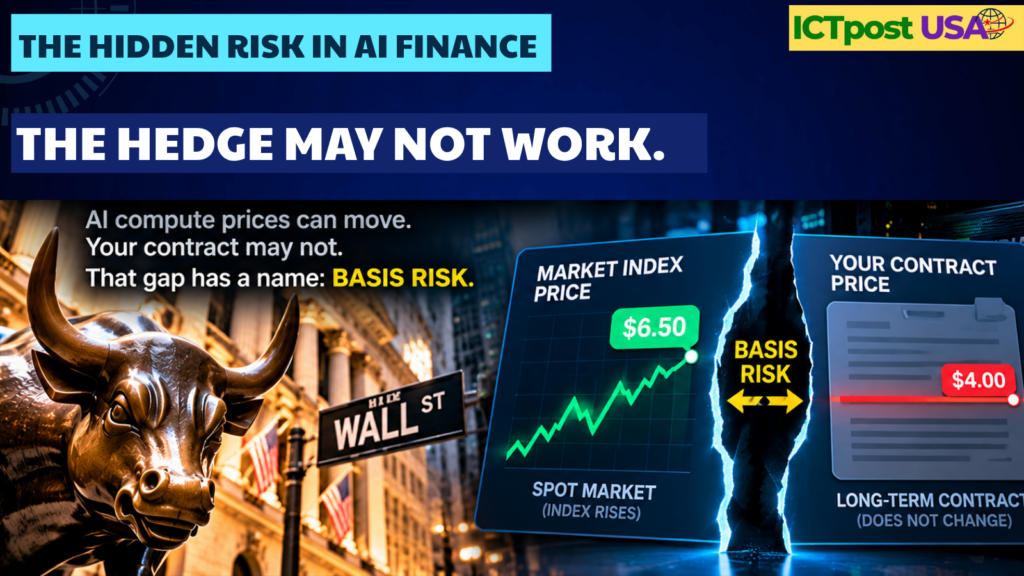
Almost nobody pays exactly the benchmark price. In commodity markets that gap is called basis risk, and it is the biggest reason hedges disappoint.
OCPI measures arm’s-length spot rentals aggregated across the market. A large enterprise, by contrast, might hold a one-year contract with volume discounts, prepayment terms and guaranteed capacity in a specific region. Nelms acknowledges the difference: the index reflects the market, he says, while a bilateral contract reflects a particular relationship at a particular moment.
Suppose that enterprise rents H200 capacity under a contract whose price moves with its provider’s own rate schedule. The OCPI jumps 39%, but the provider’s rates move by a different amount, or at a different time. A long futures position offsets part of the increase, yet leaves costs the payout does not cover. Reverse it—the index falls while the provider’s rates stay elevated—and the futures lose money even as the rental bill barely changes. That gap is basis risk.
A genuinely fixed-price customer is a different case. Its costs are not exposed to spot movements during the contract, so a hedge would add risk rather than remove it.
For institutional buyers, the question is whether the index tracks their actual exposure closely enough to be worth the margin, trading costs and risk of being wrong. That means scrutinizing how many providers contribute data, how concentrated they are and how methodology changes are governed. A transaction-based index beats averaging rate cards. It is not a substitute for due diligence.
Computing is not oil
The oil comparison is irresistible and incomplete. Crude is differentiated by grade and delivery point, but a barrel of Brent in storage today is still a barrel next month. A GPU-hour that goes unsold tonight is gone. The inventory cannot be rolled forward, and the electricity, networking and depreciation behind it are paid regardless, which is why utilization, not just price, decides whether a data center earns its keep.
Demand is also stranger than for any physical commodity. A more efficient model architecture can halve the computing a task needs overnight, suppressing demand for one chip even as AI usage grows. Cheaper compute can just as easily unleash new applications and send demand the other way.
And the asset depreciates on a technology curve. The A100 that commanded premium rates in 2023 now rents for under a dollar an hour. Any lender modeling a data center’s cash flows is betting on how fast the next chip arrives, and no futures contract hedges obsolescence.
What has to happen next
Nelms sets out three conditions for a mature market: depth and liquidity in both physical and forward trading, broad institutional trust in the benchmark, and regulatory clarity with standardized contract terms. None is guaranteed by a listing.
Liquidity is the hardest. A contract can be elegantly designed and still fail if only a handful of participants trade it. Early volume on the ICE and CME contracts will say more than any press release.
For now, the practical payoff may be less about hedging than transparency. An AI buyer negotiating with a cloud provider has a market reference to push against. A lender can test whether a borrower’s projections assume rental rates the index says are already slipping.
That is a modest start. But every commodity market began the same way: not with a flood of speculators, but with a few producers and consumers tired of guessing the fair price.
The AI industry has spent three years asking who can get the most chips. The question now reaching Wall Street is simpler and, in the end, more consequential: what is an hour of intelligence actually worth—and who is willing to put a price on it?
Wayne Nelms, chief technology officer of Ornn, was interviewed for this column.