
Elon Musk’s $15.8 Billion Bet on Building the Infrastructure of Intelligence Beyond Earth
By Dhirendra Pratap Singh | ICTpost USA Special Report
What if the next AI factory is not in Texas, but in orbit? And what if the factories that build those orbital AI systems are eventually located not in California, Texas or Arizona, or even on Earth, but on the Moon? It sounds like science fiction today, but Elon Musk believes parts of this vision could eventually become an industrial reality.
The most important story, however, is not the Moon. It is the billions of dollars being invested today to build the infrastructure that could make such a future possible. America’s AI race is no longer simply a competition between software companies. It is increasingly becoming a race for power generation, semiconductor capacity, computing infrastructure, robotics, launch systems, advanced manufacturing and global connectivity.
In that race, Musk may be attempting something unprecedented: not simply building an AI company, but developing the physical infrastructure needed to scale artificial intelligence. SpaceX’s first earnings report as a public company revealed both the scale of the opportunity and the size of the bet. The company reported $7.8 billion in second-quarter 2026 revenue, up 92% year over year, while recording a $541 million loss. More significantly, it disclosed about $18.4 billion in quarterly capital expenditures, including roughly $15.8 billion tied to AI investments.
The question facing Wall Street is simple: Can Elon Musk make the economics of this AI gamble work?
THE $15.8 BILLION QUESTION
For years, SpaceX was primarily known as a rocket company. Then it became a satellite company and, through Starlink, a global connectivity company. Today, it is increasingly moving into another area: AI infrastructure.
Reuters has reported that SpaceX’s AI-related revenues are growing rapidly and that the company has secured billions of dollars in computing agreements. Yet investors remain divided over the scale and sustainability of this opportunity. The contradiction is striking: AI revenues are growing quickly, but AI spending is also rising at an extraordinary pace.
SpaceX CFO Bret Johnsen has argued that returns on AI investments could materialize in less than a year, suggesting that the company believes its infrastructure investments could become self-financing much sooner than skeptics expect. Wall Street, however, wants to see clear evidence that the numbers can support the ambition.
SPACEX IS NO LONGER JUST A ROCKET COMPANY
The transformation is remarkable.
This is the real story.
Musk is not simply adding AI to SpaceX.
He is attempting to connect the physical infrastructure of space with the computational infrastructure of artificial intelligence.
THE FOURTH GREAT AMERICAN INFRASTRUCTURE WAVE
American economic history can be understood through major infrastructure revolutions. Railroads connected a continent, the electrical grid powered industrialization, the interstate highway system transformed commerce, and the internet connected information. Artificial intelligence could become the next major infrastructure era.
Unlike earlier technology revolutions, AI requires enormous amounts of electricity, semiconductors, servers, networking equipment and data centers. As a result, the AI race is no longer limited to software or algorithms. It increasingly involves power generation, semiconductors, data centers, robotics, advanced manufacturing, cloud infrastructure, space systems and launch capacity.
The companies that can connect and integrate these different layers could become the industrial leaders of the AI age. That is what makes SpaceX different. Its ambitions extend beyond rockets and satellites toward a broader infrastructure ecosystem that could eventually connect space, energy, computing and AI.
AMERICA’S AI INFRASTRUCTURE MOMENT
The scale of America’s AI buildout is difficult to overstate.
Across the United States, technology firms, utilities, data-center developers and investors are collectively committing hundreds of billions of dollars to AI infrastructure.
One of the most ambitious examples is the Stargate Initiative, announced in 2025, which proposes up to $500 billion in AI infrastructure investment across the United States, including next-generation data centers and computing campuses. It has been described by supporters as one of the largest AI infrastructure programs ever attempted. [techrepublic.com], [techinformed.com]
The energy implications are extraordinary.
According to the U.S. Department of Energy and Lawrence Berkeley National Laboratory, data centers accounted for approximately 4.4% of total U.S. electricity consumption in 2023 and could reach roughly 9.5% to 15.3% of total U.S. electricity use by 2030, depending on AI growth and deployment scenarios. [energy.gov], [osti.gov]
The implication is profound.
The future of artificial intelligence may depend not only on software engineers but also on electricians, construction workers, grid operators, semiconductor fabs, power plants, transformers and transmission systems. [blogs.nvidia.com], [energy.gov]
AI is increasingly becoming an infrastructure challenge.
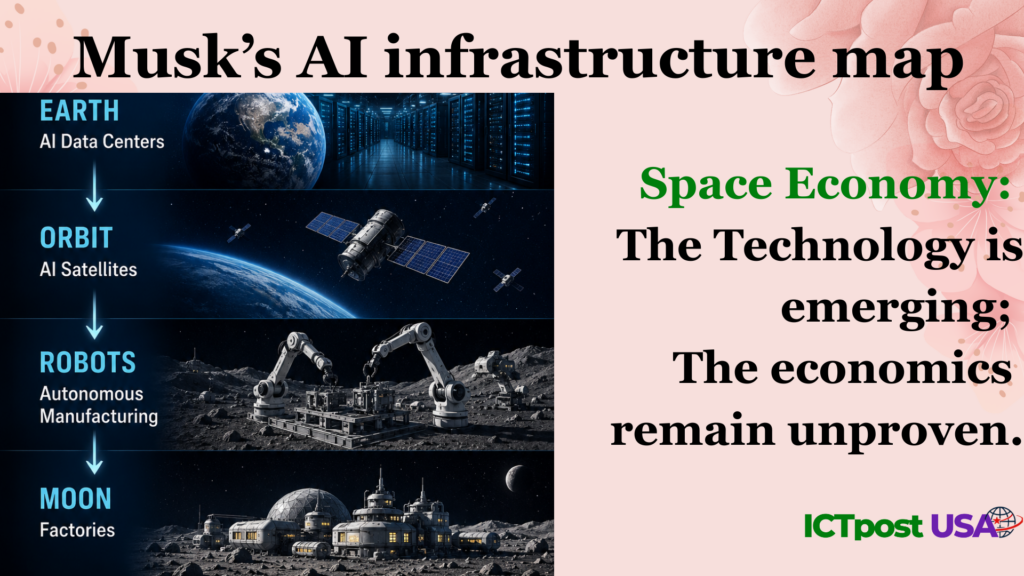
THE AI INFRASTRUCTURE PROBLEM
Why is Musk making this bet now? Because AI is rapidly becoming an infrastructure challenge rather than simply a software challenge. NVIDIA CEO Jensen Huang recently described artificial intelligence as “the largest infrastructure buildout in human history.” His view covers everything from energy infrastructure and advanced chips to cloud data centers, AI models and applications.
Every frontier AI system depends on a massive physical infrastructure. It needs chips, servers, data centers, high-speed networking, cooling systems, electricity, capital and land. As AI demand continues to grow, many of these resources are becoming increasingly constrained. More importantly, they are becoming strategic assets in the global competition for AI leadership.
WHAT AMERICA’S TECHNOLOGY LEADERS ARE SAYING
Musk is not the only technology leader thinking at national scale.
Microsoft CEO Satya Nadella has argued:
“Every company is now an AI company.” [coloradoai.news]
If that statement proves correct, every industry increasingly becomes a consumer of AI infrastructure.
NVIDIA’s Jensen Huang sees AI as an entirely new industrial layer built on energy systems, semiconductors and advanced computing. [blogs.nvidia.com], [linkedin.com]
Google CEO Sundar Pichai has compared AI’s significance to previous transformational technology shifts, while OpenAI CEO Sam Altman has repeatedly warned that future AI systems could require unprecedented levels of computing and power infrastructure. [deliberate…ctions.com], [techrepublic.com], [techinformed.com]
Viewed together, these leaders are pointing toward the same conclusion:
The next phase of AI may be constrained less by algorithms and more by infrastructure.
MUSK’S ANSWER: DON’T JUST BUILD MORE DATA CENTERS
The conventional response to rising AI demand is straightforward: build more data centers, power plants, transmission networks and GPU clusters. Musk appears to be thinking beyond these constraints. His bigger question is whether part of the computing infrastructure could eventually move beyond Earth and operate in space.
THE DATA CENTER THAT LEAVES EARTH
SpaceX and NVIDIA are exploring concepts that could eventually enable data-center-level AI computing in orbit. The long-term vision is to build orbital AI platforms capable of handling large-scale computing workloads beyond Earth. This could change the way AI infrastructure is designed. Instead of the traditional model of Earth to data center to AI, the future could move toward Earth to launch to orbit to AI compute. In an even more ambitious scenario, the Moon could become part of a larger ecosystem involving manufacturing, satellites and orbital AI computing. However, a large-scale orbital AI network remains a long-term aspiration, not a proven commercial reality, and major engineering challenges still need to be overcome.
SPACE HAS A COOLING PROBLEM
Popular imagination often sees space as an ideal place for computing, but the reality is more complicated. There is no atmosphere in space, so the heat generated by AI chips cannot be removed the same way it is on Earth. Modern AI accelerators also produce enormous amounts of heat, which must ultimately be released through radiation. So the equation is not simply solar power plus GPUs equals cheap AI. The bigger question is whether computing in orbit can ever become more economical than computing on Earth. For now, nobody knows.
THEN MUSK LOOKED AT THE MOON
During SpaceX’s first earnings call as a public company, Musk outlined plans to eventually transport industrial equipment to the Moon and establish manufacturing capabilities supported by robotics.
His vision includes factories capable of producing components for future space infrastructure.
The Moon, in this framework, ceases to be a destination.
It becomes a production platform.
A factory.
An industrial node.
WHO WILL WORK ON THE MOON?
Not humans, at least in the beginning. Robots are more likely to handle such work in space. The exact systems are still uncertain, but the economic logic is simple. Humans need oxygen, food, water, shelter, radiation protection and life-support systems, while robots mainly need electricity, maintenance, hardware and software. Neither approach is easy, but robots do not need an entire life-support system to operate in space.
WHAT IF ROBOTS BUILD THE FACTORIES THAT BUILD THE ROBOTS?
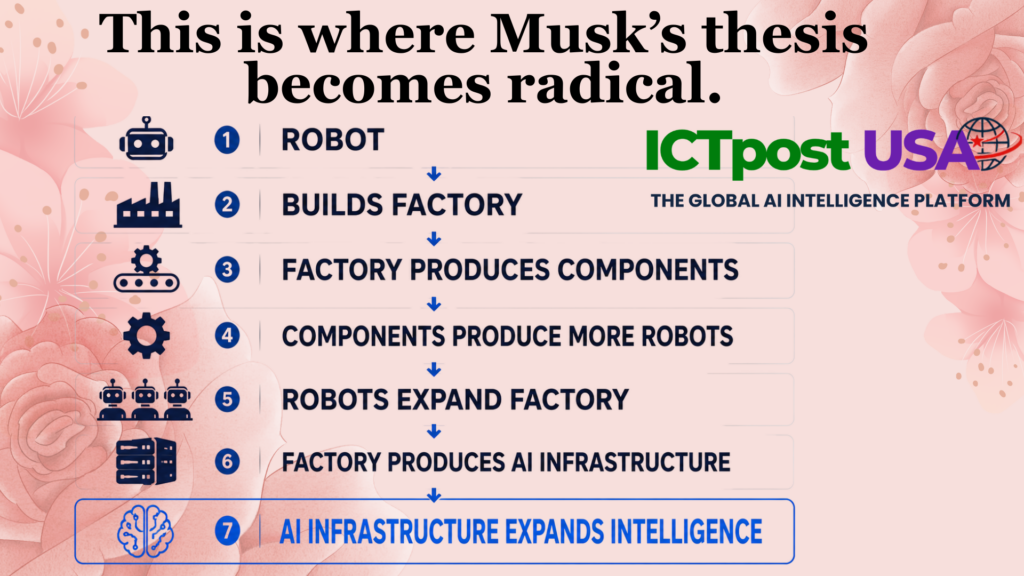
That would represent the beginning of an autonomous industrial loop beyond Earth.
Speculative? Absolutely.
Historically significant if achieved? Potentially.
THE LUNAR CATAPULT
Musk has also discussed the possibility of a future electromagnetic mass-driver system that could launch materials from the Moon. The concept takes advantage of the Moon’s gravity, which is roughly one-sixth that of Earth. If such a system were ever developed, lunar manufacturing facilities could potentially send materials and components into orbit without relying entirely on traditional rockets.
However, a theoretical concept is very different from real infrastructure. Such a system would require major advances in robotics, power generation, materials engineering, electromagnetic technology, autonomous construction and lunar manufacturing. The idea is fascinating, but the engineering challenge remains enormous.
THE CHIP LAYER OF THE STRATEGY
Another development highlights the scale of the vision.
SpaceX and Tesla have announced plans tied to a massive semiconductor-manufacturing initiative in Texas.
The objective appears clear.
Musk is not simply trying to secure AI compute.
He is attempting to influence another strategic layer:
The chips themselves.
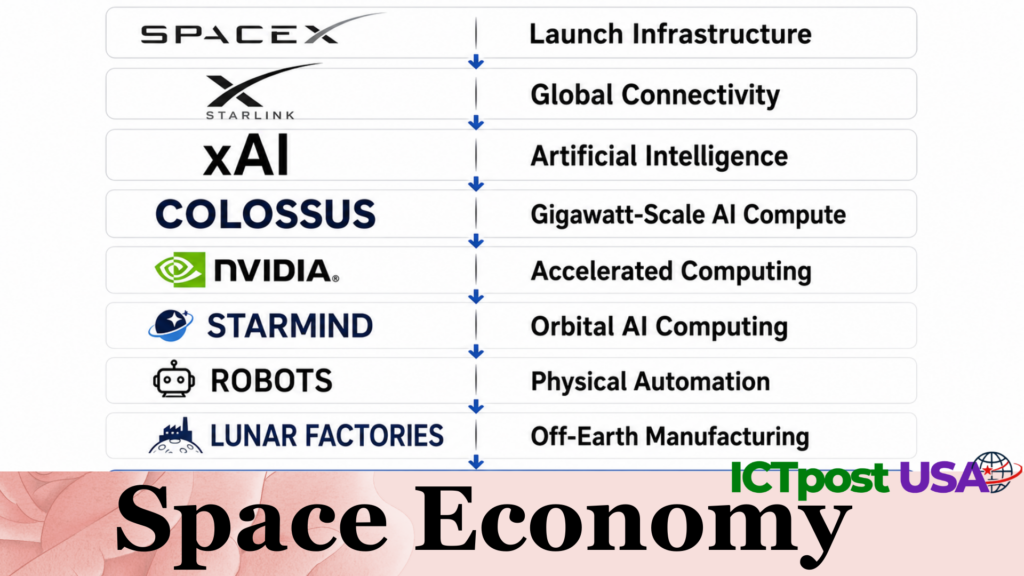
The resulting stack looks increasingly integrated:
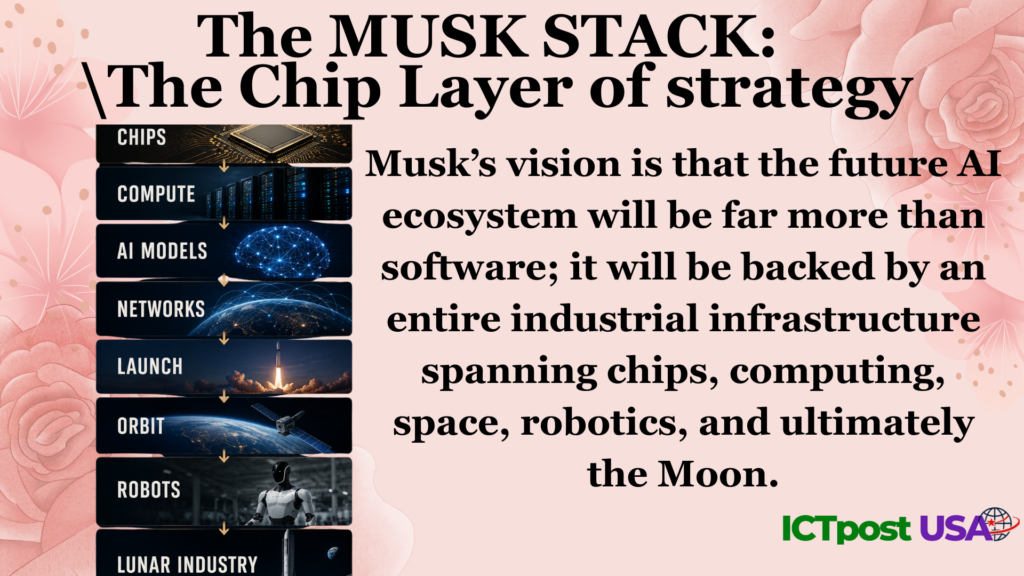
That is a much larger ambition than building an AI assistant.
NATIONAL SECURITY: WHY WASHINGTON IS WATCHING
Beyond business and technology, SpaceX’s AI strategy could have major national security implications. Artificial intelligence is increasingly being viewed by policymakers as a strategic resource, with the United States and China investing heavily in AI infrastructure, semiconductors, robotics, advanced manufacturing, space systems and autonomous technologies.
Future military capabilities, intelligence platforms, cybersecurity systems and autonomous defense networks are likely to depend increasingly on large-scale AI computing. Control over AI infrastructure could therefore become as strategically important as control over energy infrastructure was during the twentieth century. The Stargate initiative has also emphasized maintaining U.S. leadership in AI and strengthening America’s strategic capabilities.
From Washington’s perspective, the AI race is increasingly connected to national competitiveness, cybersecurity, semiconductor leadership, space capabilities, industrial capacity, energy security and technological sovereignty. Few companies operate across so many of these areas. SpaceX is one of them.
ANIL KUMAR, CTO, ICTPOST
Anil Kumar, CTO, ICTpost says, “What makes SpaceX unique is not any single technology. It is the integration of multiple infrastructures into one ecosystem. Launch systems, connectivity, AI computing, semiconductors, robotics and autonomous manufacturing are increasingly converging. The organizations capable of integrating these layers could define the next phase of industrial leadership.”
K Neelu, TECHNOLOGY EXPERT
K Neelu, Technology Expert, Head: ICTpost Intelligence Unit says, “The transition from digital AI to physical AI may be one of the most important shifts of the next decade. Once intelligent systems can operate robots, machines, factories and logistics networks, artificial intelligence stops being only software and becomes an industrial capability.”
STARSHIP IS THE KEY
Nearly every part of Musk’s broader space vision depends on one vehicle: Starship. It would need to carry satellites, computing systems, robots, factories, solar arrays, industrial equipment and construction materials into space. If Starship can significantly reduce launch costs and carry much larger payloads, it could change the economics of large-scale space industry. If it cannot achieve those goals, Musk’s broader vision becomes much more difficult and expensive. In that sense, Starship is more than a rocket; it could become the logistics platform for a future space-based industrial economy.
🐂 THE BULL CASE
History suggests transformational industries often require massive upfront investment.
Railroads required enormous capital.
Electric grids required enormous capital.
Telecommunications networks required enormous capital.
The internet required enormous capital.
The bullish argument is simple:
Musk is not spending for today’s AI economy.
He is spending for tomorrow’s.
🐻 THE BEAR CASE
Infrastructure alone does not guarantee returns.
The risks remain enormous.
- AI demand could slow.
- Computing efficiency could rise dramatically.
- Orbital computing could prove uneconomical.
- Starship could face delays.
- Lunar manufacturing may remain decades away.
- Returns on capital may disappoint investors.
Now that SpaceX is public, investors will eventually demand:
- Revenue
- Margins
- Cash Flow
- Return on Investment
Vision alone cannot satisfy Wall Street forever.
THE BIGGER CIVILIZATIONAL QUESTION
History rarely announces itself in advance. When railroads were built, few people could have imagined the modern global economy they would help create. When electrical grids spread across America, few could have predicted the digital age. And when the internet emerged, even fewer could have imagined the rise of cloud computing and artificial intelligence.
Musk’s vision of orbital AI, autonomous factories and lunar manufacturing may ultimately prove visionary, premature or economically impractical. But the larger question he is raising could shape the next generation of technological competition: What happens when intelligence becomes humanity’s most valuable industrial resource?
If AI continues to scale, the biggest constraints may no longer be software alone. They could increasingly be energy, advanced chips, computing capacity, robotics, manufacturing capability and access to space. The companies that can bring these different layers together may have a major role in defining the next industrial era.
That, more than Moon factories or orbital AI satellites, may be the real significance of Elon Musk’s SpaceX gamble.
THE SpaceX AI GAMBLE
Assessment–
AI Opportunity: ★★★★★
Technology Ambition: ★★★★★
Strategic Significance: ★★★★★
National Security Relevance: ★★★★★
Engineering Difficulty: ★★★★★
Financial Risk: ★★★★★
Near-Term Certainty: ★★☆☆☆
Long-Term Potential: ★★★★★
The most important part of Musk’s strategy may not be the Moon factory. It may not even be orbital computing. The real bet is the belief that artificial intelligence will eventually require an entirely new physical infrastructure spanning energy systems, semiconductors, compute, robotics, connectivity and access to space. Whoever builds that infrastructure could help shape the next industrial revolution. That is the real SpaceX AI gamble. editor@ictpost.com
Follow author on LinkedIn , YouTube and X.

The author Dhirendra Pratap Singh works at the intersection of Artificial Intelligence, the digital economy, public policy, and emerging technologies, exploring how technological revolutions are reshaping societies, governance systems, and global power structures. His work focuses on interpreting complex technological shifts—from AI and digital public infrastructure to technology geopolitics—and translating them into actionable insights for policymakers, institutions, and industry leaders navigating a rapidly evolving global technology landscape.