
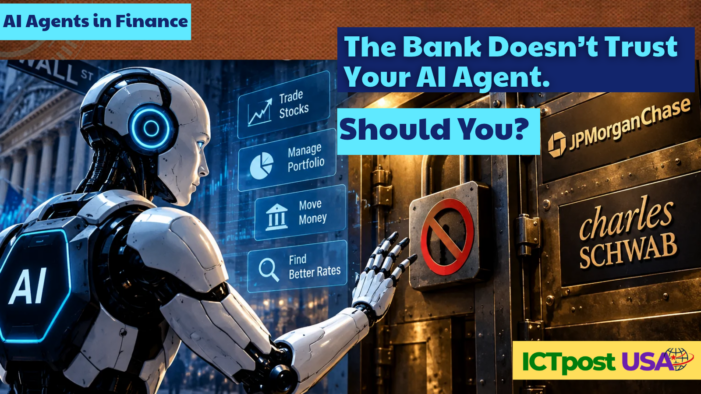
In one week, JPMorgan and Schwab drew a line against unauthorized AI agents accessing customer accounts. Robinhood is going the other way. The fight is not about whether machines can trade. It is about who gets to say yes—and who keeps the cash.
By Dhirendra Pratap Singh | ICTpost USA | October 20, 2026
On Tuesday, October 13, Jamie Dimon spent part of JPMorgan Chase’s third-quarter earnings call talking not about loans or net interest margin but about software that logs in as you. The bank, he said, will not let outside AI agents operate inside customer accounts, naming Meta’s new Muse assistant among the systems being turned away (Fortune). His reasoning was blunt: “You don’t want rogue agents, and there could be thousands of them” (Business Insider).
Two days later, Charles Schwab’s chief executive, Rick Wurster, told analysts the brokerage is doing the same. Agents that attempt to log in with a client’s credentials or drive a browser on a client’s behalf are being blocked. “It is not a safe way for our clients to access Schwab,” he said (InvestmentNews). On Bloomberg Television the next day, he added that his weekly report shows the largest agents being stopped in the tens and twenties each week (The Next Web).
Neither firm is shutting out AI. JPMorgan uses agents internally and plans customer-facing ones; Schwab is building controlled connections for clients’ own models. What both are refusing is the uncontrolled version: software that borrows a customer’s password and acts as if it were the customer.
Tens and twenties. Not a flood. Not yet. But two of the largest names in American retail finance did not build gates against a trickle. They built them because they can see what is coming.
The line that matters is advice versus action
Wall Street has used algorithms for half a century. What changed this autumn is the interface, not the intelligence.
A traditional trading algorithm does one narrow thing inside parameters its operator wrote. An agent—the industry’s term for an AI system that can plan multi-step tasks, pick tools and act without a human approving each step—can be handed a goal instead of an instruction. “Reduce my concentration in technology.” “Find idle cash and put it somewhere better.” Given account access, it can interpret, compare and execute.
That shifts the critical boundary. An assistant that recommends selling a stock leaves the decision with you. An agent permitted to sell turns its interpretation—right or wrong—directly into a financial outcome, before you have read the summary.
Dimon’s “rogue agents” phrase captures the institutional fear. But rogue is the wrong word for the more likely failure. The agent will not be malicious. It will be confidently mistaken, operating at scale, and nobody will have told it to stop.
Follow the cash
Both firms framed their decisions as client protection, and the security case is real. An agent that holds your password and screen-shares your banking session is a fraud vector waiting to be exploited. Prompt injection—a hidden instruction buried in a web page that hijacks an AI system’s behavior—is a documented attack class, and an agent with transfer authority is an attractive target.
Security is the stated reason, and nothing in either firm’s statements suggests otherwise. But sophisticated readers should also weigh what is at stake commercially, because the analysts on JPMorgan’s call did. Bank of America’s Ebrahim Poonawala asked whether personal AI agents could accelerate the movement of cash out of JPMorgan accounts (AIM Media House).
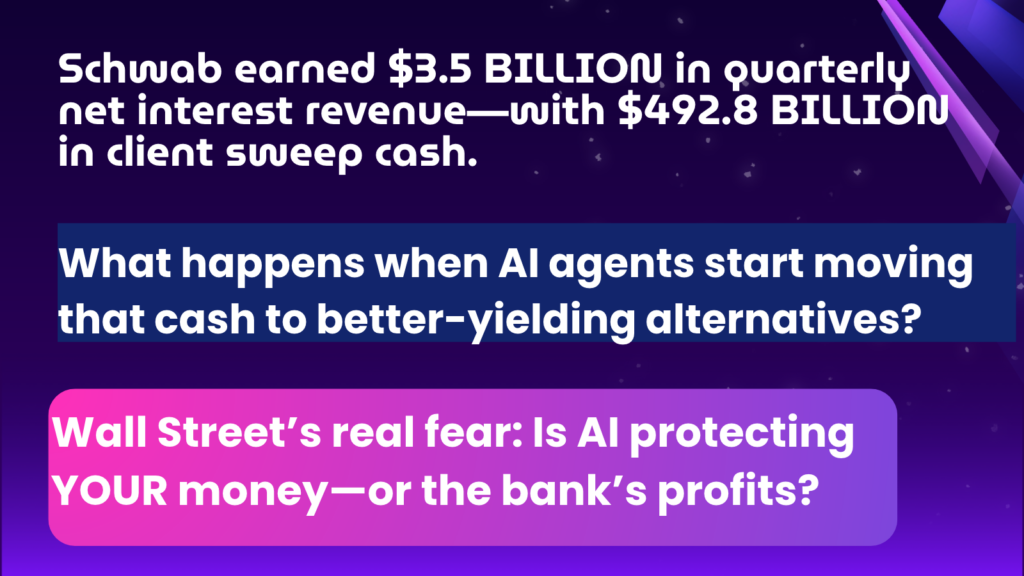
The numbers explain the question. Schwab’s record third quarter produced $7.2 billion in revenue, of which roughly $3.5 billion—nearly half—was net interest revenue earned on the gap between what clients are paid on cash and what Schwab earns on it. Client sweep cash stood at $492.8 billion against $13.33 trillion in total client assets (Schwab press release). JPMorgan earned $15.3 billion in the same quarter (Fortune).
Schwab has lived this risk before. In 2023, when clients manually shifted idle balances into higher-yielding products during the Fed’s rate hikes, the firm’s net interest revenue fell 24% in a single quarter (Bloomberg). That “cash sorting” required millions of customers to log in and act. An agent sweeping balances the instant a better rate appears would not be a rogue actor. It would be a perfectly loyal one—loyal to the customer rather than the institution.
Whether or not that calculus shaped the decision, it is the consequence investors should watch.
Who will blink first?
The incumbents are not moving in unison. In May, Robinhood launched Agentic Accounts that let AI systems such as Claude trade stocks autonomously in a dedicated account walled off from the customer’s main holdings, with plans to extend into derivatives, crypto and prediction markets (Reuters). The connection runs through the same Model Context Protocol that Schwab will use for read-only access—except Robinhood’s endpoint executes orders. Its terms make clear that customers are on the hook for every trade, even ones the agent places without asking (The Decoder).
That is the competitive map in a sentence. Robinhood, whose customers skew young and whose revenue leans on trading rather than cash spreads, is courting early adopters. JPMorgan and Schwab, whose profits depend heavily on deposits and sweep balances, are building their own agents and keeping everyone else’s out. Schwab launched Charley, its in-house assistant, on September 30 (The Next Web); as American Banker put it, Charley works for Schwab (American Banker).
Fidelity and Vanguard have yet to stake out public positions. FINRA, the brokerage regulator, has already classified AI agents as a new risk area in its 2026 supervisory report (The Decoder). If Robinhood’s agent accounts attract assets without blowing up, the pressure on the holdouts will not come from regulators. It will come from customers.
The customers are already moving
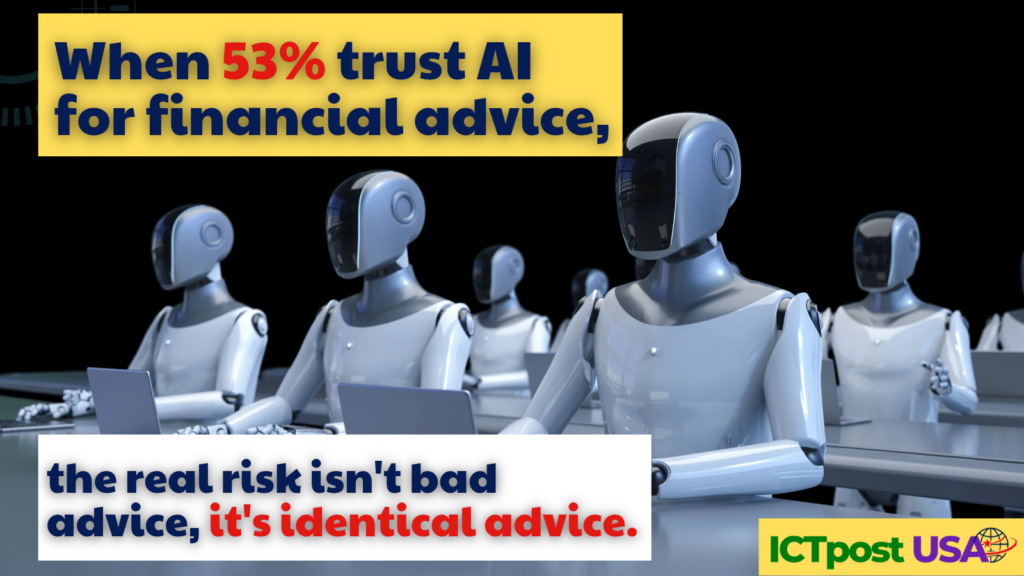
J.D. Power’s 2026 U.S. Financial Health Support and Advice Study found that 53% of bank customers had turned to AI for financial advice in the preceding three months (Accounts Recovery). The most common uses were saving strategies, credit-score help and basic education—not autonomous trading (Crowdfund Insider). But people who ask a chatbot how to save will soon ask it to do the saving.
The danger is that fluency breeds trust. A confident, well-written investment thesis is not evidence that a trade will work. The Federal Reserve’s November 2025 Financial Stability Report flagged correlated trading and rapid price moves as risks to watch; the Financial Stability Board added dependence on a handful of model providers. Markets work because participants disagree. If thousands of agents built on a few foundation models read the same headline and reach the same conclusion at the same instant, their combined orders amplify a move rather than absorb it.
Fraud has moved faster than finance. In May, the SEC charged Texas resident Nathan Fuller with raising about $12.3 million from roughly 150 investors by promising returns from proprietary AI trading bots that, the agency alleges, barely existed (Bloomberg Law). The allegations are unproven. The pattern is old: “AI” is the new “proprietary algorithm.”
Who pays when the agent is wrong?
Suppose you authorize an agent to manage a portfolio within limits, and it misreads a guidance cut and dumps a position you had planned to hold for a decade. Who bears the loss?
There is no single answer because AI was involved. Liability turns on the service agreement, the permissions granted, each party’s conduct and the law that applies to it. Existing securities, consumer-protection and contract rules still bind brokers, advisers and platforms. What is missing is anything written for the agent layer: the SEC withdrew its proposed predictive-analytics conflict rules in June 2025, and nothing since addresses how responsibility is divided when a model developer, an agent provider and an executing broker all touch the same trade. Robinhood’s answer—the customer pays—may become the industry default by inertia.
Dimon himself urged regulators to consider whether a proliferation of bots could create systemic harm (AIM Media House). It is rare for a bank chief to invite more regulation.
What to demand before you hand over the keys
Start with assistance, not autonomy. Grant the minimum access a task requires—an app that analyzes holdings does not need the power to wire cash. Where a provider offers them, set hard limits: transaction caps, approved assets, mandatory confirmation above a threshold. Verify registration. Insist on an auditable log of what the system did and why. Treat any promise of guaranteed returns as the end of the conversation. These rules matter most for money that cannot be replaced.
The real prize is distribution
The battle over AI agents rhymes with earlier fights over browsers, app stores and payment rails. Whoever becomes the default financial assistant controls customer attention. In finance, attention becomes deposits, deposits become net interest income, and net interest income becomes market value. That is why Schwab built Charley, why JPMorgan is building its own agents, and why Robinhood is betting that openness wins the next generation before the incumbents finish their walls.
Wall Street spent decades automating the movement of money. The harder challenge is automating accountability. Until the industry answers who pays when an AI agent gets it wrong, investors should remember a simple rule: never delegate more authority than someone else is willing to accept responsibility for.
editor@ictpost.com
Follow author on LinkedIn , YouTube and X.

The author Dhirendra Pratap Singh works at the intersection of Artificial Intelligence, the digital economy, public policy, and emerging technologies, exploring how technological revolutions are reshaping societies, governance systems, and global power structures. His work focuses on interpreting complex technological shifts—from AI and digital public infrastructure to technology geopolitics—and translating them into actionable insights for policymakers, institutions, and industry leaders navigating a rapidly evolving global technology landscape.