
From a community-college hoax to a deepfaked boardroom, every market-moving fraud has exploited the same gap: the minutes between a headline and its debunking. Generative AI did not create that gap. It is about to make exploiting it cheap, scalable and hard to trace.
By Dhirendra Pratap Singh | ICTpost USA | October 15, 2026
Sixteen Minutes
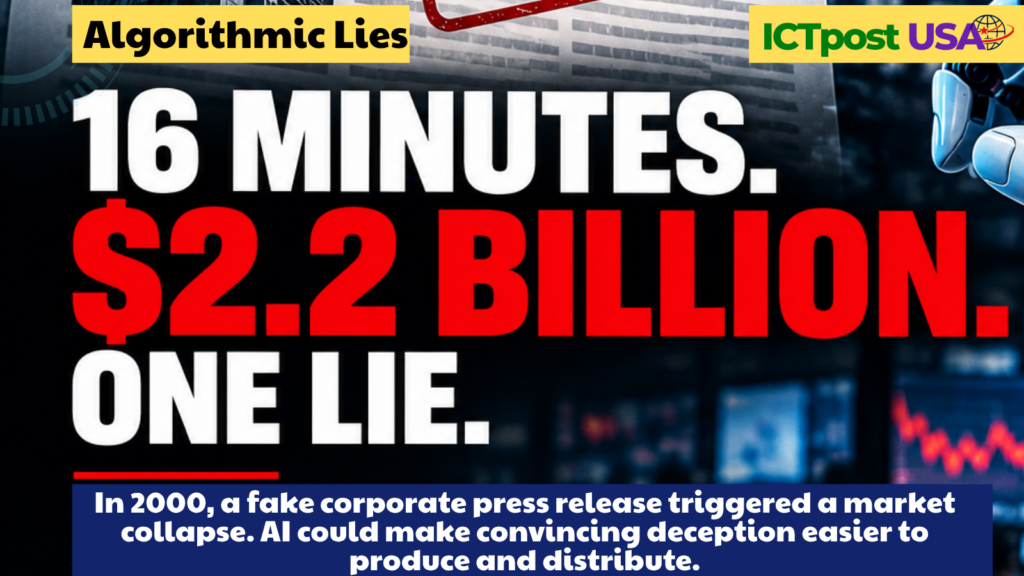
On the morning of August 25, 2000, a press release hit the newswires saying that Emulex, a Southern California networking company, was under SEC investigation, that its CEO had resigned and that its earnings would be restated downward. All three claims were false. In the 16 minutes before trading was stopped, 2.3 million shares changed hands and the stock fell from $103.94 to $43, erasing $2.2 billion in market value, according to the SEC.
The author was Mark Jakob, a 23-year-old former employee of the wire service that distributed the release. He sent it from a computer at El Camino Community College. He had shorted 3,000 Emulex shares and needed the price to fall; he walked away with more than $240,000, while investors lost roughly $110 million, the SEC said. He was sentenced to 44 months in prison.
Hold those two numbers side by side. The fraudster made $240,000. The people who sold into the panic lost $110 million. The ratio is roughly 450 to one, and it is the single most important fact about market-moving fakes: the damage is almost entirely borne by people who were not party to the fraud.
What stands out, a quarter-century later, is how little sophistication the scheme required. The fake never had to survive scrutiny. It only had to survive until the first reactions, and the reactions then became the story. A TheStreet.com editor told CNN at the time that his reporters were responding not to the press release but to the selloff itself. The price move validated the lie.
That is the mechanism to keep in mind as generative AI, software that produces fluent text, images, voices and video on demand, drives the cost of a convincing fake toward zero.
A Pattern, Not a Prediction
Wall Street does not need to imagine this risk. It has been rehearsing it for a generation, and most of the rehearsals involved no AI at all.
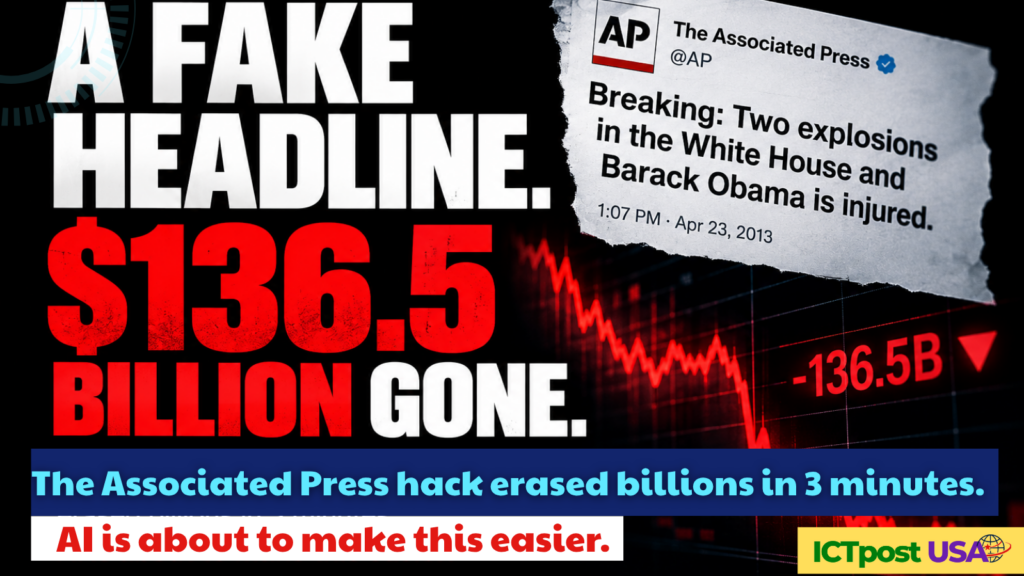
In April 2013, hackers took over the Associated Press’s Twitter account and announced two explosions at the White House that had injured President Obama. Within three minutes the episode briefly wiped out $136.5 billion of S&P 500 value, per Reuters data; the Dow dropped about 143 points before recovering. The FBI opened an investigation, and the Syrian Electronic Army claimed responsibility.
In May 2023, a fake image of black smoke beside a government building circulated with claims of an explosion near the Pentagon. The S&P 500 slipped about 0.3% to a session low before rebounding, Bloomberg reported, in what it called possibly the first instance of an AI-generated image moving the market. Russian state outlet RT pushed the claim to more than three million followers, the AP reported, and NPR traced its spread through a paid-verification account impersonating a Bloomberg feed. A viral claim of a “$500 billion swing” circulated afterward; it traces to a social-media post, not to exchange data, and this column does not repeat it.
Then, on April 7, 2025, came the cleanest case of all, because it involved no hacker, no image and no AI. Shortly after 10:10 a.m., several large finance accounts on X posted an all-caps headline claiming White House adviser Kevin Hassett had said Trump was weighing a 90-day tariff pause. He had been asked about one on Fox News and had not answered. CNBC aired it as a banner, Reuters ran a story citing CNBC, stocks surged, and the White House called it fake news within about 20 minutes, NBC News reconstructed. Reuters withdrew its report and said it regretted the error; CNBC acknowledged airing unconfirmed information.
The distinction matters, and it is central to this column’s argument. Emulex was a fax-era forgery. The AP hack was stolen credentials. The tariff rumor was a human misreading amplified by professional newsrooms. The market vulnerability predates AI by decades: it is that verification is slower than reaction, structurally. What AI changes is the cost of producing something convincing and the cost of distributing it at scale. AI is an accelerant poured onto a fire that was already burning.
How Much Can Be Lost Before Anyone Hits Pause
The circuit breakers that exist today were built for erratic prices, not for lies.
Under the Limit Up-Limit Down rule, a large-cap U.S. stock that moves more than 5% from its five-minute average price, and stays there for 15 seconds, is paused for five minutes; smaller stocks get a 10% band, per the SEC’s investor bulletin. Market-wide halts begin only at a 7% decline in the S&P 500.
Do the arithmetic on a $1 trillion company, of which there are now several. A 5% move before the first pause is $50 billion of market value. The pause does not reverse any trade executed on the way down, and when trading reopens, nothing prevents the stock from falling another 5% and pausing again, in what traders call a rolling halt. Emulex fell 60% in 16 minutes before the modern rule existed; today’s rules would slow that descent, not stop it. And at the index level there is no brake at all for a move like the 2013 drop: 0.98% on the Dow is far below any market-wide threshold.
The second reason the losses run large is that the market’s own machinery amplifies the first move. A headline hits sentiment-reading algorithms that sell in milliseconds. The initial drop trips stop-loss orders placed by investors who never saw the headline. Market makers, who cannot tell a fake from a real shock, protect themselves by widening spreads or stepping away, so each subsequent sale moves the price further. Momentum strategies see the move and join it. Options dealers hedging their books sell into the decline. None of these participants needs to believe the story; each is reacting rationally to the price. The IMF’s October 2024 Global Financial Stability Report devoted a chapter to how AI-driven trading can increase market speed and herding under stress, and that is precisely the environment a fake exploits.
So who pays? Three groups. Investors who sell into the dip and buy back higher, or whose stop orders execute at the bottom: in Emulex that was $110 million. The target company, which absorbs a reputational hit and, if the fake alleges something lasting, a higher cost of capital. And market makers and brokers who take losses providing liquidity through the move. Who gains? The fraudster, who is typically positioned short beforehand, and any fast trader who exits before the correction. The asymmetry is extreme, and it explains why the economic incentive to prevent this sits with exchanges, large asset managers and issuers rather than with the public.
Three Doors AI Opens Wider
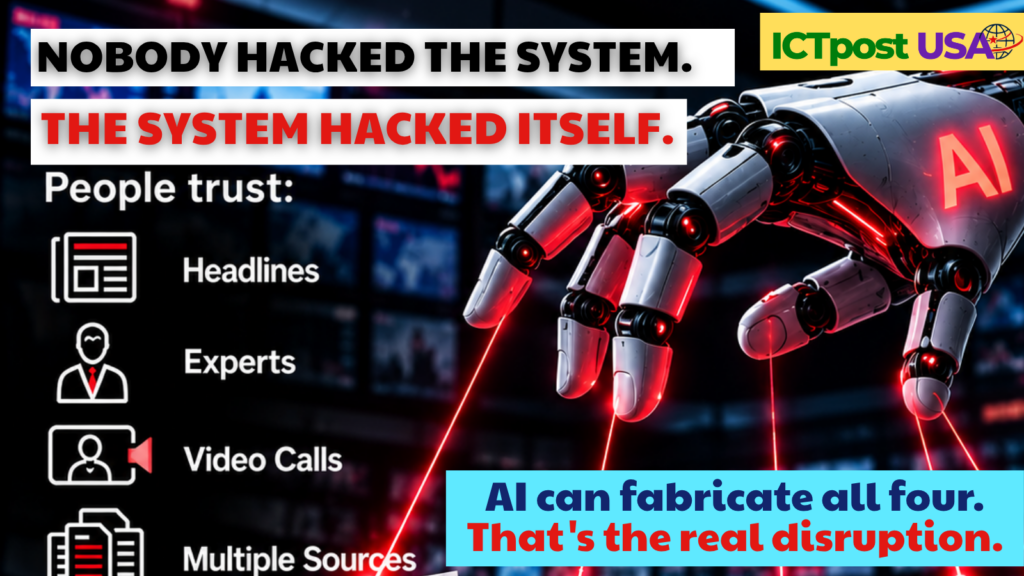
Against that backdrop, generative AI changes three specific things.
It removes the distribution bottleneck. Jakob needed a wire service to accept his release. The AP hackers needed stolen credentials. The next operator needs neither: AI can produce a site that looks like a trade publication, a stream of “analyst notes” and a swarm of accounts to cite them. The 2023 Pentagon image was a single asset. The coming version is a corroborating ecosystem, and investors reasonably treat multiple matching sources as confirmation.
It breaks the oldest verification shortcut. In January 2024, a finance employee at the Hong Kong office of engineering firm Arup joined a video call with what appeared to be the company’s CFO and colleagues. Everyone but the employee was a deepfake, Hong Kong police said, and the employee made 15 transfers totaling HK$200 million, about $25.6 million. Arup told the Financial Times only that it had reported a fraud involving fake voices and images. Nothing was hacked. A familiar face was enough.
It turns the audience into the weak point. A British study by the group Say No to Disinfo showed AI-generated content to UK bank customers and found a third “extremely likely” to move their money after seeing it, with another 27% somewhat likely. The reference point is Silicon Valley Bank, where depositors pulled $42 billion in a single day. Mobile banking turns a rumor into a wire transfer in seconds, and a bank cannot pause its depositors for five minutes.
The Regulators Have Noticed, Politely
The Financial Stability Board, the G20’s risk-monitoring body, warned in November 2024 that generative AI could let malicious actors spread disinformation capable of causing acute crises, including flash crashes and bank runs, as Reuters reported.
Enforcement is chasing the cruder cousin of this problem. On September 29, 2026, the SEC filed two civil complaints in Manhattan federal court alleging that four overseas-run entities used WhatsApp groups, impersonated investment professionals and touted “AI-generated” trading signals and bots to take at least $15 million from retail investors, in part by displaying falsified SEC filings. These are allegations in a civil case, not findings; the entities have not been found liable, and the SEC’s litigation release describes a jury demand on liability. What the case shows is narrower but useful: regulators are now building actions around AI as a lure, and the forged-credential tactic, fake regulatory paperwork to manufacture trust, is the same move a fabricated news operation would make.
The Mirror-Image Risk
There is a second danger that gets less attention. Legal scholars Bobby Chesney and Danielle Citron coined the term “liar’s dividend” for what happens once realistic fakes exist: genuine evidence can be dismissed as fake. Markets are exposed in both directions. A real regulatory action, a real executive resignation or a real product recall will increasingly arrive with a competing claim that it is synthetic. A market that can be tricked into selling on false news can also be talked out of believing true news, and the second failure is harder to diagnose.
The Verification Business: Three Technologies, Not One Industry
The easy claim is that synthetic media will create a “trust industry” the way the internet created cybersecurity. The honest version is that three very different technologies are competing for that role, at very different stages of maturity, and only one of them has a proven business model today.
Content provenance attaches a cryptographically signed record to a file: who made it, with what tool, what edits followed. The leading standard, C2PA, has backing from Adobe, Microsoft and most major image generators. Its limits are documented by the coalition itself: adoption is opt-in, so most files carry no credentials; an attacker can strip the manifest and repost the file, after which a viewer sees nothing; and a missing credential proves only absence, not forgery. Provenance also says nothing about truth. A fabricated “exclusive” produced in a C2PA-compliant tool carries a perfectly valid credential. Commercially, provenance is a standard, not a product: its value accrues to the platforms that display it, and it works for markets only if wires, newsrooms, exchanges and trading systems all read the same signal, which today they do not.
Identity authentication is the mature category. Banks already pay for know-your-customer checks, multi-factor login and voice biometrics, and the Arup loss is the sales pitch for extending that to executives, counterparties and callers. The economics are familiar: subscription or per-check pricing, sold to a buyer whose exposure is a quantified wire-fraud loss. Deloitte’s Center for Financial Services projects U.S. fraud losses enabled by generative AI could reach $40 billion by 2027, from $12.3 billion in 2023; that is the exposure buyers are pricing against. The barrier is friction: every added check slows legitimate transactions, and false rejections cost customers.
Forensic detection is the least settled. Classifiers that judge whether an image, voice or text is synthetic sit in an adversarial arms race, and researchers at MBZUAI argue the problem is structural: post-hoc detection can have an unbounded false-positive rate, and adversaries can adapt to known detectors cheaply. A benchmark paper this year notes that provenance and watermarking depend on voluntary adoption, leaving detection as the only recourse for the vast unmarked majority of content, which guarantees demand but not reliability. For a trading desk, a detector that flags a real Reuters alert as fake is as costly as one that misses a forgery. Vendors will sell it as a subscription; the question is whether accuracy holds long enough to justify renewal.
The pricing logic across all three is insurance logic. An institution facing a plausible tail loss in the tens of millions, whether a wire fraud or a position liquidated into a fake-driven dip, will pay a small fraction of that for a service that shortens the window of exposure. That supports a profitable business in regulated finance, where exposure is large and the buyer is sophisticated. It does not obviously support a mass-market one. The durable margin, if it exists, belongs to whoever becomes the verification layer that exchanges and wires are required to use, and that is as much a regulatory outcome as a technological one.
Where the Defense Must Be Built
The lesson of 2000 to 2025 is that damage is set by one number: how long a fake goes unchallenged. Four ideas follow from the record, offered as analysis rather than as anyone’s announced plan.
Authenticated issuer channels. Emulex’s hoax worked because a wire accepted an email from an alias. Wires and exchanges can treat unverified corporate announcements the way banks treat unverified wire instructions: hold first, publish after confirmation.
Machine-readable provenance for trading systems. Algorithms that ingest headlines should be able to read a source’s verification status and weight it. Humans take the cue from a blue check; machines need an equivalent, and the April 2025 episode shows that a legitimate wire citing an unverified banner is not it.
Pre-committed denial protocols. The White House needed about 20 minutes to deny the tariff claim, and the market had already moved. Companies and agencies that expect to be targeted can designate one verified channel, staffed around the clock, that traders know to check first.
Enforcement certainty. Jakob was arrested within a week. The lesson for the next hoaxer is not that fakes are hard to make but that the trades are traceable. Surveillance of trading around market-moving fake news deserves the same priority as insider-trading surveillance.
For thirty years, Wall Street competed on who received information first. The record from Emulex to the tariff rumor suggests the more valuable edge is knowing, within seconds, whether to believe it. The vulnerability was always there; AI simply lowers the price of admission for anyone who wants to exploit it. The firms that build the capacity to verify at machine speed will trade through the next hoax. The rest will be the liquidity the hoax consumes.
The next crisis may not begin with a bank failure or a housing bubble. It may begin with a flawless article that took a machine four seconds to write and a market four minutes to disprove. editor@ictpost.com
Follow author on LinkedIn , YouTube and X.

The author Dhirendra Pratap Singh works at the intersection of Artificial Intelligence, the digital economy, public policy, and emerging technologies, exploring how technological revolutions are reshaping societies, governance systems, and global power structures. His work focuses on interpreting complex technological shifts—from AI and digital public infrastructure to technology geopolitics—and translating them into actionable insights for policymakers, institutions, and industry leaders navigating a rapidly evolving global technology landscape.