

Wall Street is building a market for an asset that loses its value one hour at a time. The bet behind it is financed with borrowed money, and the first contracts have already hit a regulatory wall.
By Dhirendra Pratap Singh | ICTpost USA October 11, 2026
At 11 a.m. Eastern on August 11, CME Group, the world’s largest derivatives exchange, announced it would let investors bet on what it costs to rent Nvidia’s AI chips (CME Group, PR Newswire). Hours later, CoreWeave, which rents those chips out, reported revenue of $2.58 billion, more than double a year earlier, and a contracted backlog of about $104 billion (CoreWeave).
One announcement created a price. The other showed how much debt rests on it.
CME’s chief executive, Terry Duffy, has called compute “the new oil of the 21st century”. The line is good marketing and poor economics. Oil can sit in a tank for a year. A chip-hour that goes unsold is gone forever. Everything interesting about this market follows from that difference.
The Quarter That Doubled
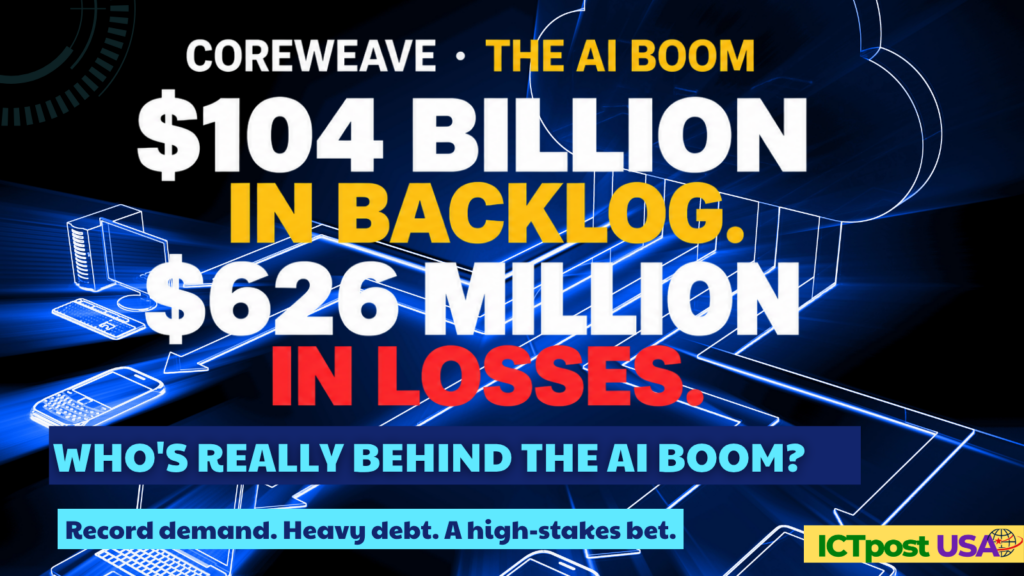
CoreWeave is the purest public bet on scarcity. Its backlog, meaning revenue promised under signed contracts, reached $104.2 billion, up from $30.1 billion a year earlier (Investing.com). More than $25 billion of new commitments arrived in the first weeks of the third quarter. More than half of the backlog sits in contracts where delivery has begun (Yahoo Finance).
But backlog is not cash. CoreWeave’s own footnote says the figure is subject to delivery and availability requirements. A customer’s commitment pays only after the company builds the data center, gets the power and installs the chips on time. Contracted demand does not remove execution risk. It moves the risk onto CoreWeave.
The company posted a net loss of $626 million for the quarter, with net interest expense of about $640 million (StockTitan, SEC filing summary). An outside analysis puts total debt near $35 billion against about $5 billion of equity, and notes the company depreciates chips over six years (Khan Capital). Those debt and equity figures are analyst compilations; verify them against the filing.
Who Gets Hurt If the Price Falls
The six-year schedule is an accounting assumption, not a prediction. Newer chips can make older ones cheaper to rent long before they wear out. Three things could go wrong, and each lands on a different investor.
If rental prices fall, lenders feel it first. The chips are the collateral, and their value tracks what they can earn. A lower rental rate means a lower recovery value on loans written against them.
If interest costs stay high, equity holders pay. With interest consuming a large share of operating profit, a modest slip in revenue can erase earnings. Equity is a thin layer atop a tall stack of debt.
If construction slips, both suffer. Interest accrues the day money is borrowed, but revenue starts only when capacity is delivered. A delayed substation or a late shipment of equipment widens the gap.
The $700 Billion Wager
CoreWeave sits inside a larger wave. Amazon, Microsoft, Alphabet and Meta have announced capital spending of $700 billion to $725 billion for 2026, up about 75% from last year, with Wall Street forecasting more than $1 trillion in 2027 (Forbes). That is announced capital spending, not all of it AI. Forbes, citing CreditSights, estimates roughly three-quarters goes to AI infrastructure, and says the spending will consume nearly all of the companies’ operating cash flow this year.
The Bottleneck Is a Substation
The International Energy Agency projects global data-center electricity demand will more than double to about 945 terawatt-hours by 2030, slightly more than Japan uses today. In the United States, data centers account for almost half of demand growth to 2030 (IEA).
The sharpest price signal comes from PJM Interconnection, the grid operator serving 13 states and Washington, D.C., including Northern Virginia’s “Data Center Alley.” Its annual auction pays generators to guarantee peak-hour power, a cost that reaches utility bills. The 2025 auction cleared at a record $329.17 per megawatt-day (Utility Dive). After a cap was introduced, this July’s auction cleared at $325, producing $16.4 billion in charges. The market monitor attributed $6.3 billion, or 38%, to data centers, and the auction fell 6,831 megawatts short of PJM’s reliability target (AI2 Work summary; regional analysis).
How a Hedge Would Work
Take an illustrative example; the numbers are invented. An AI startup plans to rent 1,000 B200 chips next quarter at $3 per chip-hour. Over a 730-hour month, that is about $2.2 million. If rental rates jump to $4, its bill rises by $730,000.
A compute future is a cash-settled bet on a published rental index. Silicon Data’s B200 index tracks hourly rental costs across global cloud platforms (Finance Magnates). The startup buys futures that gain value when the index rises. If rates jump, the futures profit offsets the higher rental bill. If rates fall, it loses on the futures but pays less to rent.
The hedge has a flaw, called basis risk. The index is not the startup’s bill. Its actual contract may be for a reserved cluster, a specific region, faster networking or a different chip generation. If the benchmark falls 10% and the startup’s own price falls 3%, the hedge pays less than the loss it was meant to cover. No futures contract delivers a chip, either.
The Market Is Stuck at the Gate
That hedge is hypothetical for now. CME’s September 28 notice says an update needed to support the compute futures launch, previously set for October 5, has been postponed pending regulatory review. The Commodity Futures Trading Commission has reportedly extended its review to November 9, and has questioned whether computing power qualifies as a financial commodity and how easily an index could be manipulated (GuruFocus). Intercontinental Exchange has announced a rival product with the index provider Ornn but has set no launch date (The Next Web).
The Counterargument
The bearish case has a serious rebuttal. Compute may get cheaper per unit while total demand keeps rising. Efficient models invite more applications, more users and more queries. Engineers are pushing to cut the cost of running AI by as much as two orders of magnitude (Investing.com). If demand grows faster than those savings, rental prices could hold and the debt could be serviced.
That scenario is plausible. But it requires demand to keep outrunning efficiency, and borrowers are betting on it for six years at a time. If efficiency wins even briefly, today’s scarcity looks like tomorrow’s glut.

What to Watch
Watch three dates. The CFTC’s November review. PJM’s December auction, which will show whether new power is arriving or a cap is hiding the shortage. And CoreWeave’s interest bill against its backlog conversion.
Oil built empires because it could be stored. Compute cannot. It spoils, it runs on a grid already short of power, and it is financed by debt that assumes the chips will not age.
Silicon Valley spent twenty years saying software would eat everything. The scarcest asset in AI was never the chip. It was the hour.
editor@ictpost.com
Follow author on LinkedIn , YouTube and X.

The author Dhirendra Pratap Singh works at the intersection of Artificial Intelligence, the digital economy, public policy, and emerging technologies, exploring how technological revolutions are reshaping societies, governance systems, and global power structures. His work focuses on interpreting complex technological shifts—from AI and digital public infrastructure to technology geopolitics—and translating them into actionable insights for policymakers, institutions, and industry leaders navigating a rapidly evolving global technology landscape.