

Once on the electricity bill, once in the retirement account. Neither charge shows up on any statement — and the federal body charged with spotting systemic risk has yet to mention it.
By Dhirendra Pratap Singh
Editor-in-Chief, ICTpost USA
Buried on page after page of a routine filing the Vanguard Multi-Sector Income Bond ETF made with the Securities and Exchange Commission this summer is a line that reads, in its entirety:
Beignet Investor LLC | 6.581% | 5/30/2049 | 74 | 76
Seventy-four thousand dollars of face value. Seventy-six thousand at market. In a fund holding billions, it is a rounding error — the kind of position no portfolio manager would bother mentioning on a call.
It is also a piece of a data center in Richland Parish, Louisiana.
Beignet Investor LLC is the special-purpose vehicle that owns Hyperion, Meta’s 2-gigawatt AI campus. In October 2025 it sold $27.294 billion of senior secured notes at 225 basis points over Treasuries — the largest single-tranche investment-grade bond ever issued (IFR). It was a 144A private placement, syndicated deliberately narrowly to roughly ten or fifteen institutional accounts, with PIMCO as the anchor.
Eleven months later, “Beignet Investor” appears in more than 3,100 filings in the SEC’s EDGAR system. In the third quarter of 2026 alone, it shows up in some 865 fund portfolio reports — Vanguard, Fidelity, T. Rowe Price, Principal, Nationwide, Franklin Templeton, Invesco. Among them are Brighthouse Funds Trust I, Voya Funds Trust, Vanguard Variable Insurance Funds and the Seasons Series Trust: variable-annuity subaccounts, which is to say retirement money.
A bond built for a dozen professional investors is now sitting, in small pieces, in an unknown number of American retirement accounts. Nobody who owns it through a target-date fund chose it. Most do not know it is there.
This is the second bill for the AI buildout. The first one arrives monthly, and more people have noticed that one.
The first bill: $29.4 billion, and nobody voted on it
PJM Interconnection runs the grid for 67 million people from Illinois to Virginia. Every year it holds a capacity auction — an arrangement in which generators are paid simply to be available, and the cost is passed to everyone who plugs anything in.
In the 2024/2025 delivery year, capacity cleared at $28.92 per megawatt-day, costing the region $2.2 billion. The next auction cleared at $269.92 and cost $14.7 billion (PJM). It has not come back down: $329.17, then $333.44, then $325.00 for 2028/2029, holding the annual bill at roughly $16 billion (PJM).
The interesting question is who caused it. PJM’s answer is unusually direct for a grid operator: for the 2027/2028 auction, peak load rose about 5,250 megawatts year over year, and nearly 5,100 of those megawatts — 97 percent — were data centers (PJM).
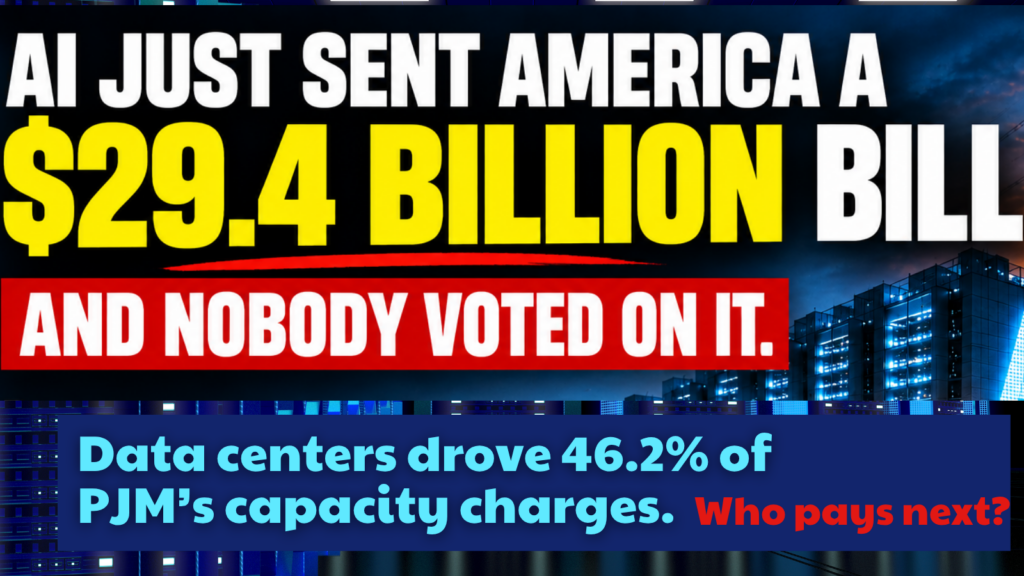
Monitoring Analytics, the independent market monitor PJM is required to fund but does not control, has put a dollar figure on it. In a report to PJM’s Members Committee on July 28, 2026, the monitor attributed $6.3 billion of the most recent auction’s charges to data center load — 38.2 percent of the total — and $29.4 billion across the last four auctions combined, or 46.2 percent (Monitoring Analytics).
Nearly half of what 67 million people paid to keep the lights on was driven by an industry that did not exist at this scale four years ago.
Joseph Bowring, who has run the monitor’s office for two decades, has stopped being diplomatic about it. “PJM is continuing to act like it’s business as usual,” he told Utility Dive in July. “You have to open your eyes and recognize that it is really a paradigm shift, and failing to do that imposes costs on other customers” (Utility Dive). His recommendation is structural: pull data centers out of the shared capacity auction entirely and make them buy their own in a separate one.
The June 2026 auction also did something it is not supposed to do. It cleared 138,318 megawatts against a reliability requirement of 156,013 — short, at a reserve margin of 14.4 percent against a 20 percent target. The market was offered the highest prices in its history and still could not find enough power.
Who pays when the load never shows up
Utilities and commissions have spent two years building defenses. Lawrence Berkeley National Laboratory counted 55 large-load tariffs as of March 2026; by September, the Edison Electric Institute’s running list had reached 73 across 32 states — 67 approved, 6 pending, none rejected (EEI).
The terms have hardened fast. Berkeley Lab found the median minimum contract term jumped from five years for tariffs proposed before 2025 to 12 years for those proposed since, with minimum billing demand at a median 80 percent of contracted capacity and collateral requirements reaching $1.5 million per megawatt at Dominion (LBNL). Virginia’s new GS-5 class, approved November 25, 2025 and effective this coming January, locks large customers into 14 years at 85 percent of contracted transmission demand.
These are serious protections. They also arrive after the capacity costs above were already incurred, and they do not reach the deeper problem, which the Federal Energy Regulatory Commission named on June 18, 2026 in a show-cause order to PJM:
“Wholesale transmission customers in particular could be left shouldering massive costs if new large loads do not ultimately attain or maintain the level of electricity demand that is being forecasted.”
FERC added that retail large-load tariffs “do not protect wholesale transmission customers from cost shifting” (FERC, Docket EL26-67-000).
Read that twice. The federal energy regulator is saying on the record that the grid is being built out against forecasts that may not materialize, and that ordinary customers hold the bag if they don’t.
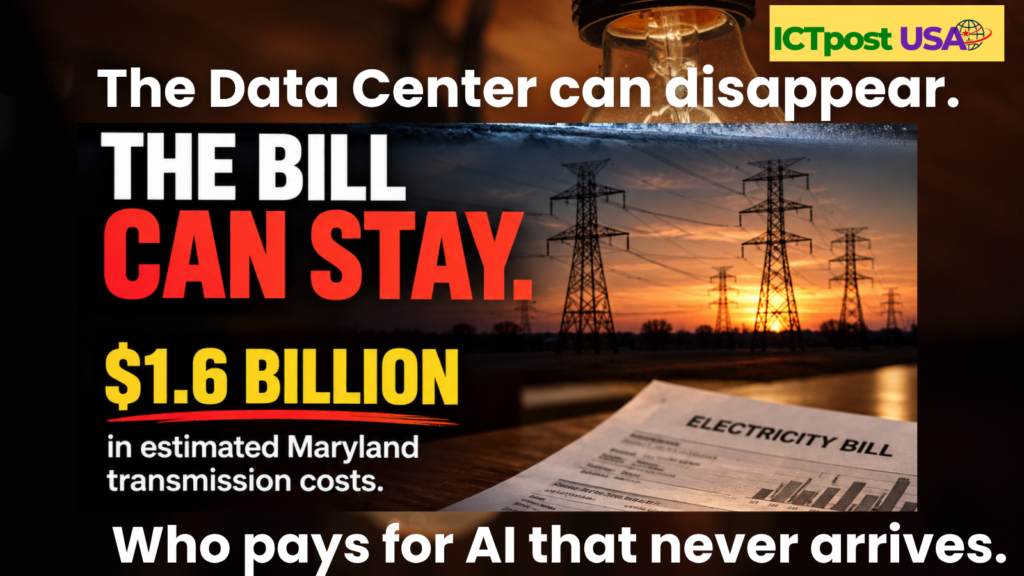
Maryland has already priced its share. In a complaint filed at FERC on May 7, 2026, the state’s Office of People’s Counsel calculated that Maryland ratepayers will pay $1.6 billion over ten years for transmission driven mainly by data centers located in other states — $823 million of it residential, about $345 per household. “PJM’s hybrid methodology,” the complaint argues, “broadly socializes to all customers costs that data centers, not existing customers, are driving,” and “insulates states and utilities that attract speculative load growth from overbuilding and stranded asset risk” (Maryland OPC, Docket EL26-63-000).
Voters have drawn their own conclusions. Annenberg found 61 percent of Americans now oppose data center construction in their area, up from 49 percent four months earlier — 69 percent of Democrats, 54 percent of Republicans, 53 percent of independents (APPC). Governor Greg Abbott, not a man known for obstructing industry, announced Texas protections in July with the line: “Residential ratepayers will not foot the bill for this industry’s growth” (Office of the Governor).
The second bill: $46 billion of exposure, off the books

Now return to Beignet.
Meta owns 20 percent of the Louisiana venture. Blue Owl-managed funds own 80. Meta contributed land and construction-in-progress and took a one-time distribution of roughly $3 billion out of the deal (Meta). Because Meta lacks “the power to direct the activities that most significantly impact the Venture’s economic performance,” it does not consolidate the entity. The $27 billion sits off Meta’s balance sheet.
What Meta does disclose, in its Q2 2026 10-Q, is this: an initial lease commitment of approximately $12.31 billion; residual value guarantees with “an aggregate threshold of approximately $28 billion that decreases over time,” for which no liability is recorded because payment is not deemed probable; and a maximum exposure to loss related to the Venture of $46.03 billion as of June 30, 2026 (SEC).
Forty-six billion dollars of disclosed maximum exposure, on an asset that does not appear as an asset. The structure is legal, audited and thoroughly disclosed. It is also, as the Bank for International Settlements described the genre in March, “shadow borrowing”: a joint venture or special purpose entity holding debt “held by private credit funds and other institutional investors, sometimes with investment grade features supported by asset backing and contractual guarantees from hyperscalers.” The BIS specifically flagged “the activation of guarantees” as a shock transmission channel (BIS).
Meta is not unusual. Moody’s counted $969 billion in total future data center lease commitments across Amazon, Meta, Alphabet, Microsoft and Oracle at the end of 2025, of which $662 billion had not yet commenced and therefore sat off balance sheet — equal to 113 percent of the five companies’ combined adjusted debt (Fortune).
The Bank of England put the borrowing wave in proportion in July: the five hyperscalers were 3 percent of outstanding US investment-grade debt at the end of 2025, but more than 15 percent of year-to-date issuance by early May. It also cited an OECD finding that the share of private credit financing AI investment rose from 9 percent in 2024 to 34 percent in 2025 (Bank of England).
The retail exit, and who was waiting on the other side
The clearest picture of how this risk migrates came in February, and it came from Blue Owl itself.
On February 18, 2026, three Blue Owl business development companies announced the sale of $1.4 billion of direct lending investments at 99.7 percent of par. The stated buyers: “four leading North American public pension and insurance investors.” The proceeds funded a return-of-capital distribution roughly six times the size of the 5 percent tender offer previously planned, and the boards said these distributions were “intended to replace future quarterly tender offers” (Blue Owl).

Chief Executive Craig Packer pushed back on the framing: “We’re not halting redemptions, we are simply changing the method by which we’re providing redemptions.” Blue Owl shares fell nearly 10 percent that day; Apollo, Ares, Blackstone, KKR and Carlyle all fell with it.
Six weeks later the method changed again. On April 2, Blue Owl limited withdrawals at two funds — Blue Owl Technology Income Corp and the $36 billion Blue Owl Credit Income Corp — honoring roughly 5 percent of $5.4 billion in redemption requests. Investors had tendered 40.7 percent of one fund’s shares. The company’s explanation named the cause plainly: “Heightened market concerns around AI-related disruption to software companies have weighed meaningfully on investor perception of software-related credit exposures.”
So: retail holders tried to leave, and the assets they were leaving were bought by pension funds and insurers. That is not a metaphor for risk transfer. It is a press release.
The Financial Stability Board filled in the scale a month later. Retail investors’ share of US private credit assets has gone from near zero to roughly 13 percent in a decade; life insurers now hold private credit at about 10 percent of portfolios; and of the $2.9 trillion in projected AI infrastructure capital spending through 2028, some $1.5 trillion is expected to come from external capital, including $800 billion from private credit (FSB).
Senators Elizabeth Warren, Richard Blumenthal, Chris Van Hollen and Tina Smith had already written to Treasury Secretary Scott Bessent on January 22, noting that “New York and Pennsylvania state pension plans are invested in Blue Owl’s $7 billion digital infrastructure fund,” and warning that “a market correction of this scale would crush retirement savers and retail investors exposed to the AI industry” (Senate Banking).
The first crack
Then, last week, a data center failed to arrive on schedule.
On September 24, Oracle sent a force majeure notice to Blue Owl’s Stack Infrastructure unit over Project Jupiter, the 1,400-acre, 2.5-gigawatt campus in southern New Mexico built as part of the Stargate program with OpenAI and SoftBank. Natural gas pipeline delays and litigation over water and air permits had pushed the schedule. The practical effect is narrow but telling: it extends the period during which Blue Owl collects development-stage rent at roughly a 9 percent yield rather than operational rent at roughly 11 percent (Reuters).
Both sides played it down. Oracle: “Project Jupiter remains on our planned schedule. We are fully committed to New Mexico and confident in our path forward.” Blue Owl: “The notice does not change the financial commitments to this multi-year project” (DCD).
They are probably right about this project. But note what the episode demonstrates. The contracts underpinning these financings contain clauses that shift economics when the physical world refuses to cooperate — and the physical world is refusing to cooperate for exactly the reason the ratepayer fight is about. Jupiter slipped because the power could not be delivered on time. The grid constraint that is raising household electricity bills is the same constraint that can impair the credit.
The two bills are not parallel. They are the same bill, arriving through two different doors.
The watchdog that hasn’t barked
Individual regulators have seen it. Federal Reserve Governor Lisa Cook said in May that “the increasing use of leverage to finance investments in an emerging technology carries risk, and a sustained boom in debt issuance could eventually represent a financial-stability concern” — while adding, fairly, that even aggressive projections would not return leverage to pre-2008 peaks (Federal Reserve). The Fed’s own May Financial Stability Report recorded that about half of surveyed market contacts cited AI-related risks, up from essentially none the previous autumn. The FSB, the BIS and the Bank of England have all published on it.
The Financial Stability Oversight Council — the body created after 2008 specifically to see risks that cross regulatory boundaries — approved its 2025 annual report on December 11, five weeks after the largest single-tranche investment-grade bond in history priced to fund a data center. The report discusses artificial intelligence as a technology that financial firms use. It does not meaningfully discuss AI-related debt, hyperscaler borrowing, or data center exposure at all (FSOC).
That omission is why Warren’s January letter demanded confirmation of a formal investigation by February 13, and why she and Blumenthal introduced the AI Bubble Transparency Act in June — legislation whose entire purpose is to make the Office of Financial Research find out who actually holds this paper.
Congress is legislating to answer a question that ought to be answerable now: how much AI infrastructure debt sits inside American retirement savings? No regulator publishes it. No analyst estimate of it exists that withstands scrutiny. The honest answer, in September 2026, is that nobody knows.
What is known is the shape of it. An industry that consumed nothing four years ago now accounts for nearly half the capacity charges on the largest grid in North America. The financing behind it is held in structures a central bank calls shadow borrowing. And a bond sold to a dozen professionals has quietly distributed itself into hundreds of ordinary funds, including the ones inside variable annuities.
America is being asked to underwrite the infrastructure of the AI age. The remarkable thing is not that the country said yes. It is that it was never asked — the charge simply appeared, twice, in two places no one thinks to look. editor@ictpost.com
Follow author on LinkedIn , YouTube and X.

The author Dhirendra Pratap Singh works at the intersection of Artificial Intelligence, the digital economy, public policy, and emerging technologies, exploring how technological revolutions are reshaping societies, governance systems, and global power structures. His work focuses on interpreting complex technological shifts—from AI and digital public infrastructure to technology geopolitics—and translating them into actionable insights for policymakers, institutions, and industry leaders navigating a rapidly evolving global technology landscape.