

By ICTpost Healthcare Intelligence Desk
(Based on court filings, regulatory documents, government reports and reporting by ProPublica, KFF, CMS and other cited sources.)
| THE BIG PICTURE Health insurers and now Medicare itself are increasingly using algorithms — not treating physicians — as the first, and often only, check on whether a claim gets paid. Cigna and UnitedHealthcare are both facing active federal litigation over automated systems (PXDX and nH Predict) that reviewers say approved or denied hundreds of thousands of claims in seconds, with minimal individualized review. In nH Predict’s case, over 90% of appealed denials are reversed — but fewer than 1 in 400 patients ever appeal. Starting this year, CMS is testing AI-driven prior authorization in traditional Medicare for the first time, paying private vendors a share of the savings from denied claims — a structure lawmakers are actively trying to block. The core unresolved question: as these systems scale, who is accountable when they’re wrong, and how would a patient even know to challenge one? |
For decades, the person standing between a patient and a medical treatment was, at least nominally, another medical professional — a claims reviewer, a medical director, someone with an M.D. who could be asked to explain a denial. That role is increasingly being shared with, and in some documented cases displaced by, software that can process a claim in about the time it takes to blink.
This is not a hypothetical. It is documented in court filings, in a ProPublica investigation, and in a federal rulemaking now being tested inside Medicare itself. A growing share of the American health insurance system’s most consequential decision — will this be paid for — is running through statistical prediction rather than individualized clinical review, and the legal and regulatory system built to police that decision is still catching up.
The 1.2-second denial
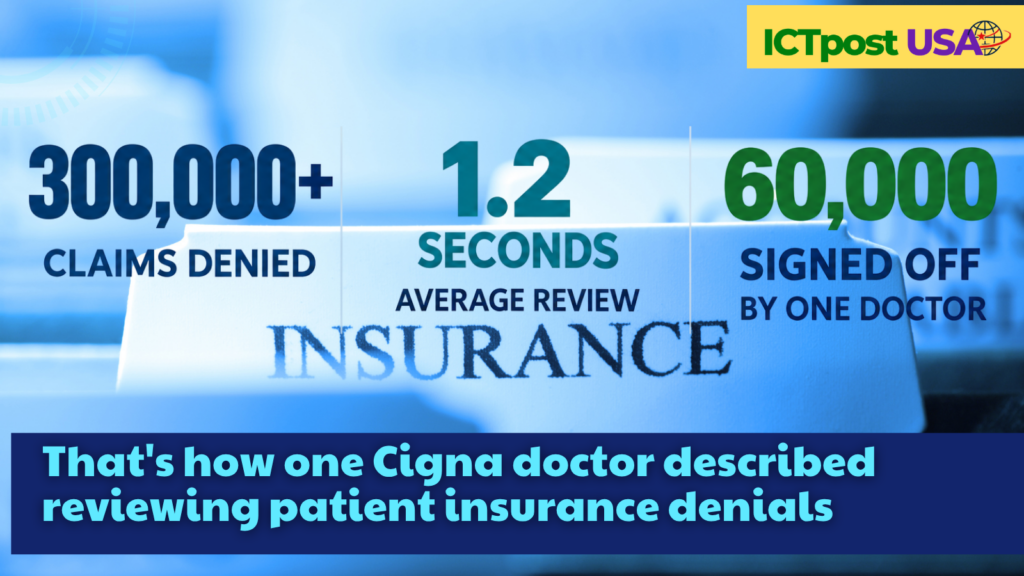
In March 2023, ProPublica and The Capitol Forum revealed the mechanics of a Cigna system called PXDX. The tool compared a diagnosis code against a list of procedures Cigna considered acceptable for that diagnosis. When the two didn’t match a pre-approved table, the claim was flagged for denial — and a Cigna medical director would sign off on batches of these flags without opening a single patient file. One former Cigna doctor described the process bluntly: “We literally click and submit. It takes all of 10 seconds to do 50 at a time.”
The scale was significant. Over two months in 2022, Cigna denied more than 300,000 claims this way, spending an average of 1.2 seconds on each one. Records reviewed by reporters showed that one Cigna doctor signed off on 60,000 denials in a single month.
Cigna disputes the characterization. A company spokesperson called PXDX “a simple tool to accelerate physician payments that has been grossly mischaracterized in the press.” The company maintains the tool verifies that codes are submitted correctly for low-cost, common procedures and does not itself deny care.
The courts have treated that distinction as a live factual dispute rather than a settled one. In March 2025, a federal judge in California allowed a class action against Cigna to proceed, permitting breach-of-fiduciary-duty claims to move forward on the theory that Cigna’s plans required a medical director to individually evaluate necessity — something the automated batch process arguably did not do. A separate 2023 suit involved a plaintiff with Lynch syndrome, a genetic condition that sharply raises cancer risk, after PxDx denied her colonoscopy and endoscopy.
Overriding the doctor in the room
If Cigna’s algorithm operates on codes, UnitedHealthcare’s operates on prediction. A subsidiary called naviHealth built a tool, nH Predict, that estimates how many days of rehabilitation or skilled nursing care an elderly patient should need after a hospital stay — based on inputs like age, living situation, and physical function — and generates a projected discharge date.
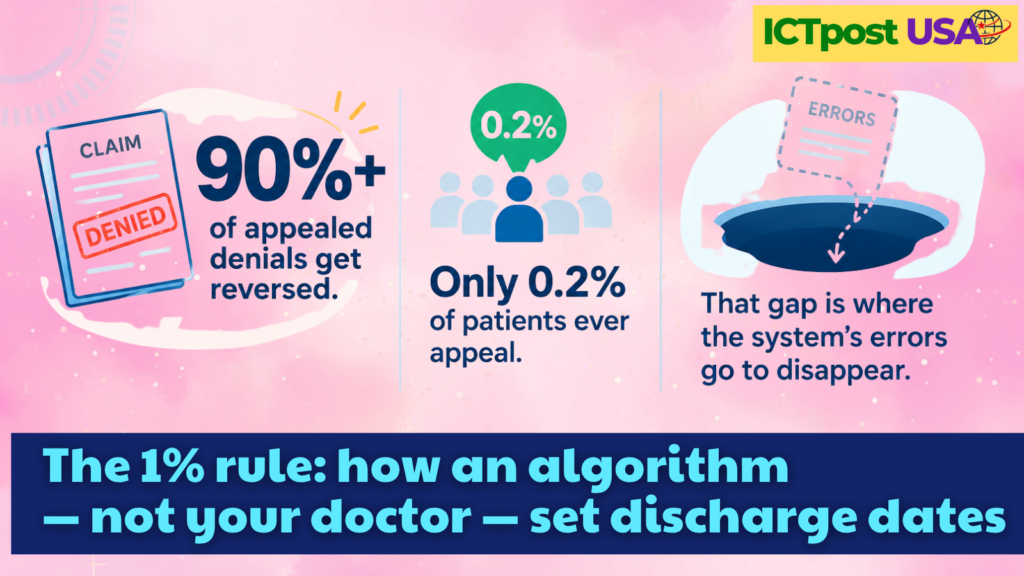
A proposed class action filed in Minnesota federal court alleges the tool was used to override treating physicians’ recommendations, citing a STAT investigation that found UnitedHealth set an internal goal for case managers to keep rehabilitation stays within 1% of the algorithm’s own projected length of stay.
The number at the center of the case is one many patients will recognize: more than 90% of coverage denials tied to nH Predict are reversed on appeal — but only about 0.2% of affected Medicare Advantage enrollees ever file an appeal, according to a KFF analysis cited in the complaint. Those two figures together suggest a system whose errors are rarely corrected, less because the errors are hard to prove and more because so few patients ever contest them. Family members allege the denials forced elderly patients out of facilities prematurely or drained savings to continue paying for care physicians said was still necessary.
UnitedHealth has defended the tool as advisory. A company statement said it “is used as a guide to help us inform providers, families and other caregivers,” and that coverage decisions rest on CMS criteria and plan terms, not the algorithm alone.
The litigation has outlasted that defense so far. A federal judge allowed breach-of-contract claims to proceed in February 2025, focused on whether UnitedHealthcare honored language in its own coverage documents promising that clinical staff and physicians — not software — would make coverage determinations. In March 2026, a magistrate judge ordered the company to hand over nearly a decade of internal records, including documents on government investigations into its use of AI in claims adjudication and the identities of members of its internal AI review board, noting that a 2024 Senate investigation had separately flagged the company’s post-acute-care denial rate.
Washington built the on-ramp, then began arguing over the guardrail
What distinguishes this moment from earlier waves of automation anxiety in healthcare is that the federal government is no longer only a regulator responding after the fact — it is now a customer for the same category of technology.
On January 1, 2026, CMS launched the Wasteful and Inappropriate Service Reduction model, or WISeR, a six-year initiative using AI and machine learning to introduce prior authorization for select outpatient services in traditional, fee-for-service Medicare, tested in six states: Arizona, New Jersey, Ohio, Oklahoma, Texas, and Washington. That matters because prior authorization has long been a feature of Medicare Advantage and commercial plans but was, until now, applied only in limited cases in traditional Medicare.
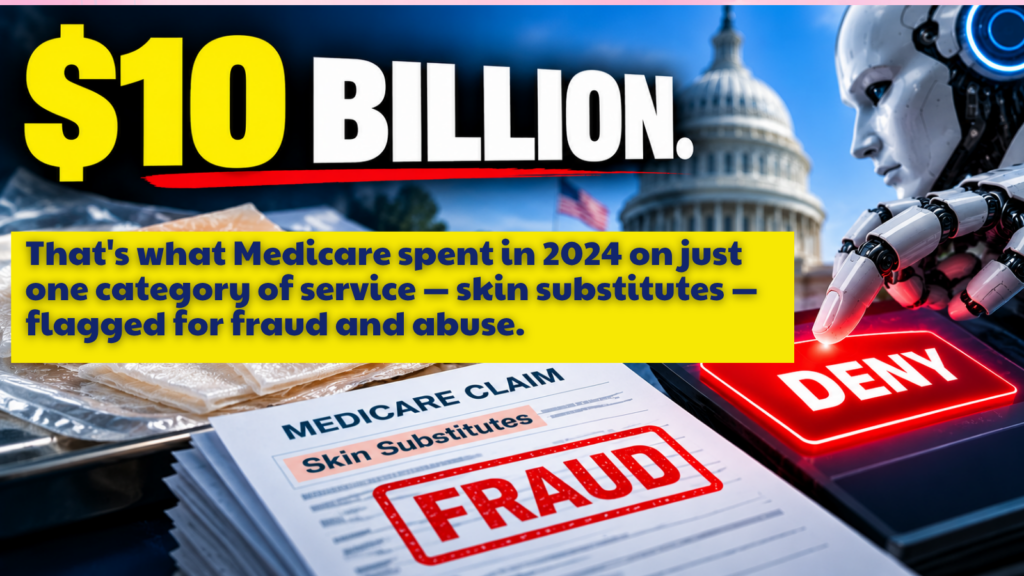
CMS has pointed to a specific justification: a September 2025 HHS Inspector General report found Medicare Part B spending on skin substitutes alone exceeded $10 billion in 2024, amid documented fraud and pricing abuse. Agency officials say the incentive structure is different from the private sector’s. CMMI Deputy Administrator Abe Sutton has said contractors are not incentivized to deny claims but to “get the determination right,” with coverage decisions expected within 72 hours, or 48 for expedited cases.
That reassurance has not settled the argument in Congress. CMS is paying private technology vendors a share of the savings generated by services denied under WISeR — a structure physician groups and lawmakers say could reward denial volume regardless of clinical accuracy. A House Appropriations effort to defund the model passed committee in September 2025 but was left out of the Consolidated Appropriations Act signed into law in February 2026. Separate legislation, the “Ban AI Denials in Medicare Act,” introduced in December 2025, would prohibit WISeR and any future CMS model that tests AI-assisted prior authorization in traditional Medicare; it remains pending.
A related, broader rule, CMS-0057-F, took effect this year requiring Medicare Advantage, Medicaid, CHIP and ACA exchange plans to adopt standardized electronic prior authorization, faster response times, and public reporting of denial rates — itself an acknowledgment from regulators that the current process needs more transparency than it has had.
The political backdrop
This debate does not exist in a vacuum. The December 2024 killing of UnitedHealthcare CEO Brian Thompson intensified public scrutiny of algorithmic claim denials industrywide, turning what had been a trade-press story into front-page news. It is a reminder of how much public frustration with automated denials already existed — but the legal and regulatory record, not that event, is what will determine how the practice is ultimately governed.
What patients can actually do
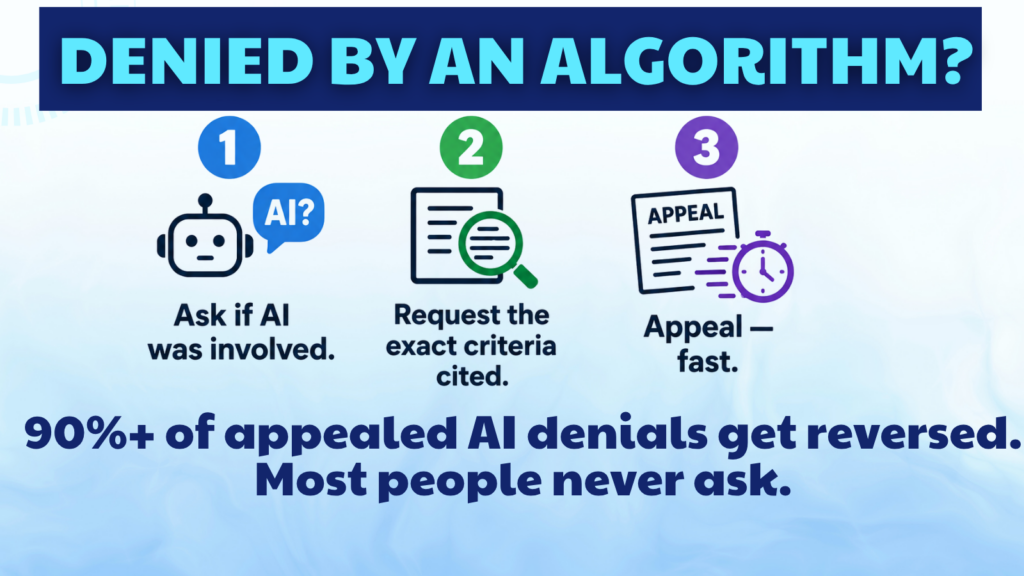
The available evidence — a 90%-plus reversal rate on appealed nH Predict denials, alongside a 0.2% appeal rate — indicates that most automated denials never receive the human scrutiny that, when it happens, frequently overturns them. That gap places the burden on patients and families to contest a denial at precisely the moment — mid-treatment, mid-crisis — when they are least equipped to do so.
Health law attorneys increasingly advise patients denied through any automated process to ask explicitly whether an algorithm was involved, to request the specific coverage criteria cited, and to appeal promptly, given typically short appeal windows and the high rate of reversal once a case is actually reviewed by a person.
The bottom line
None of this means AI has no legitimate role in claims processing — sorting paperwork, flagging likely fraud, and speeding up low-risk routine approvals can benefit patients as well as insurers. But the pattern documented in the Cigna and UnitedHealth litigation, and now built into Medicare’s own new model, involves delegating judgment calls about medically necessary care to systems that are built, funded, and in some cases financially rewarded on the basis of cost containment.
Insurers have always applied contractual and utilization-management criteria beyond any single treating physician’s word — that is not new. What is new, and what the courts and Congress are actively litigating and legislating right now, is how much of that judgment is shifting to automated systems, how little of it patients ever get to contest, and who is accountable when the system gets it wrong.
Sources: ProPublica/The Capitol Forum · CBS News · Courthouse News Service · Forbes · Healthcare Finance News · Yahoo News · Becker’s Payer Issues (x2) · LegalHIE · CMS.gov · Ensemble Health Partners · ASRA · KFF · DLA Piper
editor@ictpost.com