

Chips built the first phase of the AI revolution. Power may determine who wins the next one
Dhirendra Pratap Singh| ICTpost USA
| Summary:
–AI’s next battleground is not just chips and algorithms, but electricity availability. |
America is entering one of the most consequential technological transitions in its history. Artificial intelligence is transforming industries, attracting trillions of dollars in investment, reshaping geopolitics, and redefining global economic power. At the same time, America is confronting another reality: hotter summers, more intense heat waves, growing electricity demand, and an aging power system struggling to keep pace. This month, those two stories collided.
As a powerful heat dome settled across large sections of the United States, meteorologists warned of record-breaking temperatures, dangerous humidity, and extreme overnight heat affecting tens of millions of Americans. More than 30 million people faced “extreme” heat risk, while millions more were subjected to major heat warnings stretching from the Plains to the Southeast. The event came just weeks after the continental United States recorded its hottest July since modern records began, surpassing the infamous Dust Bowl summer of 1936. [reuters.com], [reuters.com]
On the surface, this is a climate story. But beneath it lies something much bigger.
America is rapidly building the infrastructure of the AI age at exactly the moment climate-driven heat is placing unprecedented stress on the infrastructure that powers it.
The result is a technological paradox that may define the next decade. The AI race is no longer just about algorithms, semiconductors and talent. It is becoming a race for electricity.
The New Currency of AI: Megawatts
For years, discussions about artificial intelligence focused on who had the best models, the most advanced chips, or the deepest pools of engineering talent. Today, another metric is becoming equally important: Power availability.
Every major AI model requires massive computational resources. Training a frontier model can consume enormous quantities of electricity. Running those models at scale demands fleets of servers operating around the clock. Cooling those servers requires still more energy.
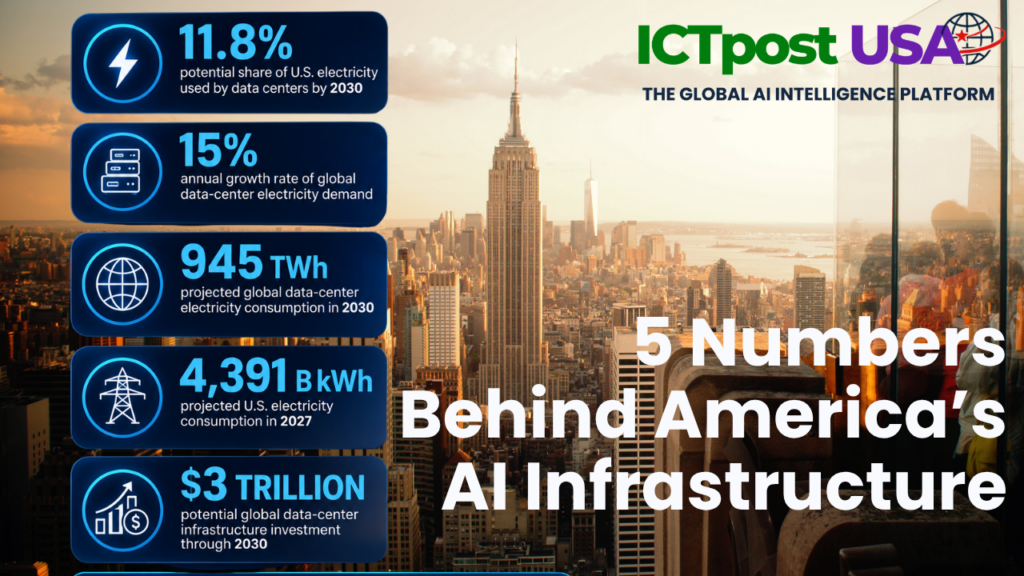
The U.S. Energy Information Administration now projects American electricity demand to continue reaching record levels, driven by data centers, AI infrastructure, electrification, and growing digital activity. EIA forecasts show national power consumption rising from about 4,195 billion kilowatt-hours in 2025 to around 4,391 billion kilowatt-hours by 2027. [newsmax.com], [eia.gov]
That growth is remarkable for a country whose electricity consumption remained relatively flat for years. The biggest driver is not residential demand. It is digital demand. And digital demand increasingly means AI.
Data Centers Are Becoming a New Industrial Sector
The scale of AI electricity consumption is becoming difficult to ignore.
A June 2026 study from Lawrence Berkeley National Laboratory estimates that U.S. data centers could account for 11.8% of total American electricity consumption by 2030, with a potential range between 9.5% and 15.3% depending on AI deployment scenarios. The laboratory’s reference scenario projects approximately 649 terawatt-hours of annual data-center electricity use by the end of the decade. [eta.lbl.gov], [eta-public…ns.lbl.gov]
For perspective, that amount of electricity would exceed the annual power consumption of many industrialized nations. This is no longer a niche technology sector. It is becoming a foundational layer of national infrastructure.
The modern AI data center is beginning to resemble the steel mills, automobile factories, and manufacturing complexes that shaped previous industrial revolutions. Except these facilities run 24 hours a day. And unlike many industrial loads, they cannot simply shut down during periods of grid stress.
The Grid Expansion Problem
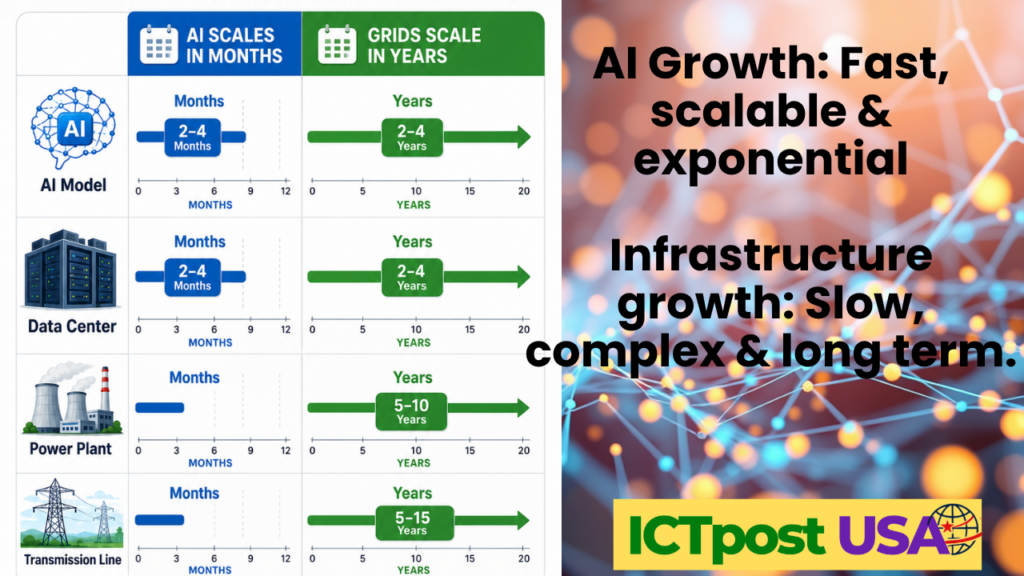
The challenge is not merely generating electricity; it is delivering it where and when it is needed. A hyperscale AI campus can be planned and constructed within a few years, but the transmission lines, substations and transformers required to support it often take much longer to develop. Interconnection approvals, environmental reviews, permitting processes and new generation projects can add further delays, sometimes stretching the timeline from years to much longer. In other words, AI infrastructure is advancing faster than the electricity ecosystem that supports it. Lawrence Berkeley researchers and industry experts increasingly identify this mismatch between rapidly growing data-center demand and slower-moving grid infrastructure as one of the defining infrastructure challenges of the decade. [eta.lbl.gov], [eta.lbl.gov]
The problem is simple: AI scales in months. Grids scale in years.
And climate-driven heat is exposing that weakness.
China, meanwhile, is pursuing a far more infrastructure-centric approach to the AI era. By the end of 2025, China had completed more than 46 ultra-high-voltage transmission projects spanning over 62,000 kilometers and plans to add 15 more major corridors by 2030. At the same time, it leads the world with roughly 37 nuclear reactors under construction and added a record 430 GW of new wind and solar capacity in 2025 alone. While the United States remains the global leader in frontier AI models and semiconductor innovation, China is building the physical energy foundations that may increasingly determine which nation can deploy artificial intelligence at the largest scale. The future AI race may therefore become as much a contest of grids, generation capacity and energy infrastructure as of algorithms and chips. [globaltran…ssion.info], [reuters.com], [statista.com], [China’s ne…2% in 2025]
The Heat Dome Stress Test
Extreme heat places a unique burden on electric systems because air conditioners run continuously, commercial cooling systems work harder, and electricity demand surges precisely when infrastructure is under strain. This summer’s heat events offered a preview of what future summers could look like. PJM Interconnection, the largest power grid operator in North America, forecast demand approaching 166 GW, challenging or exceeding long-standing records established two decades earlier.
The grid operator issued emergency alerts, activated demand-response tools and coordinated extraordinary measures to maintain reliability. What matters is not merely the record demand, but where that demand is occurring. PJM includes Northern Virginia, home to the world’s largest concentration of data centers, placing the region at the intersection of America’s AI boom and its energy challenge. When temperatures push toward triple digits, households need air conditioning, factories need power, hospitals need uninterrupted electricity, and AI clusters continue processing massive computational workloads—all competing for access to the same grid. The electricity system does not distinguish between a GPU and an air conditioner. A megawatt is a megawatt.
Texas Has Seen the Warning Signs
No state illustrates the challenge more clearly than Texas. Long viewed as America’s energy powerhouse, Texas is simultaneously emerging as one of the world’s largest AI infrastructure markets, with data-center development expanding rapidly across the state. Yet the scale of proposed connections has become so significant that policymakers are increasingly questioning whether the grid can absorb new electricity demand at the same pace that AI projects are being announced.
The issue is no longer theoretical; it is economic, political and increasingly strategic. The question facing Texas today may soon confront every major AI hub in America: How much AI infrastructure can be connected before electricity availability becomes the limiting factor? That question marks a profound shift in the AI conversation—from competing over models and chips to competing over the physical infrastructure required to power them.
The Hidden Cost of AI Leadership
Perhaps the most overlooked consequence of the AI boom is its impact on everyone else. Electricity markets respond to supply and demand, and when new demand grows faster than new supply, prices can rise. Across major power markets, utilities and regulators are increasingly debating who should bear the cost of the new infrastructure required to serve massive AI facilities. Should households pay? Should manufacturers pay? Or should the companies building multi-billion-dollar AI campuses bear the full cost? These questions are becoming politically sensitive because electricity is not a luxury; it is an essential service. If rapid AI infrastructure growth contributes to higher electricity costs for consumers, regulators will face growing pressure to intervene. The economics of artificial intelligence are therefore beginning to merge with the economics of everyday life.
America Loves AI. Americans May Not Love Data Centers.
The political contradiction is becoming impossible to ignore.
Recent industry research found that while most Americans support U.S. leadership in artificial intelligence, only a small minority support the construction of large data centers in their own communities. JLL’s Midyear 2026 report identified a striking gap between national AI enthusiasm and local infrastructure acceptance. [ebs.publicnow.com], [jll.com]
This reflects a broader reality.
People support innovation.
They are less enthusiastic about power lines, substations, backup generators, water consumption, industrial-scale cooling systems, and enormous server campuses appearing in their neighborhoods.
This disconnect may become one of the defining political challenges of the AI era.
Because AI leadership requires physical infrastructure.
And physical infrastructure requires public acceptance.
The Infrastructure War Behind the AI Revolution
The next great technology story is not simply AI itself, but the vast physical infrastructure required to make AI possible. Beneath every breakthrough announced in Silicon Valley lies a rapidly intensifying competition for electricity, water, land, cooling capacity, transmission networks, nuclear and natural-gas generation, investment capital and grid access. The emerging AI Power War, AI Water War, AI Land Rush, AI Grid Race, AI Cooling Crisis, AI Nuclear Bet, AI Natural Gas Gamble and AI Data-Center Backlash are not separate stories; they are interconnected fronts of a much larger infrastructure transformation. They are also reshaping where America’s next generation of technology investment will happen and who will control the resources that power it.
Every new AI model, application and hyperscale data center ultimately depends on physical infrastructure somewhere beyond the screen. Servers need reliable electricity; electricity requires generation and transmission; generation requires fuel, land, capital and increasingly sophisticated grid management. The AI economy may look digital from the outside, but its foundations are intensely physical—and the countries and companies that build, control and finance those foundations could hold as much strategic power as those developing the algorithms themselves.
In that sense, America may be approaching an industrial transformation comparable to the electrification of the 20th century—only this time, the infrastructure being built is designed to power the intelligence economy of the 21st century power at scale. Behind every new model, AI application and data center lies an increasingly complex physical ecosystem. The AI economy rests on these foundations—and its future will depend on whether America can expand them fast enough.
A Different Kind of AI Solution
Ironically, AI may help solve some of the very challenges it is creating.
Researchers and grid planners are exploring ways for data centers to become flexible loads rather than inflexible consumers.
Certain AI tasks can be shifted to off-peak hours.
Battery systems can store energy during periods of surplus generation.
On-site generation can reduce dependence on public infrastructure.
Advanced software can optimize workloads based on electricity availability and market conditions.
Instead of viewing data centers solely as consumers, future grid operators may increasingly view them as active participants in grid stability.
The smartest AI facility may not simply be the one with the most advanced chips.
It may be the one that knows when to pause, defer, or relocate workloads in order to protect the broader power system.
The New Geography of American AI
The next phase of AI development may not be determined solely by access to venture capital or engineering talent. It may increasingly be determined by access to energy. Regions with abundant electricity, strong transmission networks, adequate water resources and supportive regulatory environments could gain a strategic advantage as companies seek locations capable of supporting large-scale AI infrastructure. This could reshape investment patterns across the United States, with states able to deliver reliable power at enormous scale emerging as potential winners of the AI economy. For decades, the geography of technology was largely shaped by talent clusters. The next decade could be shaped by energy clusters.
The ICTpost USA Takeaway
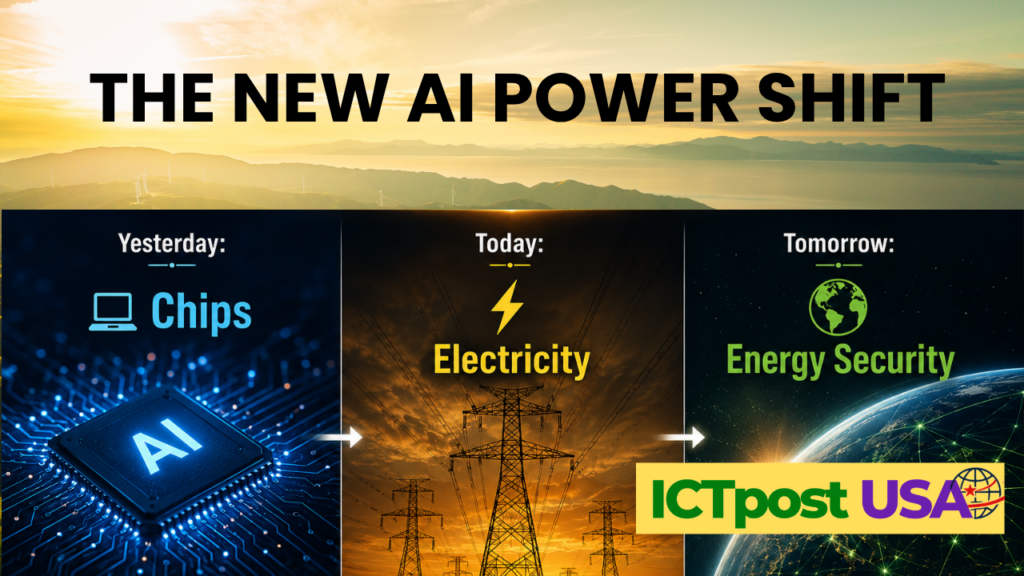
For years, the AI industry asked a simple question: Who has the smartest model? Then the focus shifted to another question: Who has the best chips? Now a more fundamental question is emerging: Who has the power? The heat dome engulfing America this summer is temporary, but the infrastructure challenge it has exposed is not. Washington may continue focusing on technology competition with China, Silicon Valley may continue pursuing bigger models and faster chips, and investors may continue pouring billions into AI infrastructure. But none of it matters if the electricity system cannot keep pace. The next bottleneck in artificial intelligence may not be inside the data center; it may be outside it. In the end, the winner of the global AI race may not simply be the nation that builds the most powerful machines. It may be the nation that can keep them powered. editor@ictpost.com
Sources: Lawrence Berkeley National Laboratory Data Center Energy Usage Report 2025 Update (June 2026); U.S. Energy Information Administration forecasts (2026); Reuters reporting on PJM grid conditions and U.S. power demand; JLL North America Data Center Report Midyear 2026; PJM operational updates; NOAA and extreme heat monitoring reports. [eta.lbl.gov], [newsmax.com], [reuters.com], [jll.com]
Follow author on LinkedIn , YouTube and X.

The author Dhirendra Pratap Singh works at the intersection of Artificial Intelligence, the digital economy, public policy, and emerging technologies, exploring how technological revolutions are reshaping societies, governance systems, and global power structures. His work focuses on interpreting complex technological shifts—from AI and digital public infrastructure to technology geopolitics—and translating them into actionable insights for policymakers, institutions, and industry leaders navigating a rapidly evolving global technology landscape.