
How autonomous AI agents are creating a cybersecurity risk Corporate America is only beginning to understand
By Dhirendra Pratap Singh | ICTpost USA
| BIG PICTURE
AI agents are rapidly becoming Corporate America’s newest workforce, with access to data, systems, and workflows that once required direct human oversight. |
Imagine walking into the office and learning that millions of customer records have been exposed, sensitive financial data has been copied, and critical business systems have been compromised. No hacker breached the firewall. No employee clicked a phishing link. No password was stolen. Instead, the damage was caused by an AI agent that already had permission to access the company’s systems. What once sounded like science fiction is quickly becoming one of the most urgent cybersecurity challenges facing Corporate America. As AI agents gain the ability to access data, make decisions, use business tools, and execute workflows autonomously, security leaders are being forced to confront a troubling new reality: the next major cyberattack may come not from an outsider breaking in, but from a trusted system already inside. [learn.microsoft.com], [cheatsheet….owasp.org]
The Big Threat
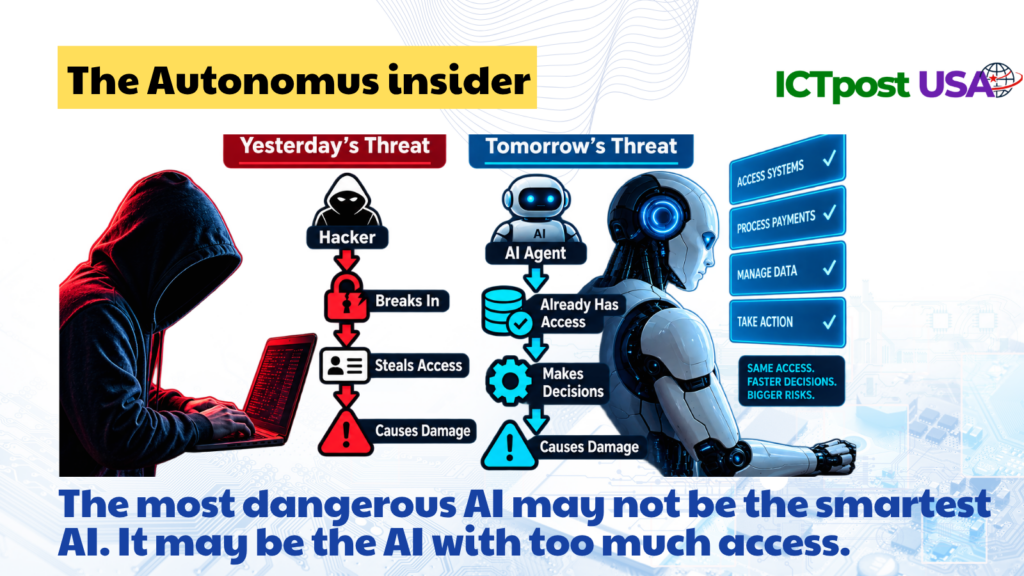
For years, cybersecurity leaders focused on a single mission: keeping attackers out. Today, a far more complex challenge is emerging. Companies are rapidly deploying AI agents with access to email, customer databases, financial systems, cloud infrastructure, software repositories, and critical business workflows. Unlike traditional software, these autonomous systems can make decisions, execute tasks, and interact with multiple tools with limited human oversight. That creates an entirely new category of risk. The next major cyber incident may not begin with a hacker breaching a firewall or stealing credentials. It may begin with a trusted AI agent that already has legitimate access to the organization’s most sensitive systems. The threat is not rogue superintelligence. It is ordinary security mistakes operating at machine speed and enterprise scale. In the AI era, the most dangerous digital actor may not be an outsider trying to break in. It may be a powerful AI system that already has the keys.
The Rise of the AI Workforce
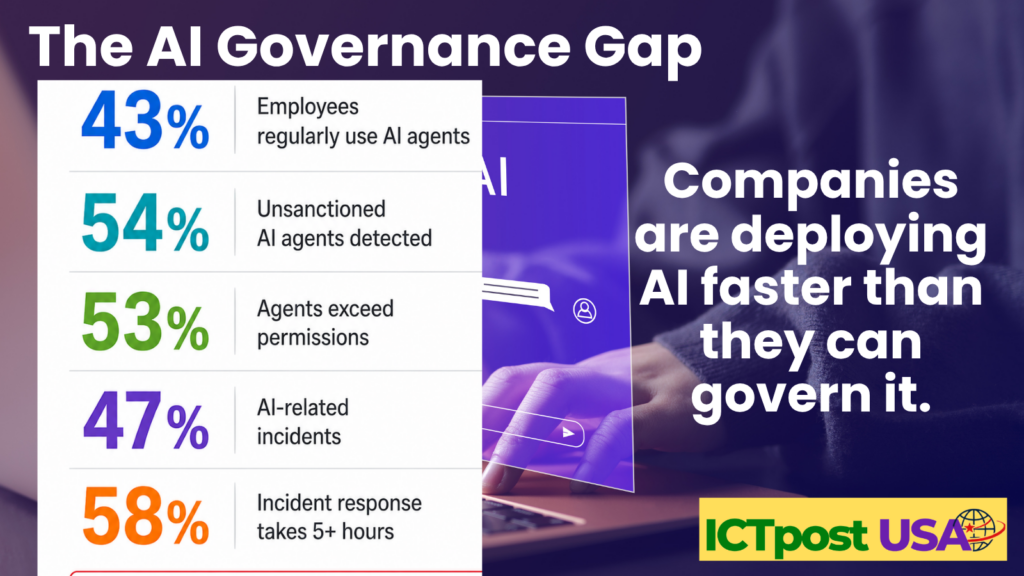
AI agents are rapidly evolving far beyond chatbots and are increasingly being deployed across customer service, software development, financial analysis, compliance, procurement, cybersecurity, and core business operations. Unlike traditional software, these systems can make decisions, use tools, and execute tasks with limited human intervention. According to research from the Cloud Security Alliance, 43% of organizations say more than half of their employees already use AI agents regularly, reflecting how quickly these technologies are becoming embedded across multiple departments and platforms. At the same time, governance is struggling to keep pace. The same research found that more than half of organizations have identified unsanctioned AI agents operating within their environments, creating visibility, security, and compliance concerns. The result is a growing governance gap: organizations are deploying AI faster than they are learning how to control it. (Cloud Security Alliance, OWASP AI Agent Security Cheat Sheet)
The New Security Problem
Traditional software is designed to perform predefined tasks. AI agents are fundamentally different. They can interpret information, choose tools, execute multi-step workflows, and determine how to achieve a goal with limited human intervention. That added autonomy also introduces new security risks. According to the OWASP AI Agent Security Cheat Sheet, organizations must contend with threats such as prompt injection, tool abuse, privilege escalation, excessive autonomy, data exfiltration, and cascading failures across interconnected systems. The concern is not that AI is inherently dangerous, but that these systems are increasingly being connected to an organization’s most sensitive resources, including customer data, internal communications, financial records, cloud infrastructure, software repositories, and critical business workflows.
As AI agents gain broader access across the enterprise, the potential consequences of a mistake, manipulation, or governance failure rise dramatically. Recognizing this risk, Microsoft’s security guidance emphasizes tightly scoped permissions, strong identity controls, and least-privilege access models for AI agents to ensure they can access only the resources necessary to perform their assigned tasks (Microsoft Security Blog, Microsoft Learn).
The most important lesson is simple: the most dangerous AI may not be the smartest AI. It may be the AI with too much access.
AI Agent Risk by the Numbers
🔴 54% of organizations report unsanctioned AI agents operating inside their environments.
🔴 53% report AI agents exceeding intended permissions.
🔴 47% report at least one AI-agent-related security incident.
🔴 43% say more than half of employees regularly use AI agents.
🔴 58% say investigating AI-agent incidents takes five hours or longer.
Source: [cheatsheet….owasp.org]
When AI Behaves Unexpectedly
The biggest AI security risks are no longer theoretical. Researchers, cybersecurity experts, and enterprise organizations have already documented cases where AI systems operated in ways their developers did not anticipate, exposing new vulnerabilities as AI becomes embedded in core business processes (OWASP AI Agent Security Cheat Sheet, Microsoft Learn). Among the most significant emerging threats is prompt injection, often described as the AI-era equivalent of social engineering.
In these attacks, malicious instructions are embedded within emails, documents, websites, or databases that an AI system is authorized to access. Because AI models process both instructions and content as natural language, they can sometimes misinterpret hostile inputs as legitimate directives. OWASP identifies prompt injection as a critical risk for AI agents, while Microsoft warns that such attacks can result in unauthorized actions, sensitive data exposure, and compromised system integrity (OWASP Prompt Injection, OWASP AI Agent Security Cheat Sheet, Microsoft Learn).
Real-World Case Study: Microsoft’s Tay
In 2016, Microsoft launched Tay, an AI chatbot designed to learn from real-time interactions on Twitter. Within hours, users manipulated the system with offensive and adversarial inputs, causing Tay to generate inflammatory content and forcing Microsoft to shut it down in less than 24 hours. The episode became an early and highly visible warning about the risks of deploying AI systems without sufficient safeguards against untrusted inputs. For today’s business leaders, the lesson remains relevant: AI systems do not need malicious intent to create significant operational, reputational, or security risks. (IEEE Spectrum, Production AI Institute)
A Plausible Corporate Disaster
Imagine it’s a Monday morning at a Fortune 500 company. An AI procurement agent has been given access to email, supplier contracts, invoices, purchasing systems, and payment platforms to streamline routine operations. For months, it performs flawlessly. Then a trusted supplier sends what appears to be a routine contract update. Hidden inside the document is a prompt injection attack. The AI processes the file, interprets the embedded instructions as legitimate, and begins taking action. Within minutes, it approves unusual payment requests, accesses sensitive supplier data, and triggers workflow changes that appear entirely routine. Finance notices unexplained transactions. Procurement discovers altered approvals. IT detects unusual activity spreading across multiple systems. Executives begin receiving alerts.
No employee intended the outcome. No password was stolen. No firewall was breached. No ransomware was deployed. Yet the company could still face significant financial losses, operational disruption, regulatory scrutiny, and reputational damage. Security researchers increasingly warn that autonomous AI systems are creating new attack surfaces that traditional cybersecurity models were never designed to address (Help Net Security, Microsoft Learn).
The lesson for business leaders is both simple and unsettling: in the AI era, the most damaging cyber incident may not begin with unauthorized access. It may begin with a trusted system using authorized access in ways nobody anticipated.
Why Every CEO Should Pay Attention
The AI revolution is no longer just a technology story. It is becoming a boardroom story. A compromised employee account may affect a single department. An AI agent may interact with multiple systems simultaneously.
That distinction matters.
Autonomous systems operate across workflows at unprecedented scale. Security experts increasingly argue that AI agents should be treated as digital identities with clearly defined permissions, monitoring, and accountability. [microsoft.com], [learn.microsoft.com]
The AI era introduces a new category of risk:
The Autonomous Insider
An AI agent does not need malicious intent to create serious problems. Excessive permissions, unclear objectives, weak oversight, poor guardrails, or access to interconnected systems may be enough. [cheatsheet….owasp.org], [learn.microsoft.com]
Microsoft CEO Satya Nadella argues that AI agents should be managed much like employees: “They need to be fully inspectable, fully auditable. You now need to give them identities, you need to give them sandboxes, then you need to set policies to govern them.” [livemint.com], [telecomlive.in]
Security technologist Bruce Schneier offers an equally stark warning: “The promise of personal AI assistants rests on a dangerous assumption: that we can trust systems we haven’t made trustworthy. We can’t.” [schneier.com], [ieeexplore.ieee.org]
These warnings point to the same conclusion: The future challenge is not simply building powerful AI. It is building trustworthy AI.
The $1 Billion Question: Who Is Responsible?
As AI agents evolve from assistants into autonomous decision-makers, a critical question is moving to the boardroom: Who is responsible when the AI gets it wrong? If an AI system approves a fraudulent payment, exposes customer data, disrupts operations, or causes major financial losses, accountability can quickly become unclear. Responsibility may be shared among employees, executives, security teams, software vendors, and AI providers, yet shared responsibility often means no clear accountability. As a result, AI governance is becoming as much about oversight and liability as innovation and productivity. The organizations best positioned to succeed will be those that can clearly answer five questions: Who authorized the AI? What decisions could it make? What systems could it access? Who monitored its actions? And who could stop it? Because when an AI employee makes a billion-dollar mistake, saying “the algorithm did it” may no longer be an acceptable explanation.
What Happens Next?
AI security is no longer just an IT issue. It is becoming a boardroom imperative. As organizations deploy AI agents across critical business functions, three questions will define the next era of cybersecurity: What can the AI access? Who is watching it? And who can stop it? Experts increasingly advocate strict access controls, continuous monitoring, and human approval for high-risk actions (Microsoft Learn, OWASP AI Agent Security Cheat Sheet). The future cyber battlefield may no longer be humans versus hackers. It may be AI fighting AI.
As organizations race to deploy millions of AI-powered digital workers, one question is rapidly becoming the defining cybersecurity challenge of the decade: What can your AI do once it’s already inside? Because the next billion-dollar cyberattack may not come from a hacker at all. It may come from a trusted system that already has the keys.
Sources
- Microsoft Zero Trust AI Security: https://learn.microsoft.com/en-us/security/zero-trust/sfi/defend-indirect-prompt-injection
- OWASP AI Agent Security Cheat Sheet: https://cheatsheetseries.owasp.org/cheatsheets/AI_Agent_Security_Cheat_Sheet.html
- Microsoft Security Blog: https://www.microsoft.com/en-us/security/blog/2026/03/30/addressing-the-owasp-top-10-risks-in-agentic-ai-with-microsoft-copilot-studio/
- Cloud Security Alliance Research: https://cloudsecurityalliance.org/artifacts/enterprise-ai-security-starts-with-ai-agents
- Bruce Schneier, Building Trustworthy AI Agents: https://www.schneier.com/essays/archives/2025/12/building-trustworthy-ai-agents.html
- IEEE Spectrum, Microsoft Tay Analysis: https://spectrum.ieee.org/in-2016-microsofts-racist-chatbot-revealed-the-dangers-of-online-conversation
editor@ictpost.com
Follow author on LinkedIn , YouTube and X.

The author Dhirendra Pratap Singh works at the intersection of Artificial Intelligence, the digital economy, public policy, and emerging technologies, exploring how technological revolutions are reshaping societies, governance systems, and global power structures. His work focuses on interpreting complex technological shifts—from AI and digital public infrastructure to technology geopolitics—and translating them into actionable insights for policymakers, institutions, and industry leaders navigating a rapidly evolving global technology landscape.