
ICTpost USA Special Report | AI Unsung Heroes
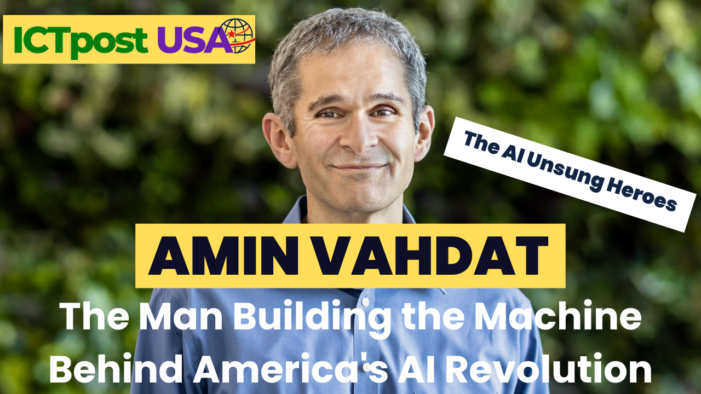
Role: Google Fellow & Chief Technologist, AI Infrastructure ICTpost Unsung Hero Category Why He Belongs on the List While others build AI applications, Amin Vahdat has spent decades building the foundation beneath them. Amin Vahdat may be remembered for building the engine that made intelligence possible.
Amin Vahdat
Domain: AI Infrastructure • Distributed Systems • Networking • Hyperscale Computing
The Infrastructure Architect
Because the AI revolution is not powered by algorithms alone. It is powered by the invisible machinery that trains them, scales them, and delivers them to billions of users.
In the history of artificial intelligence, many people will be remembered for creating intelligence.
The world sees the chatbot. It rarely sees the infrastructure that makes the chatbot possible. Behind every AI model lies an enormous machine of chips, networks, data centers, software, power and systems engineering. Amin Vahdat has spent decades building that machine.
The AI Revolution Has a Hidden Layer
Sam Altman is associated with the rise of ChatGPT. Jensen Huang became the face of the GPU revolution. Sundar Pichai represents Google’s transformation into an AI-first company. Mark Zuckerberg is betting billions on the next generation of intelligent systems. Their names dominate the AI story.
But beneath every model, every AI assistant, every autonomous agent and every billion-dollar AI application is another story—one that rarely makes the headlines.
It is the story of infrastructure. Because artificial intelligence does not exist in the cloud as magic.
It exists because thousands of processors can communicate with one another at extraordinary speed. Because enormous quantities of data can move through sophisticated networks. Because memory, storage, software, cooling, electricity and computing resources can be coordinated continuously. Because data centers can operate at planetary scale. And because somebody has to make all of those pieces work together.
Few people have spent more of their careers solving that problem than Amin Vahdat.
Today, Vahdat is a Google Fellow and SVP/Chief Technologist for AI and Infrastructure, leading work that spans custom silicon, data centers, networking, supply chain and operations—the physical and digital foundation on which Google’s AI systems depend.
He is not the face most people associate with artificial intelligence. He may be something more important: One of the people building the machine underneath it.
The Man Behind the Invisible Layer
The easiest way to understand Vahdat’s importance is to look beyond AI. Long before generative AI became a global phenomenon, he was working on a fundamental computer science problem: How can thousands of computers work together as if they were one? This is at the heart of distributed systems, the field that shaped much of his career.
After earning his Ph.D. in computer science from UC Berkeley, Vahdat built his career in distributed systems, networking and large-scale computing. As a professor at UC San Diego, he worked on problems that seemed far removed from today’s consumer AI. But those same ideas are now central to cloud computing, modern data centers and large AI systems, where thousands of processors must work together efficiently.
The technology has changed, but the fundamental challenge remains the same: How do you make enormous computing systems work as one? Vahdat has spent decades working to solve that problem.
When Networking Became the Real Computer
For years, networking was seen as background infrastructure. Processors did the computing, software was the product, and networks simply moved data between them. AI has changed that. Modern AI systems rely on thousands of accelerators working together, which requires huge amounts of data to move quickly between processors, memory and storage.
The network is no longer just connecting the computer—it is becoming part of the computer. A powerful AI chip is only useful if it can communicate efficiently with other chips. Slow or poorly designed networks can leave expensive computing power underused, while high-performance networks can help thousands of processors work together as one system.
That is why networking has become a major battleground in AI infrastructure. And this is exactly the area where Amin Vahdat has spent much of his career.
The Google Bet: Build the Whole Stack
Vahdat’s importance becomes even clearer when viewed through Google’s broader technology philosophy.
Google did not simply build software and purchase infrastructure from somewhere else.
Over decades, it developed increasingly integrated capabilities across computing, networking, storage and specialized hardware.
Vahdat has been deeply involved in that evolution.
His Google career included leadership of networking and later broader compute, storage and network hardware and software infrastructure. His current AI-infrastructure responsibilities extend across custom silicon, data centers, networks, supply chain and operations.
Every AI Prompt Starts a Symphony
When a user types a simple question into an AI assistant, the experience feels easy. A few words go in, and an answer quickly appears. But behind those few seconds, a complex process is taking place. The request travels through a network, computing resources are assigned, AI accelerators process the information, data moves between processors and memory, and servers coordinate everything before the final response reaches the user.
Now imagine millions of people doing this at the same time, with thousands of AI workloads running across massive computing infrastructures. AI begins to look less like a simple software application and more like an industrial system. That is the transformation that people like Vahdat are helping to make possible.
The Billion-Connection Problem
One of the clearest windows into this invisible world is Fathom, a Google system designed to understand network performance across the company’s production infrastructure.
Fathom does something that sounds almost impossible at human scale.
It monitors billions of TCP connections around the clock across Google’s data centers.
Why?
Because at hyperscale, a tiny performance problem can become a massive systems problem.
Fathom helps determine whether latency is being caused by the host, the network or the server. It gives engineers a way to see what is happening inside a computing environment operating at extraordinary scale.
Think about what that means.
Billions of connections.
Millions of interactions.
Countless packets.
Thousands of systems.
And somewhere inside that enormous complexity, a tiny delay can become a clue.
Fathom turns that complexity into something engineers can understand and act upon.
This is not the glamorous side of AI.
There is no chatbot demo.
No futuristic humanoid robot.
No viral product launch.
But without this kind of engineering, hyperscale computing becomes dramatically harder to operate.
The invisible layer determines how visible AI performs.
The Infrastructure Revolution Was Already Coming
This is what makes Vahdat’s career particularly interesting. He did not become important because AI suddenly became popular. The problems he had been working on for decades simply became more important as technology evolved. Distributed systems, once seen as a specialized area of computer science, now form the foundation of cloud computing. Data-center networking has become critical to the performance of large AI systems, while reliability and large-scale computing have become essential to the global AI economy.
In many ways, Vahdat was working on tomorrow’s problems before tomorrow arrived.
From Professor to Planet-Scale Engineer
There is another reason Vahdat’s story deserves attention. He represents a generation of computer scientists whose most important work was not created for public attention. It was created to make complex systems work. His academic career at UC San Diego focused on computer systems, distributed computing and networking before he moved into Google’s world of hyperscale infrastructure.
The transition from academic research to operating systems at global scale is significant. A research paper can show that an idea works, but a global infrastructure system has to work every second, every day, at massive scale and under unpredictable demand. There is no room for failure. That is a very different engineering challenge—and one that Amin Vahdat has spent decades solving.
The New AI Bottleneck Is Not Just Compute
The AI industry has become obsessed with compute—how many GPUs, TPUs, data centers and megawatts are needed to build bigger AI systems. But compute alone does not create intelligence at scale. It also needs reliable networks, power, cooling, software, security and efficient operations, all working together seamlessly.
This is why the next phase of the AI race may depend as much on infrastructure efficiency as on smarter models. The real question is no longer just who can build the smartest AI model, but who can deliver more intelligence with every chip, every watt, every dollar and every second. And that is where engineers like Amin Vahdat become critical to the future of AI.
Why His Role Matters
Vahdat’s elevation to a top AI infrastructure role at Google reflects how important infrastructure has become to the future of AI. Google increasingly sees AI as an integrated systems challenge involving custom chips, computing platforms, networking and data centers. At Google Cloud Next 2026, Vahdat and his colleagues discussed the next phase of AI infrastructure for the agentic era, where AI systems will move beyond answering questions to reasoning, using tools and taking actions.
This new generation of AI will place even greater demands on infrastructure. An AI system that answers occasional questions is very different from an AI agent that continuously reasons, retrieves information, writes software, analyzes data and takes action. Such systems will require infrastructure that is faster, more reliable, more scalable, more energy-efficient and increasingly available around the clock. In other words, the infrastructure supporting AI must evolve as quickly as the intelligence itself.
The Great Convergence
For decades, technology was divided into separate industries. Chip companies built processors, networking companies moved data, cloud companies provided computing power, data-center companies built facilities, and software companies developed applications. AI is now bringing all these areas together.
Modern AI systems depend on every part of this infrastructure working together. Chips affect networking, networking affects computing performance, computing affects power needs, and power and cooling influence data-center design. Software determines how efficiently these resources are used, while AI workloads are also shaping the next generation of chips.
The boundaries between these industries are disappearing. The computer is becoming the infrastructure, and the infrastructure is becoming a competitive advantage.
The Most Important People in AI May Not Be Famous
There is a paradox at the heart of the AI revolution: the more powerful AI becomes, the less people see the infrastructure that makes it possible. Users do not see the networks, specialized chips, storage systems, cooling, power systems or data-center operations working behind the scenes. They simply type a question and see an answer appear on the screen.
But there is no magic inside that box. Behind every AI interaction is a massive computing system working continuously. And people like Amin Vahdat are helping build and operate the infrastructure that makes it all possible.
The AI Unsung Hero
History often remembers the person who creates a product, the CEO who announces it, or the scientist whose breakthrough changes an industry. But major revolutions are built by thousands of specialists solving complex problems that most people never see. The AI revolution is no different. Some are building models, some are designing chips and algorithms, some are developing robots, and others are building the infrastructure that allows all of these technologies to scale.
Amin Vahdat belongs to that last group. His contribution is not a single chatbot or a headline-making product. It is something much less visible but equally important: helping build the systems that allow artificial intelligence to operate at enormous scale. That could ultimately make his work one of the most important contributions of the AI era.
ICTpost USA Insight
The first chapter of the AI revolution was about creating intelligence. The next chapter will be about scaling that intelligence. And scaling AI will require much more than better algorithms. It will require better chips, faster networks, more efficient data centers, smarter software, better energy management and stronger systems engineering. Most importantly, all these layers will need to work together seamlessly.
This is why the next generation of AI leaders may not always be household names. They will include infrastructure architects, semiconductor engineers, networking scientists, data-center experts and engineers solving AI’s growing energy challenges. Some will build the systems that allow millions of machines to work together as one. They may never become celebrities, but their work will determine how far artificial intelligence can go. Amin Vahdat is one of them.
They don’t make the AI headlines. They make the AI revolution work. editor@ictpost.com