
The Biggest Privacy Threat of the AI Era Isn’t Surveillance. It’s Your AI Conversations.
Millions of Americans now tell AI things they would never tell a search engine. As AI investment surpasses $100 billion in the U.S., those conversations are becoming one of the most valuable and potentially vulnerable assets of the digital economy.
By Dhirendra Pratap Singh | ICTpost USA
| THE BIG PICTURE
The internet learned what people do. Artificial intelligence is beginning to learn why they do it. Americans are rapidly integrating AI into everyday life. According to Pew Research Center, 62% of U.S. adults say they interact with AI at least several times a week, reflecting how deeply AI has become embedded in daily activities. Meanwhile, Stanford University’s 2025 AI Index found that 78% of organizations use AI and 71% use generative AI in at least one business function, highlighting the growing volume of human-AI interaction across society and the economy. [pewresearch.org], [hai.stanford.edu] As AI systems become more personal and conversational, a crucial question is emerging: What happens when technology accumulates years of intimate conversations about your life? |
For decades, technology companies built vast businesses around tracking what people clicked, searched, bought, watched, and liked. AI is changing the equation. Millions of Americans now use chatbots to discuss career uncertainty, financial stress, relationship problems, health concerns, and personal decisions they might never share publicly. Unlike traditional digital data, these conversations can reveal motivations, fears, ambitions, insecurities, and patterns of thinking. The internet learned what we do. AI is beginning to learn why we do it. That shift is creating a new category of personal information, one that may be more revealing than search histories or social media profiles and could redefine the future of privacy, trust, and individual control in the AI era.
The Internet Knows What You Clicked. AI May Know Why.
The digital economy was built on behavioral data, tracking what we search, buy, watch, and click. But most of that information answers a simple question: What did you do? AI conversations can reveal something far more valuable: Why did you do it? A search query provides a signal; a conversation exposes context, motivation, fears, ambitions, and decision-making patterns. Behavior explains actions. Context explains intention. And in the AI era, understanding intention may become one of the most valuable assets of all.
Building the Digital Portrait
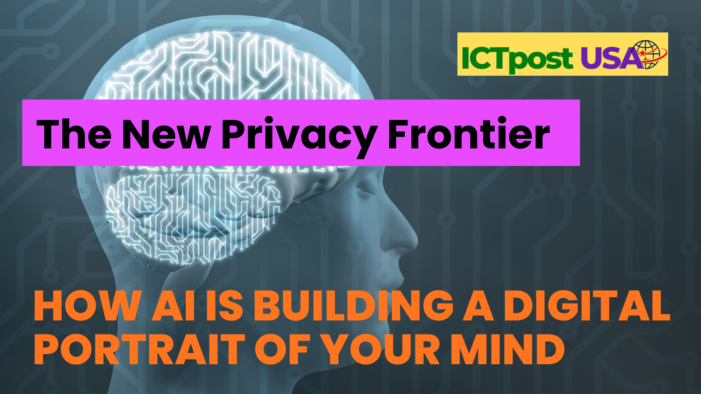
The traditional diary was private by design. People wrote down their thoughts believing no one else would ever read them. Today, millions of people are creating digital versions of those diaries through conversations with AI. A discussion that begins with workplace stress can gradually expand to include finances, relationships, health concerns, family challenges and long-term ambitions. Individually, these exchanges may seem ordinary. Collectively, they can reveal patterns, priorities, fears and decision-making habits over time. That is what makes conversational AI different from previous technologies: its value lies not in a single interaction, but in the accumulated understanding that emerges across months and years of conversations. While friends, family members, colleagues and advisers typically see only fragments of a person’s life, AI may increasingly encounter all of them, creating something far more comprehensive: a digital portrait of who you are—and who you may become. The trend extends far beyond the workplace. Pew Research Center recently found that nearly half of U.S. adults now use AI chatbots, while roughly one-quarter report using them daily. As AI tools become part of everyday routines involving work, education, health and personal decision-making, the conversational records they generate are emerging as a significant new category of personal information—one that may ultimately reveal not only what people do, but why they do it.
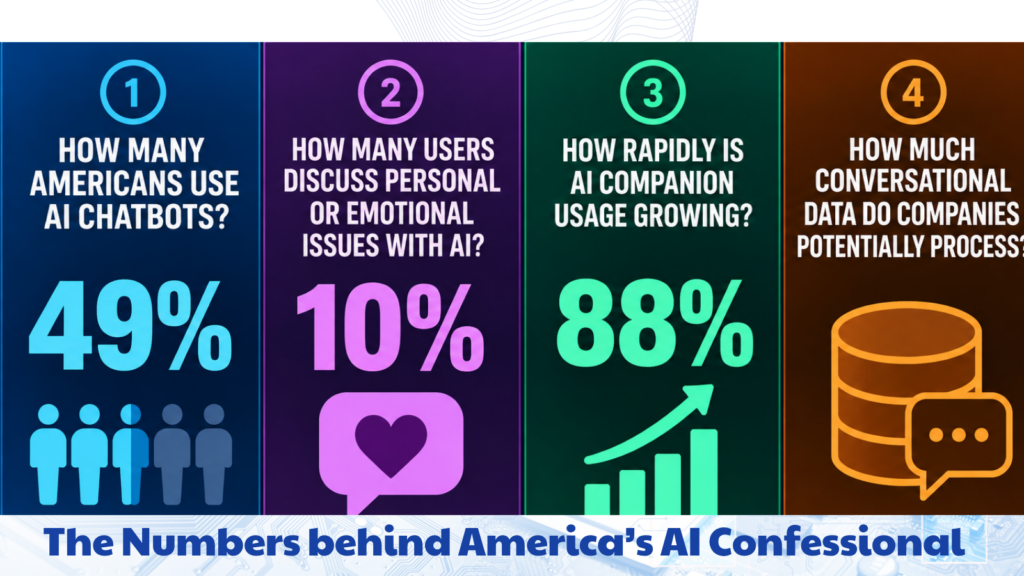
Sources: Pew Research Center (2026) | Appfigures, reported by TechCrunch (2025)
Why Privacy Rules Are Struggling to Keep Up
Policymakers are increasingly being asked to regulate a privacy challenge that was never envisioned when most of today’s laws were written. Existing frameworks were built for an internet of websites, cookies, accounts, and transactions. AI is different. A single conversation can contain financial concerns, health questions, family dynamics, career decisions, personal beliefs, and emotional struggles, often within minutes. More significantly, the value of AI does not come solely from the information users provide, but from the insights these systems can infer. NIST has warned that AI can generate new information and conclusions beyond what individuals explicitly disclose. That shifts the debate from protecting data to governing inference. The critical questions are no longer just what information is collected, but who controls the insights derived from it, who can access them, how long they persist, and who ultimately benefits from them. As AI becomes more embedded in everyday life, those questions are moving from academic discussions to pressing business and policy challenges.
Real-World Signs the Debate Has Already Begun
The concerns surrounding AI privacy are no longer theoretical.
Regulators are already taking action.
Federal Scrutiny of AI Companion Services
In 2025, the FTC launched an inquiry into AI companion chatbot providers, focusing on how companies evaluate and manage risks associated with highly human-like interactions.
Why it matters: AI is evolving beyond productivity software. For many users, it is becoming a relationship-based technology built around trust and conversation.
Public concern is increasing alongside adoption. Pew Research Center found that about six in ten Americans say they want more control over how AI is used in their lives, while majorities believe AI is advancing rapidly and could put personal information at risk. [pewresearch.org]
NIST’s AI Risk Management Guidance
NIST’s AI Risk Management Framework and Generative AI Profile identify privacy as a core governance challenge for organizations deploying advanced AI systems.
Why it matters: Privacy is increasingly becoming a boardroom issue rather than merely a compliance concern.
Together, these developments signal a larger trend. Increasingly, the debate is moving from theoretical risks to real-world examples that illustrate how conversational AI creates new privacy, governance, and trust challenges.
Real-World Cases Showing Why Conversational Privacy Matters
Samsung’s ChatGPT Data Exposure Incident (2023)
In one of the earliest and most cited examples of AI-related information risks, Samsung engineers accidentally uploaded confidential semiconductor source code, internal testing information, and notes from a private company meeting into ChatGPT while seeking assistance with work tasks. Samsung subsequently restricted employee use of generative AI tools and tightened internal controls. The incident became a landmark example of how people can unintentionally reveal highly sensitive information during seemingly routine AI conversations. [forbes.com], [techworm.net]
Why it matters:
The risk was not a traditional cyberattack. Employees voluntarily shared sensitive information through conversational prompts. The episode demonstrated that conversational AI can become a new pathway for exposing valuable intellectual property. [forbes.com], [techworm.net]
Italy’s Temporary Ban of ChatGPT Over Privacy Concerns (2023)
Italy became the first Western country to temporarily restrict ChatGPT, citing concerns about personal-data collection, transparency, age verification, and the use of user information to train AI models. Regulators argued that users lacked sufficient information about how their data could be processed and used. The move sparked a global debate about whether existing privacy laws are adequate for conversational AI systems. [reuters.com], [cnn.com]
Why it matters:
The case signaled that regulators are increasingly concerned not only about what users tell AI systems, but also about how those conversations may be stored, analyzed, and used to generate new insights. [reuters.com], [cnn.com]
The Dangerous Illusion of the AI Confessional
People share deeply personal information with AI for a simple reason: it feels safe. Unlike humans, AI does not appear judgmental, impatient, or distracted, and it is available whenever users need advice, reassurance, or a sounding board. For people navigating career uncertainty, financial stress, relationship challenges, or anxiety, that accessibility can be remarkably compelling. But there is an important distinction between the feeling of privacy and actual privacy. A conversation may feel confidential while still taking place on a technology platform governed by policies, infrastructure, and data-management practices. As AI becomes more conversational and deeply integrated into everyday life, that gap between perception and reality is emerging as a critical trust issue. Consumers increasingly want assurance that their information is handled responsibly, protected securely, and used transparently. In the AI economy, trust may prove to be as valuable a competitive advantage as the technology itself.
Regulators are beginning to recognize that AI systems can influence, infer, predict, and profile in ways earlier digital technologies could not. Trust remains one of the defining challenges of the AI era. Salesforce research found that 42% of customers trust businesses to use AI ethically, down from 58% in 2023, highlighting a growing gap between enthusiasm for AI capabilities and confidence in how organizations manage data responsibly. [salesforce.com], [mobileecos…mforum.com]
| Your AI Is Listening. Ask These Questions First.
Before sharing information with an AI assistant, ask: Every AI conversation adds another piece to your digital profile. Share thoughtfully. |
From Data Collection to Personality Collection
The internet’s first era was built on collecting data. The AI era may be built on collecting context. Consider two consumers who ultimately buy the same luxury vehicle. One searches for the car online and makes a purchase. The other spends months discussing career ambitions, financial pressures, social status, and personal goals with an AI assistant before reaching the same decision. The outcome is identical, but the insight is not. One interaction reveals behavior; the other reveals motivation. That distinction represents a significant new source of value, allowing AI systems to move beyond predicting what consumers might do toward understanding why they do it. The concern is not simply that companies know what people buy. It is that they may increasingly understand the emotions, aspirations, pressures, and vulnerabilities driving those decisions. In that environment, privacy becomes more than protecting data. It becomes protecting the context of human lives.
What Could Go Wrong?
An AI assistant connected to calendars, email, banking records, health platforms, and years of conversations could potentially know when a person is under financial stress, considering a career change, struggling with a relationship, facing health concerns, or planning a major purchase. Individually, each piece of information may appear harmless. Combined, they can create an extraordinarily detailed picture of a person’s life, priorities, vulnerabilities, and future intentions. If such insights were ever misused, exposed, or accessed in ways users did not anticipate, the consequences could extend far beyond traditional advertising. The issue is no longer simply who has access to data. Increasingly, it is who has access to the conclusions that can be drawn from it.
Who Owns the Digital Version of You?
One of the biggest unanswered questions in the AI era is deceptively simple: Who owns the digital version of you that emerges from years of interaction? Every conversation contributes another piece of the picture. Users provide the context, share their concerns, reveal their ambitions, and expose their decision-making patterns. Over time, repeated interactions can create remarkably detailed profiles, not because people intentionally set out to build them, but because those profiles naturally emerge from thousands of conversations. As AI systems become more personalized, questions about ownership, access, retention, and deletion become increasingly important. Who stores these insights? Who analyzes them? How are they used? And what rights should individuals have over a digital representation built from their own experiences and thoughts? The answers could help determine not only the future of privacy, but also the economics and governance of the AI industry itself.
The Case for Conversational Privacy
Existing privacy laws were designed for a world of databases and transactions. AI introduces something different: continuous conversation. A single chat may reveal little, but years of conversations can create a detailed picture of a person’s life, relationships, priorities, and vulnerabilities. That reality may require a new concept of conversational privacy that focuses not only on protecting individual pieces of data, but also the insights that emerge when those pieces are connected. Long before generative AI, security expert Bruce Schneier and privacy scholar Daniel Solove argued that privacy is about more than secrecy. It is about control over how personal information is collected, combined, and used. As AI becomes a daily companion for millions, that distinction is becoming increasingly important.
“Privacy is not simply about hiding secrets. It is about maintaining appropriate control over personal information and how it is used.”
— Daniel J. Solove, privacy scholar and author of Understanding Privacy
“Privacy protects us from abuses by those in power, even if we’re doing nothing wrong at the time of surveillance.”
— Bruce Schneier, security technologist and author [salesforce.com]
The stakes are growing alongside adoption. Gallup reports that more than half of U.S. employees now use AI at least a few times a year, and nearly two-thirds of workers in organizations using AI say it improves productivity. As AI becomes more useful, the amount of personal context shared with these systems is likely to expand as well. [gallup.com]
The Question Every AI User Should Ask
For decades, technology companies competed to capture our attention. Increasingly, AI systems are competing to understand our intentions. The question is whether privacy, transparency, and individual control can evolve as quickly as the technologies shaping them. Because the next privacy battle may not be over the data we generate, but over the digital versions of ourselves that emerge from years of conversation.
The next privacy battle may not be over our data, but over the digital versions of ourselves built from years of conversation.
References & Sources
Stanford University Human-Centered AI (HAI)
AI Index Report 2025
https://hai.stanford.edu/ai-index/2025-ai-index-report
Pew Research Center
How Americans View Artificial Intelligence
https://www.pewresearch.org
Federal Trade Commission (FTC)
Rite Aid Facial Recognition Case
https://www.ftc.gov
FTC Inquiry Into AI Companion Chatbots
https://www.ftc.gov
National Institute of Standards and Technology (NIST)
AI Risk Management Framework
https://www.nist.gov/itl/ai-risk-management-framework
Generative AI Profile (NIST AI 600-1)
https://nvlpubs.nist.gov
Gallup
Artificial Intelligence Workplace Adoption Tracker
https://www.gallup.com
Salesforce
State of the Connected Customer Research
https://www.salesforce.com
Bruce Schneier
The Eternal Value of Privacy
https://www.schneier.com/essays/archives/2006/05/the_eternal_value_of.html
Daniel J. Solove
“I’ve Got Nothing to Hide” and Other Misunderstandings of Privacy
https://digital.sandiego.edu/sdlr/vol44/iss4/5/
Shoshana Zuboff
The Age of Surveillance Capitalism
https://www.hup.harvard.edu/books/9781610395694
editor@ictpost.com
Follow author on LinkedIn , YouTube and X.

The author Dhirendra Pratap Singh works at the intersection of Artificial Intelligence, the digital economy, public policy, and emerging technologies, exploring how technological revolutions are reshaping societies, governance systems, and global power structures. His work focuses on interpreting complex technological shifts—from AI and digital public infrastructure to technology geopolitics—and translating them into actionable insights for policymakers, institutions, and industry leaders navigating a rapidly evolving global technology landscape.