AI has quadrupled the price of the one component Apple can’t engineer around. The cheapest relief is in Hefei — and both parties in Washington have told Apple’s new CEO to leave it there.
By K. Neelu | ICTpost Global AI Intelligence
On August 13, Commerce Secretary Howard Lutnick stood beside Tim Cook and Senator Ted Cruz in Houston and cut the ribbon on Apple’s new Advanced Manufacturing Center. Cook noted that Apple had sourced more than 20 billion chips from American suppliers the prior year. It was the choreography of a relationship that works.
The next day, Lutnick told The Wall Street Journal what he thought of Apple’s plan to buy memory chips from two Chinese manufacturers. “The Trump administration is not in favor of that,” he said. There had to be “other solutions to the memory issue, but it’s not great American companies using Chinese memory.” Had he told Apple directly? “Plainly.”
Three months on, the standoff is unresolved and the stakes have grown. Apple has a new chief executive who calls the shortage “absolutely a crisis” and will not rule out Chinese suppliers. A bipartisan Senate bloc has demanded a written pledge that Apple will never use those chips anywhere on earth. And the Commerce Department still has no rule that would actually stop the purchase — because none exists.
This is the Apple-China story of 2026. It is not the one the company spent two decades preparing for.
How much money is at stake
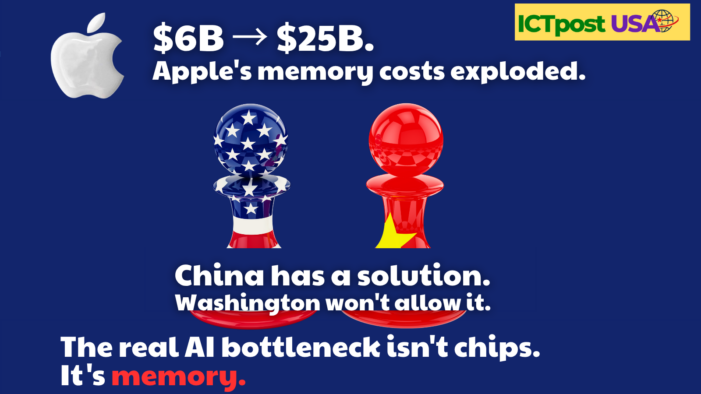
The number that frames everything: Apple is expected to spend about $25 billion this year on NAND flash — the storage chips in every iPhone — to buy roughly the same volume that cost it about $6 billion in 2025, according to Journal analysis of TechInsights data. That is a $19 billion increase for one category of memory, before counting DRAM.
The cause is artificial intelligence. Hyperscalers building AI data centers have outbid consumer electronics for the finite output of Samsung, SK hynix and Micron, who together control more than 90% of DRAM. Those suppliers have redirected fab capacity to the high-bandwidth memory that sits beside Nvidia’s accelerators, where margins run far higher. Micron’s fiscal third-quarter revenue more than quadrupled to $41.5 billion at an 84.9% gross margin. SK hynix told investors in October that the shortfall could last until 2030.
The shift lands on Apple’s bill of materials with unusual force. TrendForce estimates memory’s share of iPhone Pro component costs rose from roughly 10% a year ago to 34% in the third quarter, and expects it to exceed 40% in the first half of 2027. Apple raised prices across Macs, iPads and the Vision Pro in June, and on iPhones in September. It has guided December-quarter gross margin to 45–46%, down from 47.9%, and attributed the decline to memory. Citi estimates a 140-basis-point margin headwind for the calendar year. Apple’s inventory has ballooned to $14.5 billion from $5.7 billion as it buys ahead, and its manufacturing purchase commitments rose $33 billion in a single quarter.
A company that built its margins by squeezing suppliers is now being squeezed by them. That is why it went looking for a fourth supplier, and found one in a city most Americans could not place on a map.
The firewall that didn’t hold
ChangXin Memory Technologies, or CXMT, makes commodity DRAM in Hefei, Anhui province — roughly 10% of global output and climbing. Its counterpart in NAND, Yangtze Memory Technologies, or YMTC, operates from Wuhan. Both are creatures of Beijing’s industrial policy: state entities held more than 35% of CXMT before its Shanghai listing, and the company ran years of state-funded losses before the shortage pushed it into profit.
The Financial Times reported on June 27 that Apple was lobbying federal agencies for clearance to buy CXMT chips, and that Cook had raised it personally with Treasury Secretary Scott Bessent. By July the Journal reported Apple was testing CXMT memory across iPhones and MacBooks — and that HP and Acer were already shipping it in laptops sold outside the United States.
Apple’s pitch was a geographic firewall: Chinese chips only in devices sold in China, freeing Korean and American supply for everyone else. Chief Operating Officer Sabih Khan argued that memory involves little customization, so Apple could buy standard parts without sharing design secrets.
Congress took one sentence to dismantle it. On July 29, Senators Chuck Schumer and Jim Banks led a bipartisan letter demanding Apple commit by August 21 to never using CXMT or YMTC chips in any product worldwide. The China-only limit “cannot be expected to hold,” they wrote, “because once a part clears qualification for Apple production, extending it worldwide is a single procurement decision away.” The House Select Committee on China separately urged Lutnick to put CXMT on the Entity List outright.
Indiana is not an incidental signatory. Micron is building a fab there and has lobbied the administration from the opposite side of the table. The security argument and the commercial argument for blocking Apple point the same way, and they are made by the same senators. Apple has not publicly answered the deadline.
Governance by disapproval
Here is the detail that makes this stranger than the headlines: Apple is not legally barred from buying these chips.
CXMT sits on the Pentagon’s 1260H list of Chinese military companies, which bars Defense contracting and carries reputational cost but does not prohibit commercial purchases. YMTC’s Entity List designation restricts exports to the company, not purchases from it. Export-control lawyers have said Apple could buy off-the-shelf CXMT parts tomorrow.
What Apple wanted was not permission but insurance — an assurance that Commerce would not add CXMT to the Entity List mid-contract and sever a supply line it had spent months qualifying. No administration will give that assurance, and this one has said so in print. The result is a standoff conducted entirely in the gray zone, where Washington cannot forbid what it disapproves of but can make proceeding ruinously risky.
The precedent is 2022, when Apple planned to put YMTC flash in the iPhone 14. Schumer and Tom Cotton objected, sanctions legislation was introduced, Apple shelved the plan, and YMTC landed on the Entity List two months later. That playbook worked because Apple could afford to walk away. Memory was cheap and the supplier marginal. Neither is true now.
Ternus holds the line, and hedges
Cook became executive chairman on September 1, with policymaker relationships explicitly in his remit. His successor, John Ternus, inherited the problem and made it his own. “The constraints in memory are absolutely a crisis,” he told Time in an interview published October 15. Asked about Chinese chips: “Our fundamental belief is that all options should be on the table.” He added he had met administration officials “to make sure we’re working together.”
It is a striking stance for a new CEO’s first month — not a retreat, but a public refusal to abandon the option two months after the Commerce Secretary said “plainly” that he should.
What Apple has done, though, is more telling. The company that historically preferred short contracts and hard bargaining has signed a supplier-friendly long-term DRAM deal with SK hynix and is close to a four-to-five-year agreement with Samsung beginning in 2027, with volumes guaranteed and prices set later by the market. Those are the actions of a company that has concluded Washington will not relent — and that the Korean suppliers know it.
The leverage that was never there
CXMT’s real value to Apple was arguably never the chips but the threat of them: a credible fourth supplier to wave at Samsung, SK hynix and Micron. Korean trade reports in August suggested that threat was hollow — Apple sought a below-market quote and CXMT, with capacity locked up by Huawei, Xiaomi, ByteDance and Tencent through 2027, declined to discount. CXMT’s shares rose roughly 500% on their Shanghai debut. A company whose stock quintuples in a day does not need Apple’s business badly enough to cut prices for it.
Meanwhile CXMT has become a threat to American memory makers regardless of Apple. When its president announced a denser DDR5 server module in October, Micron fell nearly 4% in a day. The senators feared Apple’s imprimatur would legitimize CXMT globally. The market has already done that.
What this means
For Apple, the outcome is the worst of both worlds. It has absorbed the political cost of courting Chinese suppliers and captured none of the commercial benefit. Its memory bill is up by tens of billions, its contracts are being written on suppliers’ terms, and price increases have become a quarterly ritual.
For Washington, the episode exposes the limits of governance by disapproval. The administration has a view and a podium but no rule — perhaps because a formal ban on Chinese commodity memory would ensnare HP, Acer and dozens of smaller American firms already buying it. Pressuring the biggest company is easier than writing a law that binds everyone.
For investors, the fact that matters most is the one SK hynix stated plainly: this could run to 2030. The AI buildout is not just consuming power and capital. It is consuming the ordinary inputs of the consumer-electronics industry — and the political system has not decided whether relieving that pressure or containing China matters more.
Apple spent twenty years reducing its dependence on China. It may now discover that the fastest way out of a memory shortage still runs through China — and that Washington is no longer willing to let the market decide. editor@ictpost.com
Sources
- Lutnick interview, via 9to5Mac/WSJ · Houston event details, The Next Web
- Apple NAND spend $6B→$25B, WSJ/TechInsights via 24/7 Wall St.
- iPhone Pro memory BOM share, TrendForce; Samsung deal · MacRumors on Samsung deal
- Gross margin guidance, inventory, Citi estimate, $33B commitments · Apple FY2026 10-K
- Micron results, Forbes
- Schumer-Banks letter · House Select Committee letter, via FT · 2022 Cotton/Gallagher bill
- Apple testing CXMT; HP/Acer; 1260H status, MacRumors/WSJ · Export-law view, iThinkDiff · Entity List insurance ask, via FT
- Ternus Time interview, via AppleMagazine · Earnings call, Gizmodo
- CXMT pricing standoff — secondary, unconfirmed · CXMT IPO and share, Wikipedia — verify · Micron selloff on CXMT DDR5 · SK hynix 2030 outlook — secondary