


In Loudoun County, Virginia, the industry’s next constraint isn’t silicon. It’s electrons.
By Dhirendra Pratap Singh | ICTpost USA
For years, one answer was automatic. A company wanted to build a data center in Loudoun County, Virginia — the beating heart of the world’s largest data-center market — and the answer was yes. Now, for the first time, the answer is: wait.
On September 16, the county’s Board of Supervisors voted 7-1-1 to pause new data-center applications for up to twelve months. It is a small procedural vote with an outsized meaning. In the capital of American AI infrastructure, officials are now asking the question the industry spent three years avoiding: how much more can the ground beneath this boom actually hold?
Board Chair Phyllis Randall called it a pause, not a moratorium — county counsel had warned that an indefinite freeze could be unlawful — and framed it as time to write new rules governing data centers and their impact on nearby communities. (WJLA) But the signal is bigger than the semantics. The place that said yes to every data center for a decade just said: not so fast.
That question — how much growth can the infrastructure absorb — points to something the AI industry has not fully reckoned with. The next constraint on artificial intelligence may not be chips, models, or computing capacity. It may simply be electricity.
Nine miles from the county vote, a second fight makes the same point in a different key. A proposed transmission corridor known locally as the “Golden to Mars” line is meant to connect two substations in eastern Loudoun County. Dominion Energy says it’s necessary for grid reliability. Homeowners along the route — and, according to local reporting, a school district whose land sits in the corridor — say they’re being asked to absorb the physical cost of a boom they never chose. By July, per one local station’s coverage, those homeowners had effectively lost the fight before the State Corporation Commission. (Loudoun Now; WUSA9; WSET)
These are small, local stories. But they are the clearest evidence available anywhere that the defining constraint on artificial intelligence is quietly shifting — from a question of how many advanced chips a company can buy, to a question of how much electricity a county, a state, or a national grid can physically deliver.
The Number Nobody Predicted
Three years ago, the constraint everyone worried about was semiconductors: Nvidia’s order backlog, TSMC’s fabrication capacity, export controls on advanced chips to China. That worry was not misplaced, and it hasn’t disappeared. But it has been joined — and in some corners of the industry, overtaken — by a constraint that has nothing to do with silicon and everything to do with copper wire, substations, and the physics of how much power a regional grid can move from one place to another.
Consider what has happened to Dominion Energy’s own forecasts. As of December 2024, the utility that serves Northern Virginia’s “Data Center Alley” had 40 gigawatts of data-center capacity under contract — up 88 percent from 21 gigawatts just five months earlier, in July 2024. Requests for substation engineering letters of authorization, an earlier-stage signal of coming demand, jumped from 8 gigawatts to 26 gigawatts over the same window, a 245 percent increase. (DataCenterDynamics) Dominion has since raised its five-year capital spending forecast to $50.1 billion for 2025 through 2029, up 16 percent from the prior $43.2 billion plan, and internal modeling now stretches toward as much as 70,000 megawatts of long-run demand. (Virginia Business) “What’s undeniable,” Dominion chief executive Robert Blue said in February 2025, “is that data center growth in Virginia is not slowing down. In fact, it’s accelerating.”
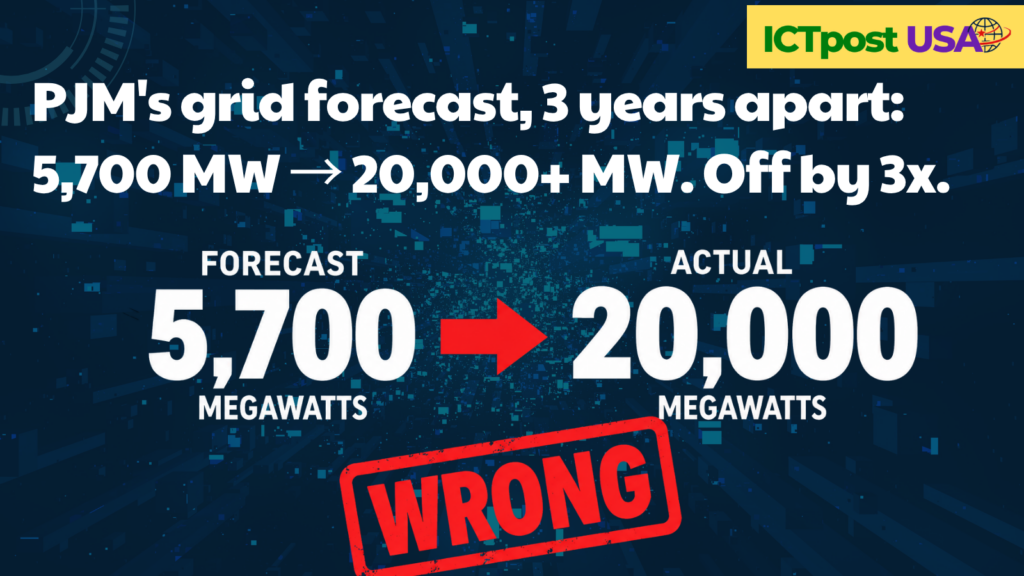
The regional grid operator, PJM Interconnection (Pennsylvania, New Jersey, and Maryland), has had to rewrite its own math even faster. Its 2022 forecast had projected roughly 5,700 megawatts of added load in the Dominion zone by 2037. Its 2025 forecast puts that figure above 20,000 megawatts from data centers alone — a more than threefold revision in three years. (IEEFA) Grid planners do not typically miss their own long-range forecasts by that margin. When they do, it usually means the thing they’re trying to measure is growing faster than the models built to measure it.
What This Is Already Costing
The infrastructure strain is not an abstraction sitting somewhere in the future. It is already visible in the price of electricity itself. PJM’s capacity auction — the mechanism by which the grid operator pays power plants to guarantee they’ll be available years in advance — cleared at $28.92 per megawatt-day for the 2024/2025 delivery year. For 2025/2026, it jumped to $269.92. For 2026/2027, it cleared at $329.17 — roughly an elevenfold increase in two auction cycles. (IEEFA) Monitoring Analytics, PJM’s own independent market monitor, attributed 63 percent of the 2025/2026 price spike directly to data-center demand, translating to roughly $9.3 billion in additional annual costs spread across ratepayers in PJM’s 13-state footprint. (IEEFA)

Those costs land on ordinary utility bills. Washington, D.C.-area Pepco customers saw average increases of roughly $21 a month starting in June 2025, with about $10 of that tied specifically to the capacity-price spike; Western Maryland customers saw about $18 a month; Ohio customers, about $16 — all changes the market monitor linked explicitly to data-center-driven demand. (IEEFA) These are not Silicon Valley abstractions. They are line items on the electric bills of people who have never used ChatGPT, arriving because a data center down the road needed the grid to guarantee it more power.
The scale of the underlying demand is global, not just regional. The International Energy Agency reported in April 2026 that global data-center electricity consumption rose 17 percent in 2025 — against roughly 3 percent growth in overall global electricity demand — with AI-focused facilities growing even faster than the data-center average. The agency projects data-center power use will roughly double by 2030, with AI-specific consumption tripling over the same period. Five major technology firms’ combined capital spending surged past $400 billion in 2025 and is expected to rise a further 75 percent in 2026. “There is no AI without energy,” said IEA Executive Director Fatih Birol, “and countries that provide secure, affordable and rapid access to electricity will be one step ahead.” (IEA)
Why Hyperscalers Are Suddenly Buying Nuclear Plants
The most striking evidence of how seriously the industry takes this constraint is what its biggest players are actually doing about it — and increasingly, the answer is: building or reviving their own power plants rather than waiting for the grid.
Microsoft struck a deal with Constellation Energy to restart Three Mile Island’s undamaged reactor unit, rebranded the Crane Clean Energy Center, under a 20-year power purchase agreement to feed Microsoft’s data centers directly. As of Bloomberg’s May 2026 reporting, the restart was on track for 2027. (World Nuclear News; Bloomberg) Amazon expanded a power-purchase arrangement with Talen Energy for 1.9 to 1.92 gigawatts of behind-the-meter nuclear power from the Susquehanna plant to feed AWS data centers directly — an $18 billion deal structure that had to be restructured after federal regulators initially rejected an earlier version of the interconnection arrangement. (PowerMag; Utility Dive) And in January 2026, Meta signed deals with three separate nuclear energy companies for more than 6 gigawatts of power to feed its “Prometheus” AI supercluster. (TechCrunch; CNBC)
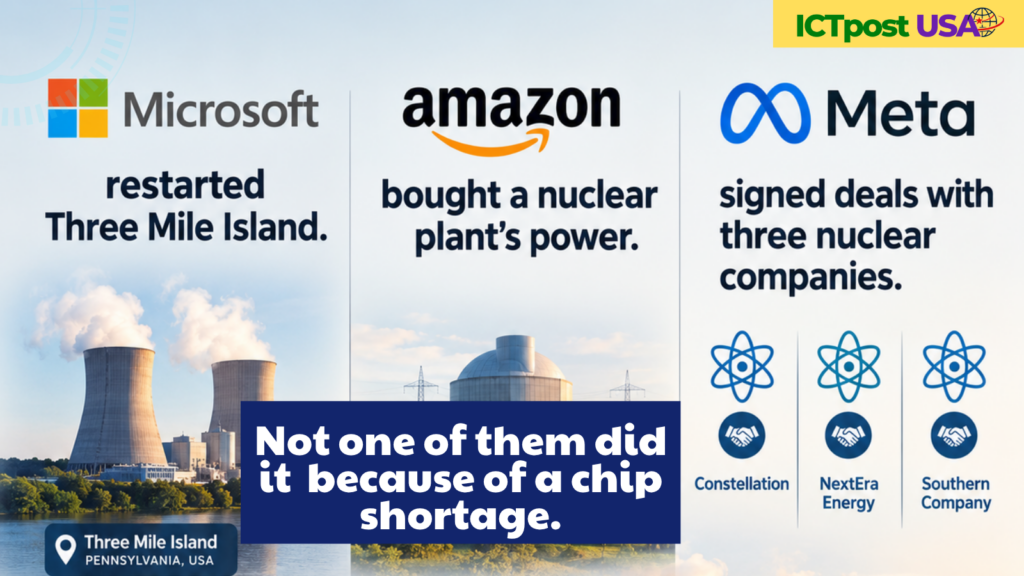
None of these are the moves of companies confident that the public grid will simply keep pace with their ambitions. They are the moves of companies that have concluded the grid won’t — and that owning or contracting for dedicated generation is now a more reliable path to computing capacity than waiting in line for a utility interconnection. It is a remarkable reversal for an industry that, in the cloud-computing era, built its entire value proposition on renting infrastructure rather than owning it.
The Bottleneck Behind the Bottleneck
None of this diminishes the importance of advanced chips — Nvidia’s position at the center of AI infrastructure spending remains real, and the financing arrangements built around chip supply carry their own risks. But it increasingly looks like a mistake to treat semiconductor supply as the binding constraint on how fast artificial intelligence can scale. A hyperscaler can, in principle, buy as many advanced chips as it can finance. It cannot, in the same way, simply purchase a faster interconnection queue, a new high-voltage transmission corridor, or a county government willing to approve construction on the timeline its investors expect.
That distinction matters enormously for where investment capital should logically flow next. The first phase of the AI boom rewarded the companies that could design the most capable models and the chips to run them. The next phase may reward, just as richly, the utilities, transmission-engineering firms, nuclear operators, and grid-technology companies capable of actually delivering the electrons those chips require — sectors that have historically attracted far less attention from technology investors than they may be about to receive.
It also raises a harder question that Loudoun County’s supervisors, whether they intended to or not, put directly on the table: who bears the cost of a boom concentrated in a handful of physical places? The data-center industry’s revenue accrues to a small number of very large technology companies. The transmission lines, the substation upgrades, and the higher capacity prices land on regional ratepayers and the communities living beside the new infrastructure. Reconciling that mismatch — between where AI’s financial returns are captured and where its physical costs are borne — may prove to be a more consequential policy fight over the next several years than any debate about chip export controls.
The industry has spent three years treating computing power as the scarce resource that would determine the pace of the AI age. Northern Virginia is a preview of a different possibility: that the scarce resource was never computing power. It was power, period.
editor@ictpost.com
Follow author on LinkedIn , YouTube and X.

The author Dhirendra Pratap Singh works at the intersection of Artificial Intelligence, the digital economy, public policy, and emerging technologies, exploring how technological revolutions are reshaping societies, governance systems, and global power structures. His work focuses on interpreting complex technological shifts—from AI and digital public infrastructure to technology geopolitics—and translating them into actionable insights for policymakers, institutions, and industry leaders navigating a rapidly evolving global technology landscape.
Frequently Asked Questions: The AI Power Bottleneck
Why are AI companies buying nuclear power plants?
Hyperscalers like Microsoft, Amazon, and Meta are securing dedicated nuclear power because the public electric grid can’t guarantee the electricity their AI data centers need fast enough. Microsoft struck a 20-year deal to restart Three Mile Island’s Crane Clean Energy Center; Amazon expanded an $18 billion nuclear power arrangement with Talen Energy; and Meta signed deals with three nuclear companies for over 6 gigawatts of power for its “Prometheus” AI supercluster.
Is the AI industry’s biggest bottleneck chips or electricity?
Increasingly, it’s electricity. Companies can buy as many advanced chips as they can finance, but they can’t buy a faster grid interconnection, a new transmission line, or faster local government approval. Data-center power demand forecasts in Northern Virginia have tripled in three years, outpacing what utilities and grid operators originally planned for.
Why did Loudoun County pause new data centers?
On September 16, 2026, Loudoun County’s Board of Supervisors voted 7-1-1 to temporarily suspend new data-center applications for up to 12 months, giving officials time to write new rules addressing the strain data centers place on the local power grid and nearby communities.
How much has AI data-center demand raised electricity prices?
PJM Interconnection’s capacity auction price rose from $28.92 per megawatt-day in 2024/2025 to $329.17 in 2026/2027 — roughly an 11-fold increase. PJM’s independent market monitor attributes 63% of the most recent spike to data-center demand, adding an estimated $9.3 billion in annual costs across its 13-state region.
Are ordinary consumers paying for AI’s power demand?
Yes. Utility customers in the Washington, D.C. area, Maryland, and Ohio have seen monthly bill increases of $16–21 that regulators have tied directly to data-center-driven capacity price increases — costs borne by people who may never use an AI product themselves.