
Inside the Utah Revolt That Could Redefine the Future of Artificial Intelligence
By Dhirendra Pratap Singh, ICTpost USA Investigations Team
With Bureau Reports
“The future of Artificial Intelligence may not be decided inside Silicon Valley. It may be decided in the deserts of Utah.”
The road through Utah’s Box Elder County stretches for miles beneath an endless blue sky. Sagebrush bends in the desert wind. Ranches sit quietly against distant mountain ranges. Water is precious here. Every drop matters.
It is an unlikely place to witness one of the defining battles of the Artificial Intelligence era. Yet this quiet corner of America has become the center of a national conversation about how, and whether, the AI revolution can expand without overwhelming the communities and natural resources that support it.
In early 2026, a proposal emerged for what was billed as one of the world’s largest AI data center campuses: the Stratos Project. Backed by investor Kevin O’Leary and facilitated through Utah’s Military Installation Development Authority (MIDA), the original plan envisioned roughly 40,000 acres in Hansel Valley and power capacity approaching 9 gigawatts, more than double Utah’s current peak electricity demand.
Supporters viewed the project as a catalyst for economic growth, high-skilled jobs, and critical infrastructure for American AI leadership and national security. Critics saw unprecedented demands on electricity, water, air quality, and local democratic oversight in an already drought-stressed region near the shrinking Great Salt Lake.
What began as a local land-use dispute quickly evolved into something much larger.
The New Equation
For decades, the technology industry operated on a straightforward formula:
More chips = More computing power = Better AI
That equation is no longer sufficient.
Today, AI leadership increasingly depends on six interconnected factors:
AI Leadership = Chips + Compute + Talent + Data + Energy + Public Trust
The first four are familiar. The last two have become decisive. Without reliable energy, advanced chips sit idle. Without public trust, even the most ambitious projects face delays, redesigns, legal challenges, and political backlash.
Utah has forced the industry and policymakers to confront this new reality.
Scale-Back, Pause, and Political Fallout
The Stratos story changed dramatically after its rapid approvals during April and May 2026.
Facing growing public opposition, legal challenges, and pressure from state leaders, Kevin O’Leary agreed in June 2026 to substantially reduce the project’s footprint. Approximately 20,000 acres were removed from the original proposal, including sensitive areas near Locomotive Springs. While still significant in scale, the project would no longer be the world’s largest data center campus. Initial power requirements were also reduced, with early phases expected to require between 1 and 1.5 gigawatts.
Political consequences followed.
In Utah’s June 2026 Republican primary, longtime Senate President J. Stuart Adams, who also chaired the MIDA board that advanced the project, lost his seat in an upset widely linked to voter dissatisfaction surrounding the development. Several local officials also faced mounting political backlash.
In late July 2026, MIDA formally paused work on the project, citing respect for the referendum process and ongoing litigation.
Several legal challenges remain active. The Box Elder Accountability Referendum (BEAR) group is contesting the rejection of citizen referendum petitions, while the Alliance for a Better Utah has filed a separate lawsuit challenging MIDA’s authority and approval process. Box Elder County and O’Leary’s company have sought dismissal of parts of the litigation.
Despite the pause, O’Leary has stated that project planning and design work continue. His team intends to submit revised water permit applications, while emphasizing that no construction has yet begun and that environmental reviews and permitting processes remain outstanding.
Water-right applications filed earlier in 2026 were withdrawn following thousands of public objections. Developers have indicated they will refile with expanded hydrological analysis. Current plans rely initially on on-site natural gas generation, although Utah Governor Spencer Cox has publicly advocated for incorporating cleaner energy sources in later phases, including nuclear, geothermal, and solar energy.
Stratos Project: Then and Now
| Original Plan | Revised Plan |
|---|---|
| 40,000 Acres | ~20,000 Acres |
| Up to 9 GW Power | 1-1.5 GW Initial Phase |
| World’s Largest | Significantly Reduced |
| Full Development Proposal | Project Under Pause |
Three Resources Every AI Model Depends On
Every interaction with AI appears effortless.
A user enters a prompt.
Seconds later, a response appears.
What remains invisible is the vast infrastructure that powers that exchange.
Electricity
Training and operating advanced AI systems requires enormous amounts of electricity. As AI adoption expands across healthcare, finance, manufacturing, education, research, defense, and government, utilities are preparing for sustained increases in power demand.
Data centers are expected to become one of the fastest-growing categories of energy consumption during the coming decade.
Water
Heat is the unavoidable byproduct of intensive computing.
Keeping thousands of processors operating safely requires advanced cooling systems. Depending on location and technology, water plays a critical role in that process.
Efficient water management is therefore becoming increasingly important, particularly across the water-stressed American West.
Land
Unlike software, AI infrastructure occupies physical space.
Large-scale data centers require extensive land, transmission infrastructure, transportation access, and proximity to reliable energy supplies.
Communities become stakeholders in every major AI investment.
The question is no longer simply where companies can build.
It is where communities are willing to host them.
Why Utah Became a National Story
The Stratos project attracted national attention not simply because of its size, but because it exposed a growing challenge facing the United States.
Supporters argued that developments of this magnitude are essential to maintaining America’s leadership in Artificial Intelligence, strengthening domestic computing capacity, and creating long-term economic opportunity.
Critics raised different questions:
- Will local water resources remain protected?
- Can the electric grid absorb additional demand without increasing costs for households?
- Will environmental safeguards keep pace with rapid technological expansion?
These are not anti-technology questions.
They are public policy questions.
As the debate intensified, it evolved into a broader national conversation:
- How should America balance innovation with sustainability?
- How can communities participate meaningfully in decisions that reshape their future?
- How can AI infrastructure expand while maintaining public trust?
The Utah conversation is increasingly becoming the American conversation.
The Birth of America’s AI Environmental Movement
Every transformative technology eventually reaches a defining moment.
The automobile led to highway safety standards.
Nuclear energy created entirely new regulatory frameworks.
Social media sparked global debates over privacy, misinformation, and digital rights.
Artificial Intelligence is now entering its own defining chapter.
Not inside a research laboratory.
Not inside a corporate boardroom.
But within the communities where AI infrastructure is being built.
Utah represents one of the clearest signals that America has entered a new phase of the AI revolution, one in which citizens are asking not whether AI should advance, but how it should advance responsibly.
This is not a movement against Artificial Intelligence.
It is a movement for accountability.
The Fourth Resource: Public Trust
Technology companies often describe AI through the language of computation: processors, algorithms, training models, and inference engines.
Communities view the same developments through a different lens, focusing on quality of life, reliable utilities, responsible development, transparency, and stewardship of local resources.
Neither perspective is wrong.
Both are essential to understanding the future of AI.
The challenge for policymakers, businesses, regulators, and community leaders is finding a framework where innovation and responsibility advance together.
As AI infrastructure expands, engineering excellence alone will not determine success.
Equally important will be the ability to earn and sustain public confidence.
In the emerging AI economy, public trust is becoming as strategic and valuable as computing power itself.
Innovation and Stewardship Can Coexist
The debate surrounding AI infrastructure is often framed as a choice between technological progress and environmental responsibility.
That is a false choice.
America has repeatedly demonstrated its ability to lead both innovation and environmental advancement.
The next generation of AI facilities is expected to incorporate:
- Renewable and low-carbon energy sources
- Closed-loop and recycled-water cooling systems
- Advanced liquid and immersion cooling technologies
- AI-driven energy optimization
- Waste-heat recovery systems
- Smarter grid integration
These innovations are not obstacles to AI.
They may become its greatest competitive advantages.
Organizations that reduce resource consumption while maintaining performance can lower costs, improve resilience, and strengthen public support.
Sustainability is evolving from a compliance requirement into a strategic business imperative.

Dr. Khalid Moidu, a U.S.-based healthcare professional and medical informatics expert, believes the debate around AI infrastructure extends far beyond technology.
Dr. Moidu says, “Artificial Intelligence is becoming essential infrastructure for healthcare, scientific discovery, and economic growth. As AI scales, sustainability must become part of every infrastructure decision, not as an obstacle to innovation, but as a requirement for long-term success. The future of AI will be measured not only by computational power, but by how responsibly we manage energy, water, and environmental resources.”
His perspective reflects a growing consensus across sectors: AI infrastructure is no longer merely an engineering challenge.
It is also an environmental, public-health, economic, and societal challenge.
The Next AI Race
Artificial Intelligence has always been shaped by competition.
The first race was for better algorithms.
The second was for larger datasets.
The third was for faster chips.
Now the world is entering a very different contest:
The race to build sustainable intelligence.
This competition will not be measured solely by FLOPS, GPUs, or model parameters.
It will also be measured by:
- Megawatts
- Water efficiency
- Grid resilience
- Carbon intensity
- Community trust
The organizations and nations that solve these challenges will define the next era of AI leadership.
The AI Infrastructure Revolution
Global investment in AI infrastructure has accelerated at historic speed.
Technology companies are investing hundreds of billions of dollars in data centers, semiconductor manufacturing, fiber networks, energy systems, and supporting infrastructure.
For decades, software was viewed as weightless.
Artificial Intelligence has changed that perception.
AI is becoming one of the most infrastructure-intensive industries in modern history.
Every large language model depends on an ecosystem of electricity, cooling systems, network connectivity, specialized talent, and facilities operating around the clock.
The cloud now has a visible footprint.
And communities increasingly understand its scale.
A New Generation of Data Centers
The AI data center of 2035 is likely to look very different from today’s facilities.
Future campuses will prioritize efficiency, resilience, and environmental performance rather than simply consuming more resources.
Industry innovations already under exploration include:
- Advanced liquid and immersion cooling
- Closed-loop water recycling systems
- Small modular nuclear reactors
- Renewable energy integration
- AI-powered energy management
- Waste-heat recovery technologies
- Carbon-aware computing
The next competitive advantage may not belong to the company with the largest GPU fleet.
It may belong to the company that operates it most efficiently.
Beyond Protest
The Utah debate should not be viewed as a victory for one side or a defeat for another.
It is better understood as the beginning of a more mature conversation.
Communities want transparency.
Technology companies seek certainty.
Governments seek economic growth.
Environmental experts seek responsible stewardship.
These objectives do not have to conflict.
The future of AI depends on finding common ground among them.
An American Conversation
The United States has led every major computing revolution of the past half-century.
From personal computers to the internet.
From cloud computing to generative AI.
American innovation has repeatedly transformed the world.
The next chapter of that leadership may depend on something different.
Not simply building faster.
But building smarter.
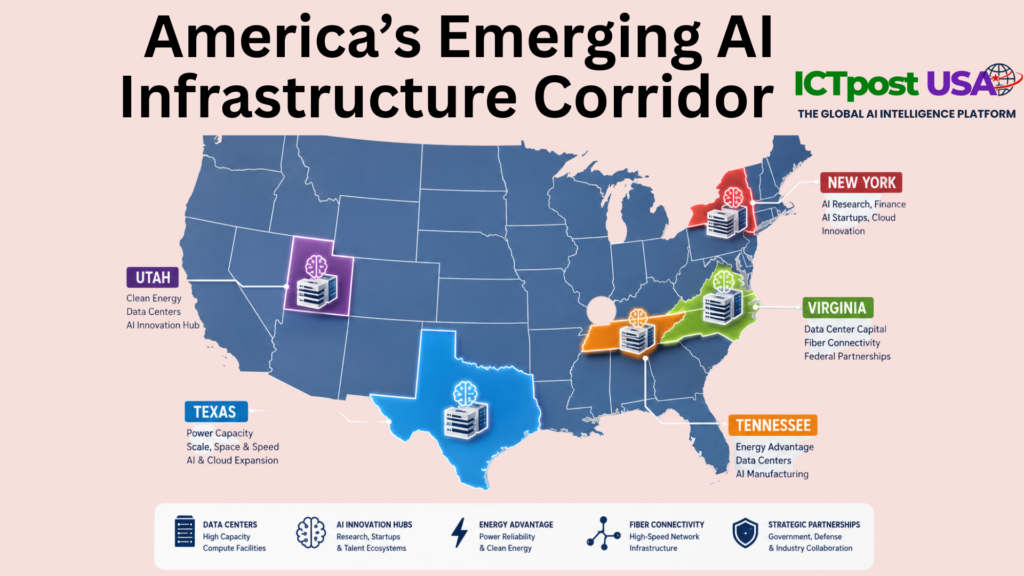
The conversations emerging in Utah, Virginia, Texas, Tennessee, New York, and other states reflect the strength of an open society where communities, businesses, researchers, and public officials collectively shape the future of technology.
Innovation is strongest when it earns public confidence.
Artificial Intelligence is no longer only a technology story.
It is an energy story. A water story. An infrastructure story. A public-policy story. A community story. And ultimately, a human story.
The debate unfolding in Utah is not the end of the AI revolution. It is the beginning of its next chapter. History may remember this period not as the moment America questioned Artificial Intelligence, but as the moment it began asking a far more important question:
How should AI grow responsibly?
The answer may help define the twenty-first century. The future of Artificial Intelligence will not belong to those who simply build the largest data centers. It will belong to those who earn the confidence of the communities that power them. editor@ictpost.com
Follow author on LinkedIn and X.

The author Dhirendra Pratap Singh works at the intersection of Artificial Intelligence, the digital economy, public policy, and emerging technologies, exploring how technological revolutions are reshaping societies, governance systems, and global power structures. His work focuses on interpreting complex technological shifts—from AI and digital public infrastructure to technology geopolitics—and translating them into actionable insights for policymakers, institutions, and industry leaders navigating a rapidly evolving global technology landscape.