
By 2030, Artificial Intelligence could redefine global power more profoundly than oil, nuclear weapons, or even the internet.
By Dhirendra Pratap Singh | ICTpost USA
(With Bureau Reports from Washington DC, New Delhi and Beijing, and research inputs from global technology, policy and industry sources.)
Executive Summary
- Artificial Intelligence is emerging as a new source of geopolitical power, with PwC estimating it could contribute up to $15.7 trillion to the global economy by 2030, making it one of the largest economic transformations in modern history. [pwc.co.nz], [pwc.com]
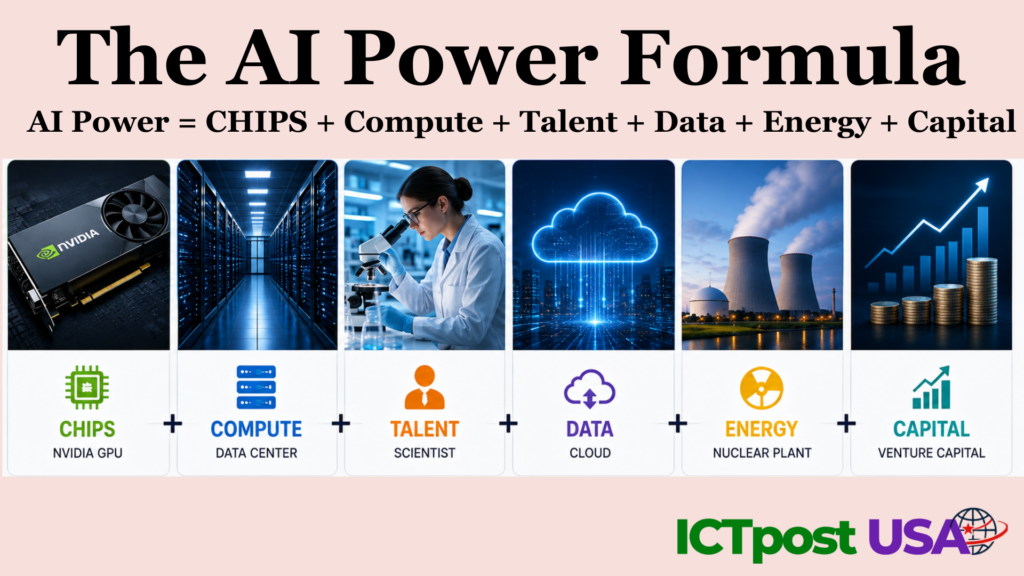
- The global AI race is no longer just about algorithms. ICTpost’s analysis identifies five pillars of AI power: compute, energy, talent, capital, and deployment. Nations that combine all five will enjoy the strongest long-term advantage.
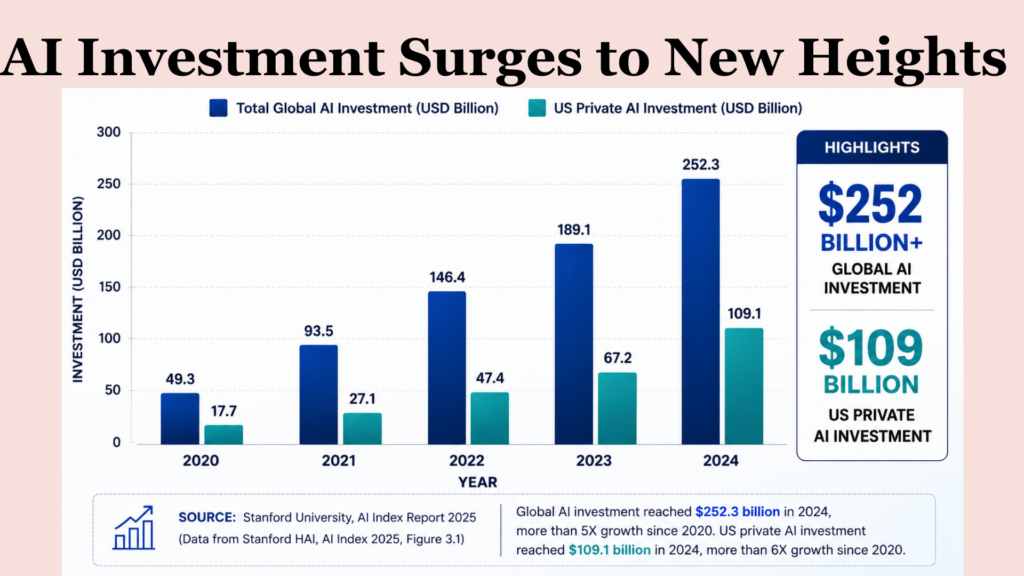
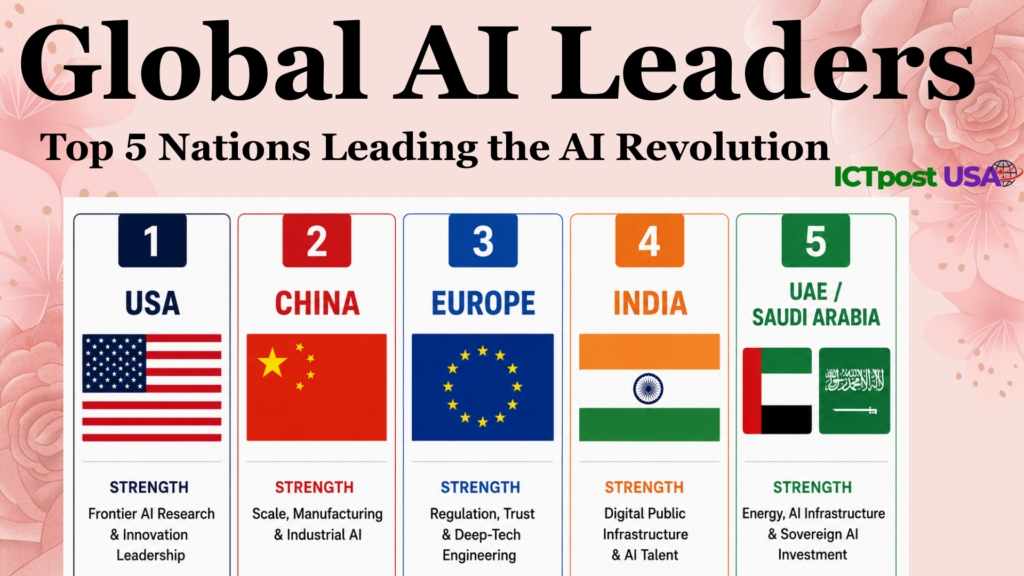
- The United States remains the innovation leader, driven by frontier AI research, venture capital, hyperscale cloud platforms, and companies such as OpenAI, Microsoft, Google, NVIDIA, Anthropic, Meta, and Amazon. U.S. private AI investment reached $109.1 billion in 2024. [hai.stanford.edu], [hai.stanford.edu]
- China is the strongest challenger, leveraging scale, industrial deployment, manufacturing strength, robotics leadership, and state-backed investments. Chinese AI models have rapidly narrowed the performance gap with their Western counterparts. [hai.stanford.edu], [businesswire.com]
- India’s biggest opportunity lies in “AI for Billions.” Supported by IndiaAI Mission, India Stack, Aadhaar, UPI, ONDC, and a vast talent base, India has the potential to become a global leader in population-scale AI adoption and digital inclusion.
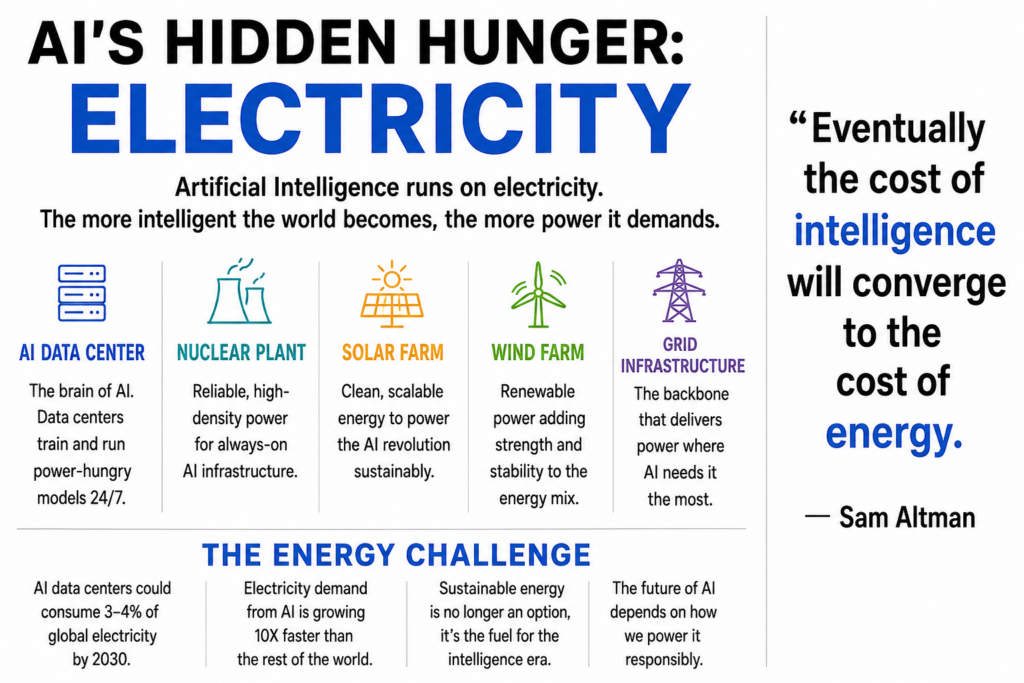
- Energy may ultimately determine AI leadership. Global data-center electricity consumption is projected to approach 950 TWh by 2030, making power generation, grid infrastructure, and energy security as strategically important as semiconductors and software. [theguardian.com]
- The future AI order is likely to be multipolar rather than winner-takes-all. The United States may lead innovation, China deployment, Europe governance, the Middle East energy infrastructure, and India large-scale implementation.
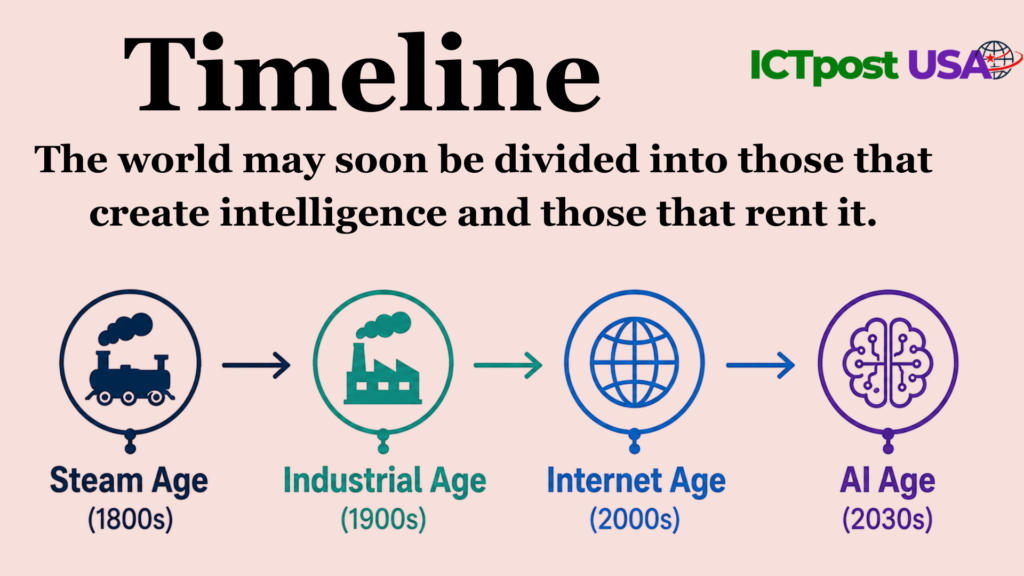
- The defining divide of the next decade may not be between developed and developing economies, but between nations that create intelligence and those that depend on intelligence created elsewhere.
Key Takeaway
The AI race is no longer simply a technology competition. It is a contest for economic leadership, energy security, semiconductor dominance, digital sovereignty, and geopolitical influence in the twenty-first century.
For more than a century, nations measured power through territory, industrial output, military strength, energy resources, and economic scale.
Today a new metric is emerging.
Intelligence.
Not human intelligence alone, but machine intelligence.
Artificial Intelligence has become the first technology in history capable of amplifying nearly every other form of national power simultaneously. It can accelerate scientific discovery, enhance military capabilities, improve healthcare outcomes, optimize industrial production, reshape financial systems, transform education, and influence public decision-making.
This is why governments around the world are investing at unprecedented scale.
According to PwC, AI could contribute up to $15.7 trillion to the global economy by 2030, while Stanford University’s 2025 AI Index reports that global corporate investment in AI reached $252.3 billion in 2024, with U.S. private investment alone climbing to $109.1 billion. [pwc.co.nz], [hai.stanford.edu], [hai.stanford.edu]
Yet economics may be only part of the story.
The larger question is geopolitical.
Who will control the intelligence infrastructure of the 21st century?
Why This Race Is Different From Every Previous Technology Race
History offers many examples of transformative technologies.
Steam engines drove industrial empires.
Electricity transformed manufacturing.
Nuclear technology altered military strategy.
The internet created digital giants.
Artificial Intelligence is fundamentally different because it acts as a force multiplier across all sectors simultaneously.
A powerful AI ecosystem improves productivity, accelerates research, strengthens defense capabilities, and creates new economic opportunities.
As NVIDIA CEO Jensen Huang recently observed: “AI is now infrastructure, just like electricity and the internet.” [blogs.nvidia.com]
That statement may prove as historically important as saying electricity was infrastructure in the early 1900s.
The nations building AI infrastructure today may enjoy strategic advantages for decades.
The Five Pillars of AI Power
Most discussions about the global AI race focus almost entirely on foundation models and breakthrough applications. That approach overlooks a more important reality. AI leadership is not determined by algorithms alone. Long-term success will depend on five interconnected pillars working together: compute, energy, talent, capital, and deployment.
Compute forms the foundation of modern AI and reflects a nation’s access to advanced GPUs, semiconductor technologies, and large-scale computing infrastructure required to train and operate sophisticated AI systems. Energy is equally critical because the most advanced AI models depend on massive data centers that consume vast amounts of electricity. As AI capabilities expand, access to abundant, reliable, and affordable power is becoming a strategic advantage in its own right.
Talent remains another decisive factor. Every major breakthrough begins with researchers, engineers, scientists, and entrepreneurs capable of transforming ideas into real-world innovations. Without world-class talent, even the most advanced infrastructure cannot generate sustained technological leadership. Capital is the fourth pillar, providing the financial resources needed to build semiconductor plants, data centers, research laboratories, and long-term AI ecosystems that often require years of investment before producing returns.
The fifth pillar is deployment, which is frequently underestimated. Building powerful AI systems is only part of the challenge. The real economic value emerges when AI is successfully integrated into healthcare, manufacturing, agriculture, finance, education, transportation, public services, and other sectors of the economy. Nations that can deploy AI effectively at scale often gain advantages that extend far beyond research laboratories.
Many countries excel in one or two of these areas. Some possess abundant capital but lack talent. Others have strong research communities but limited computing infrastructure. A few enjoy energy advantages yet struggle with large-scale deployment. Very few nations combine all five pillars into a cohesive ecosystem. In the long run, that distinction may determine which countries become true AI superpowers and which remain dependent on technologies developed elsewhere.
The United States: The Innovation Leader
The United States remains the world’s AI innovation center.
OpenAI, Microsoft, Google DeepMind, Anthropic, NVIDIA, Meta, Amazon and dozens of startups collectively represent the strongest AI ecosystem ever assembled.
Stanford’s 2025 AI Index found that U.S.-based institutions produced 40 notable AI models in 2024, far ahead of any other country. [hai.stanford.edu], [businesswire.com]
America’s biggest strength is not capital or compute. It is innovation velocity.
The ability to move from research paper to global deployment faster than competitors remains a uniquely American advantage.
However, leadership is not guaranteed. The next frontier may depend less on algorithms and more on electricity.
China: Scale, Efficiency, and State-Led Strategy
While the United States continues to lead through private-sector innovation and venture-capital-driven entrepreneurship, China is pursuing a fundamentally different path built on scale, efficiency, and state-led strategic coordination.
According to the Stanford AI Index, the performance gap between leading American and Chinese AI models has narrowed dramatically in recent years. What was once a double-digit advantage for U.S. models has shrunk significantly as Chinese developers rapidly improve model quality, efficiency, and deployment capabilities. Chinese models such as DeepSeek, Alibaba’s Qwen, and offerings from ByteDance have demonstrated increasingly competitive performance across major benchmarks, particularly in cost efficiency and large-scale deployment. [hai.stanford.edu], [businesswire.com]
China has also established itself as a global leader in AI research output, scientific publications, citations, and patent activity. Its dominance extends beyond software into industrial implementation. Nowhere is this more visible than in robotics and smart manufacturing, where China accounts for more than half of global industrial robot installations and continues to integrate AI across factories, logistics networks, transportation systems, and smart-city initiatives. [hai.stanford.edu]
Yet China faces a critical constraint. Despite remarkable progress in AI applications and model development, access to advanced semiconductors remains its most significant challenge. U.S. export controls have accelerated China’s push for technological self-reliance, prompting massive investments in domestic chip manufacturing, AI hardware, and semiconductor research. Chinese companies such as Huawei are expanding production of indigenous AI processors, while the broader ecosystem is working to reduce dependence on foreign technology. However, gaps remain in areas such as advanced chip manufacturing, high-bandwidth memory, and next-generation packaging technologies.
As a result, China is increasingly pursuing what many analysts describe as a “good-enough” strategy. Rather than focusing exclusively on building the most powerful frontier models, Chinese companies are emphasizing system-level optimization, cost efficiency, deployment at scale, and practical applications. The objective is not simply to match the most advanced systems in the world but to create AI that is affordable, accessible, and deployable across industries and national infrastructure.
China’s strengths lie in scale, execution, industrial integration, robotics, manufacturing, and increasingly competitive open-weight models. Its challenges are concentrated in advanced computing infrastructure, semiconductor independence, and questions surrounding transparency and international trust. As the global AI race evolves, the competition is no longer defined solely by model performance. It is increasingly shaped by cost, energy efficiency, infrastructure resilience, and sovereign control over critical technologies. In that broader contest, China has positioned itself as a formidable and increasingly sophisticated challenger to American AI leadership.
India: The Power of Scale, Digital Public Infrastructure, and Real-World Applications
India may currently trail the United States and China in the race to build frontier AI models, but its most significant strengths lie elsewhere. Rather than competing solely on model size or cutting-edge research, India is positioning itself around scale, digital infrastructure, and the ability to deploy AI across one of the world’s largest and most diverse populations.
Through the IndiaAI Mission, backed by an investment of approximately ₹10,372 crore, the country is building a shared computing infrastructure with more than 45,000 GPUs to support researchers, startups, and enterprises. The initiative is also supporting multiple indigenous AI model proposals while establishing governance frameworks designed to encourage responsible and inclusive AI development.
At the same time, India is strengthening its semiconductor ambitions. Under the India Semiconductor Mission, government-approved projects represent investments of roughly ₹1.64 lakh crore, including semiconductor fabrication facilities, compound semiconductor plants, and advanced packaging units. The next phase of the strategy increasingly focuses on building capabilities across the semiconductor value chain, including equipment, materials, design intellectual property, and ecosystem development.
India’s greatest competitive advantage, however, is its digital public infrastructure. Platforms such as Aadhaar, UPI, DigiLocker, ONDC, and India Stack have already demonstrated how technology can be deployed at population scale. Combined with one of the world’s largest pools of software engineers and technology professionals, these platforms provide a foundation for the large-scale adoption of AI across healthcare, agriculture, education, financial inclusion, public services, and governance.
This creates an opportunity that is fundamentally different from the approaches pursued by either the United States or China. While others compete to build the most powerful models, India has the potential to become the global leader in applying AI to improve the lives of billions of people. In many ways, India’s opportunity is not simply “AI for enterprises” or “AI for governments,” but “AI for billions.”
The challenges, however, are equally clear. Private AI investment in India remains modest compared with the world’s leading AI economies. Advanced semiconductor manufacturing is still in its early stages, and frontier AI research requires significantly greater levels of funding, computing capacity, and international collaboration. Bridging the gap between policy ambitions and execution will also be critical for sustaining momentum over the coming decade.
Yet India’s position in the global AI race should not be underestimated. If the country can successfully combine its strengths in talent, trusted digital infrastructure, affordable computing, and large-scale deployment, it could emerge as one of the world’s most important centers for applied and inclusive AI. The future leaders of the AI era will not be defined solely by who builds the largest models, but also by who creates the greatest real-world impact. On that measure, India may possess one of the most compelling opportunities of all.
The Great Misconception: Compute Alone Will Not Decide the Winner
A growing narrative suggests that whoever owns the most GPUs wins. Reality is more complicated. Compute matters enormously.
But history shows infrastructure alone rarely determines leadership.
Britain had coal. America had oil. Yet innovation ecosystems ultimately converted resources into power.
Similarly, AI leadership will require:
- Chips
- Software
- Talent
- Institutions
- Entrepreneurs
- Regulation
- Industry adoption
An AI superpower cannot be built with hardware alone.
The Risks Nobody Talks About Enough
Most discussions celebrate AI. Fewer discuss the dangers. The AI race presents serious challenges:
Much of the global conversation around Artificial Intelligence focuses on its promise: higher productivity, scientific breakthroughs, economic growth, and technological leadership. Yet beneath the optimism lies a set of structural challenges that could shape the future of the AI race as profoundly as innovation itself.
One of the most immediate concerns is energy stress. Advanced AI systems require enormous computational resources, and those resources consume vast amounts of electricity. As nations and corporations build larger models and expand data-center infrastructure, energy availability is becoming a strategic factor in competitiveness. The AI leaders of tomorrow may not simply be the countries with the best algorithms, but those capable of generating sufficient, affordable, and reliable power to sustain them.
A second challenge is the growing phenomenon of talent inflation. The world’s leading AI researchers, chip architects, and machine-learning engineers have become some of the most sought-after professionals on the planet. Technology companies are offering unprecedented compensation packages, while governments are easing immigration rules to attract top talent. This intense competition risks concentrating expertise in a handful of regions and organizations, making it increasingly difficult for emerging economies and smaller companies to compete.
The rise of AI also threatens to deepen digital inequality. Today, only a small group of countries possess the advanced semiconductor capabilities, computing infrastructure, research ecosystems, and capital required to build frontier AI models. Nations that lack these assets risk becoming consumers rather than creators of intelligence technologies, potentially widening the technological and economic gap between AI leaders and AI followers.
Another challenge is regulatory fragmentation. Different regions are developing AI policies according to their own economic, social, and political priorities. Europe emphasizes governance and safety, the United States prioritizes innovation and market leadership, while China pursues state-guided development. As these approaches diverge, businesses may face increasingly complex compliance requirements, and the absence of globally aligned standards could slow international collaboration.
Finally, there are serious security concerns. As AI systems become more capable, they also create new risks. Advanced AI can strengthen cybersecurity defenses, but it can also be exploited for cyberattacks, misinformation campaigns, autonomous weapons systems, and sophisticated digital espionage. The same technologies that increase economic productivity can also become instruments of geopolitical competition.
As IMF Managing Director Kristalina Georgieva has warned, AI could affect nearly 40 percent of jobs worldwide, creating both opportunities and disruptions. The challenge for governments, businesses, and societies is not simply to accelerate AI development, but to ensure that its benefits are distributed broadly, its risks are managed responsibly, and its transformative power serves human progress rather than deepening existing divides. [imf.org], [cnbc.com]
This does not necessarily mean mass unemployment. But it does mean societies must prepare for significant labor-market disruption.
The Global AI Power Matrix (ICTpost Analysis)
| Factor | United States | China | Europe | India | Middle East |
|---|---|---|---|---|---|
| Frontier AI Models | Very Strong | Strong | Moderate | Emerging | Emerging |
| AI Compute Infrastructure | Very Strong | Strong | Moderate | Emerging | Growing |
| Energy Availability | Moderate | Strong | Moderate | Moderate | Very Strong |
| AI Talent | Very Strong | Strong | Strong | Very Strong | Growing |
| Private Capital | Very Strong | Moderate | Moderate | Emerging | Strong |
| Industrial Deployment | Strong | Very Strong | Strong | Growing | Emerging |
| Regulation & Governance | Moderate | Strong State Control | Very Strong | Developing | Developing |
| Long-Term Strategic Position | Very Strong | Very Strong | Strong | Strong | Rising |
ICTpost Insight: The United States leads in innovation, China in deployment, Europe in governance, the Middle East in energy, and India in population-scale digital implementation. The future AI order is likely to be multi-polar rather than winner-takes-all.
The Compute Gap: The Race Behind the Headlines
The popular narrative is that AI is a software story.
The reality is different.
AI has become a compute story.
According to Stanford’s AI Index, U.S. private AI investment reached approximately $109.1 billion in 2024, compared with $9.3 billion in China and $4.5 billion in the United Kingdom. [hai.stanford.edu], [hai.stanford.edu]
However, investment figures tell only part of the story. China compensates for this gap with industrial scale, system-level optimization, and aggressive deployment across manufacturing, robotics, logistics, and public infrastructure. [hai.stanford.edu], [hai.stanford.edu]
The emerging lesson is that AI leadership is no longer measured solely by who spends the most money, but by who converts investment into national capability.
The Energy-to-Intelligence Ratio
One of the least explored metrics in the AI race is what ICTpost calls the Energy-to-Intelligence Ratio.
In the industrial age, countries converted energy into economic output.
In the AI age, countries are increasingly converting energy into intelligence.
Global data-center electricity consumption is projected to approach 950 TWh by 2030, nearly double recent levels, driven largely by AI workloads. [theguardian.com]
This creates a new geopolitical equation:
More Energy → More Compute → More AI Capability → More Economic Power
This helps explain why:
- The United States is revisiting nuclear power.
- China continues expanding energy generation.
- The UAE and Saudi Arabia are investing heavily in AI infrastructure.
- Technology companies are signing long-term power agreements.
The future AI leaders may ultimately be the nations with the cheapest and most reliable electricity.
The Real AI Divide
Many observers believe the AI race is primarily a contest between America and China.
That view may be too narrow.
The more important divide may emerge between countries that can build intelligence and countries that must import it.
Just as the industrial revolution separated manufacturing powers from resource suppliers, the AI revolution could separate intelligence producers from intelligence consumers.
For developing nations, the biggest strategic question is no longer whether to adopt AI.
It is whether they can develop the computing infrastructure, talent base, and institutional capacity necessary to participate in creating it.
Beyond Superpowers: The Overlooked Players in the AI Race
Much of the global AI conversation revolves around the United States, China, Europe, and increasingly India. Yet focusing exclusively on major powers risks overlooking an important reality: the future AI ecosystem is likely to be far more distributed than many assume.
Several smaller nations are already carving out strategic positions. Singapore has emerged as a leading hub for AI governance, talent development, and digital infrastructure. The United Arab Emirates is leveraging capital and energy resources to attract leading AI companies and build sovereign AI capabilities. Canada continues to play an outsized role in AI research, while countries such as Japan, South Korea, Israel, and France are investing aggressively in specialized areas ranging from semiconductors and robotics to cybersecurity and advanced computing.
Meanwhile, many countries across Africa, Latin America, Southeast Asia, and the broader Global South face a different challenge: ensuring they are not left behind in the AI transformation. The gap between nations that create advanced AI systems and those that primarily consume them could become one of the defining economic divides of the coming decade. Access to computing infrastructure, skilled talent, digital connectivity, and affordable AI services may increasingly determine a country’s ability to compete in the global economy.
The future AI landscape may therefore be less about a handful of superpowers dominating the world and more about how effectively countries build partnerships, share infrastructure, and participate in emerging AI ecosystems.
The Corporate Power Question
Another frequently overlooked aspect of the AI race is that the most influential players are not always governments.
Historically, transformative technologies were often developed through national programs. In the AI era, however, many of the critical breakthroughs are being driven by private companies. OpenAI, NVIDIA, Microsoft, Google, Meta, Amazon, Anthropic, and other technology firms collectively control vast computing resources, talent pools, and research capabilities that rival those of many nation-states.
This creates a new strategic tension. Governments increasingly view AI as a matter of national competitiveness and security, yet much of the underlying infrastructure remains in private hands. As a result, public policy and corporate strategy do not always align perfectly. Governments seek sovereignty, resilience, and control, while companies naturally prioritize innovation, scalability, profitability, and global market access.
The balance between national interests and corporate influence may become one of the most important governance challenges of the AI era. The countries that manage this relationship effectively could gain a significant competitive advantage.
Competing Visions of AI Governance
The global AI race is not only a competition over technology. It is also a competition between different philosophies of innovation and governance.
The United States has largely pursued an innovation-first approach, emphasizing entrepreneurship, private investment, research freedom, and rapid commercialization. This model has produced many of the world’s leading AI companies and breakthrough technologies.
Europe has taken a different path, focusing on regulation, transparency, safety, privacy, and ethical deployment. European policymakers argue that public trust is essential for the long-term success of AI and that innovation without adequate safeguards can create significant social risks.
China follows yet another model, combining rapid innovation with strong state oversight and strategic industrial planning. This approach allows large-scale deployment and coordination but raises ongoing debates around governance, transparency, and data control.
None of these models is perfect. Excessive regulation can slow innovation, while insufficient oversight can undermine public trust and create unintended consequences. The long-term winners may be those that successfully balance innovation, competitiveness, safety, and societal trust.
Ultimately, the future of Artificial Intelligence will not be shaped solely by who builds the most powerful models. It will also depend on who creates the most trusted, accessible, secure, and economically valuable AI systems for society. This broader contest may prove just as important as the race for technological leadership itself.
The Defining Story of the Twenty-First Century
The AI race is often compared with the space race.
That comparison is too small.
Space exploration changed prestige. Artificial Intelligence may change civilization.
As Stanford HAI Executive Director Russell Wald observed: “AI is a civilization-changing technology.” [businesswire.com], [hai.stanford.edu]
History remembers the societies that mastered transformative technologies.
The British Empire mastered steam. The United States mastered computing. The next era may belong to those who master intelligence itself.
But perhaps the most important question is not who builds the most powerful AI. It is who builds the most useful AI. The countries that succeed will not simply create larger models. They will create better healthcare systems.
Smarter economies. More productive industries. Stronger educational systems. And more resilient societies.
The ultimate winners of the AI age may not be those with the most algorithms. They may be those that convert intelligence into human progress.
That is the real race. And it has only just begun. editor@ictpost.com
Follow Dhirendra Pratap Singh on LinkedIn and X.

The author Dhirendra Pratap Singh works at the intersection of Artificial Intelligence, the digital economy, public policy, and emerging technologies, exploring how technological revolutions are reshaping societies, governance systems, and global power structures. His work focuses on interpreting complex technological shifts—from AI and digital public infrastructure to technology geopolitics—and translating them into actionable insights for policymakers, institutions, and industry leaders navigating a rapidly evolving global technology landscape.