
AI fluency is hardening into the next great credential. The market already pays a 62% premium for it, and a multibillion-dollar race is under way to control who stamps it. Whether that stamp predicts anything is another question.
By Dhirendra Pratap Singh | ICTpost USA
In April 2025, Shopify Chief Executive Tobi Lütke sent his staff a memo whose title read like a notice at border control: “Reflexive AI usage is now a baseline expectation at Shopify.” Teams that wanted more headcount would first have to show why AI couldn’t do the work, and AI competency would become part of performance reviews and hiring decisions (Digital Commerce 360).
At the time, it looked like one founder’s provocation. Eighteen months later, it reads like a template.
Google now weighs AI use in software engineers’ performance reviews (HR Executive). Walmart offers its U.S. associates a free OpenAI certification (Reworked). Europe has written “AI literacy” into law.
What is emerging is something no regulator designed and no single company owns: an AI passport. It is portable proof that a worker can use AI productively, check what it produces and answer for the result. Like a real passport, it won’t guarantee a destination. But increasingly, without one, you may not get through the gate.
The Price of the Stamp
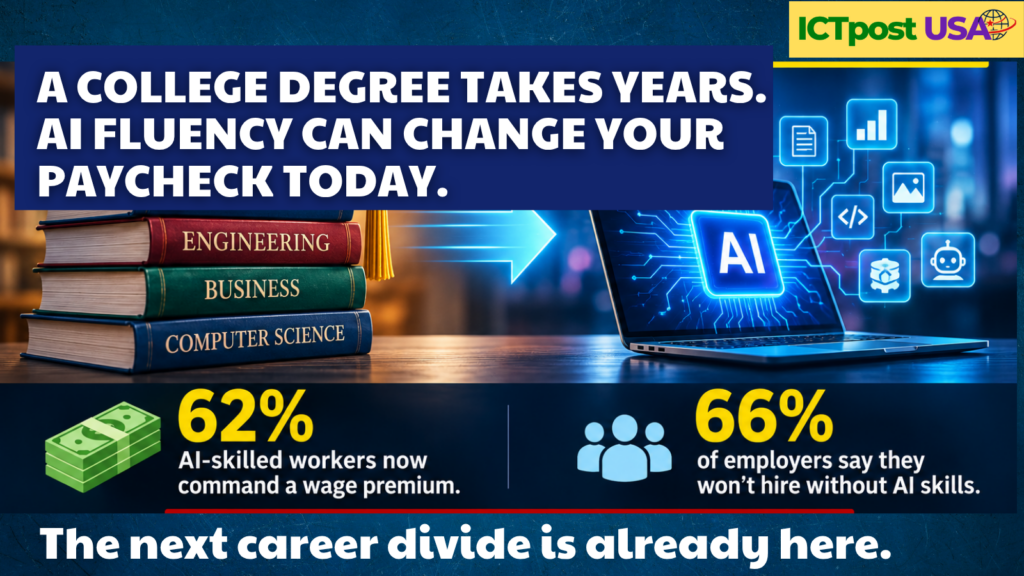
PwC’s 2026 Global AI Jobs Barometer, which analyzed more than one billion job ads across 27 countries, found that workers with AI skills command an average wage premium of 62%, up from 57% a year earlier. Jobs requiring specific AI skills grew 69% since 2019, against 9% for the overall job market (PwC). Two years earlier, the premium was roughly 25% (Let’s Data Science). The premium reaches 118% in consumer markets and only 16% in government (Kyodo via Nordot).
PwC’s global chief AI officer, Joe Atkinson, described “a new divide emerge between different models for talent and value creation.” It shows up on pay slips.
Hiring managers signaled it early. In Microsoft and LinkedIn’s 2024 Work Trend Index, 66% of leaders said they wouldn’t hire someone without AI skills (Microsoft), and 71% said they would rather hire a less experienced candidate with AI skills than a more experienced one without them (Storyboard18). Experience, the oldest currency in the labor market, is being outbid by fluency.
India shows how fast the stamp spreads beyond tech. In non-technology job descriptions, mentions of AI skills rose nearly six-fold between 2020 and 2026, according to Naukri (Telangana Today). Indeed India’s managing director, Sashi Kumar, said employers now hire for “demonstrable skills, certifications and practical capability” (CXOToday). Meanwhile, India’s tech workforce grew just 2.3% in fiscal 2026, and Nasscom’s chairperson, Sindhu Gangadharan, predicted roles demanding “significantly higher AI fluency” (The Core). That means fewer seats, with a higher bar for each one.
Follow the Money
Every credential needs an issuing authority, and whoever issues it collects a toll. That is why the scramble to define “AI fluent” is less an education story than a business one.
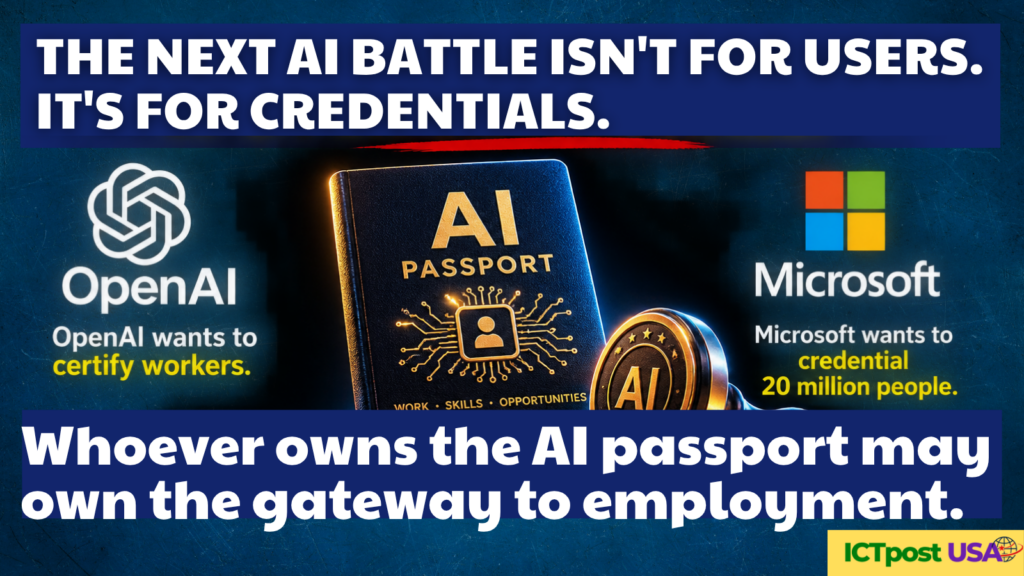
OpenAI has committed to certifying 10 million Americans by 2030, with partners including Walmart, John Deere, Boston Consulting Group, Accenture and Indeed. It is also building a jobs platform to match employers with AI-skilled candidates (OpenAI). Consider the loop this creates. The company that sells the model trains the workers, tests them, certifies them on its own product and routes them to employers. Each certified worker is a future enterprise seat, and each hiring match is data about which skills command a price. No toll booth in the history of hiring has sat this close to the product being tolled.
Microsoft is running the same play with a stronger hand. Its Microsoft Elevate initiative pledged $4 billion over five years and aims to help 20 million people earn AI credentials within two years, delivered through LinkedIn and GitHub (Microsoft). Microsoft owns the network where the badge is displayed, the platform where recruiters search for it and the productivity software where the skill is used. OpenAI’s jobs platform is, in effect, a challenge to that whole chain.
The learning platforms are consolidating for the same prize. Coursera and Udemy agreed to an all-stock merger with an implied equity value of about $2.5 billion, pitched explicitly as reskilling for the AI era (Barchart). The deal was reported to have closed in May 2026 (Built In). Universities, meanwhile, risk becoming content suppliers to the platforms that own the credential.
For investors, the lesson is to look past who teaches AI and ask who owns the verification layer. Courses are becoming commodities, and AI itself makes tutoring cheap. Durable value sits with whoever’s stamp employers trust and whose hiring systems read it: the assessment, the profile and the job match. That points to platform owners with distribution, not standalone course sellers. It also carries a warning. Education companies have chased hot credentials before.
The Certification Bubble
Here is the question the AI passport boom has not answered: what if employers are wrong?
The MBA was once treated as proof of management talent. Coding boot camps were sold as a fast lane into tech, until demand collapsed. 2U, which ran boot camps with more than 50 universities, decided to wind them all down, partly because of the rapid adoption of AI (Higher Ed Dive). Even the celebrated shift to skills-based hiring disappointed. A Harvard Business School and Burning Glass Institute study found that dropping degree requirements changed outcomes for fewer than 1 in 700 hires in 2023 (Higher Ed Dive). Some 45% of firms made the shift “in name only” (MIT Good Companies, Good Jobs).
The pattern is familiar. A credential starts as a signal of ability, becomes a filter and ends as a box to tick. AI certificates face a sharper version of the problem, because the skill they test can decay within months as the tools change. A multiple-choice exam on prompting tells an employer little about whether a candidate will spot a confident, wrong answer in a client memo. A badge can look precise and measure nothing that matters.
Inside companies, the same trap is visible. Deloitte found that worker access to AI tools grew 50% in a year, yet fewer than 60% of employees with access use AI daily. Lawyers warn that grading staff on AI adoption could invite discrimination claims (HR Executive). Salesforce’s Ruth Hickin has said it is too early to tie AI skills to performance reviews (Indeed). Counting logins is easy. Measuring judgment is not.
Who Teaches the Experts?
The deepest problem concerns the young.
Stanford researchers using ADP payroll data found that workers aged 22 to 25 in the most AI-exposed occupations saw a 13% relative decline in employment, while experienced workers in the same jobs held steady or grew (Stanford SIEPR). Lead author Erik Brynjolfsson noted that “workers who use AI to augment, not automate work, have seen job gains” (AfroTech). PwC adds that exposed entry-level roles are being “seniorized,” asking juniors for skills once expected of veterans (Let’s Data Science).
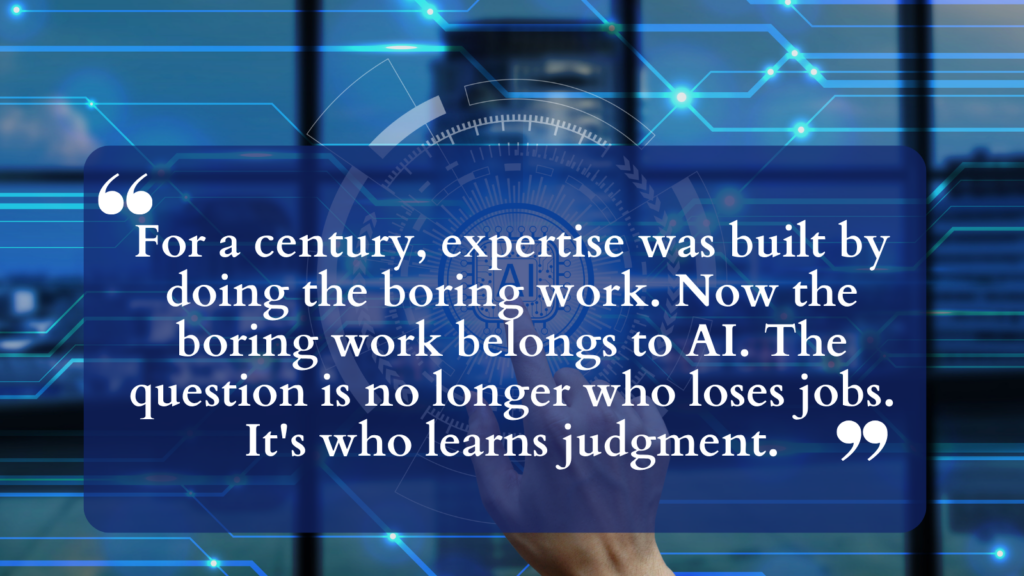
That sets up a paradox that may define the decade. For a century, professional expertise was built through apprenticeship by drudgery. Junior analysts built spreadsheets, junior lawyers reviewed documents and junior engineers fixed small bugs. The work was dull, but it was how judgment formed. AI now does much of that work. If employers demand that new hires arrive already fluent, already judicious and already senior, they are asking for the output of an apprenticeship system they are quietly dismantling. An AI passport can certify that someone can direct the machine. It cannot certify the years of error-correction that teach a person when the machine is wrong. A company that stops training juniors today may find, a decade from now, that it has no seniors left to check the AI.
What the Passport Should Actually Prove
Real fluency is not prompting. It is knowing when the model is wrong, breaking a messy problem into pieces a machine can handle, verifying the results and owning the outcome. PwC’s data suggests the fastest-rising demand is for judgment, creativity and leadership (PwC).
For workers, that means building an evidence trail of real decisions rather than a pile of badges. For companies, it means measuring outcomes rather than usage, training before testing and keeping a paid path for juniors to learn. Microsoft’s own survey found only 39% of AI users had been trained by their employer (Microsoft). For policymakers, the EU now requires firms deploying AI to ensure staff AI literacy, with supervision slated to begin in August 2026 (Travers Smith). Their task is to keep the passport portable and fair, not a private toll owned by whichever vendor got there first.
The industrial age asked what you could lift. The information age asked what you knew. The AI age is starting to ask what you can direct, and it wants paperwork.
But a passport doesn’t prove you can travel. It proves you’re allowed to. The real danger of the coming credential boom is that employers confuse the two, and workers let them. editor@ictpost.com