
By Dhirendra Pratap Singh, ICTpost USA
Buried in the fine print of Microsoft’s newest enterprise product is a sentence that undercuts the loudest investment thesis of the year.
Agent 365 is Microsoft’s control plane for artificial-intelligence agents — a registry, an identity system and a security perimeter for the swarm of autonomous software workers that companies have begun deploying across their operations. It was unveiled at Ignite in November 2025 as the answer to a question executives had started asking nervously: who manages the machines?
Microsoft’s product page lists the price at $15 per month. Then it adds, without apology: “Pricing is per user, not per agent.”
The company that built the cockpit for the agentic workforce bills for it by the human.
That single line is the cleanest expression of where enterprise software actually stands in the autumn of 2026 — and how far it has drifted from the story the stock market told itself earlier this year.
The $2 trillion funeral
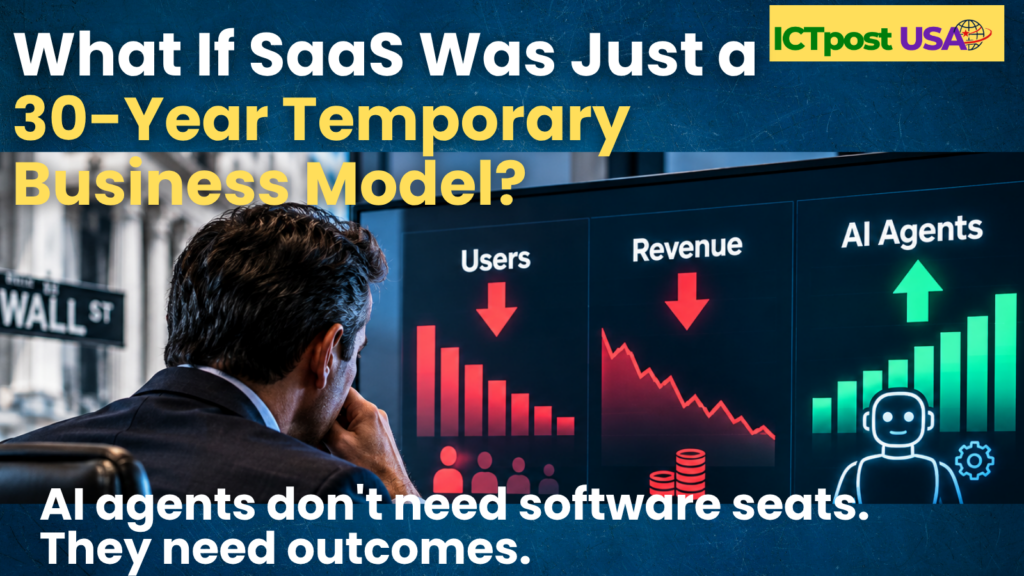
The funeral began in late January. On January 29, the S&P 500 Software & Services Index fell 8.7% to a nine-month low, with SAP down more than 16%, Atlassian off 12.6%, Microsoft 12.1%, HubSpot 11.5% and Salesforce 7.1% (Reuters). Within a week the sector had shed roughly $1 trillion. By early February, information-services firms were caught in the downdraft too: Thomson Reuters fell 18% and RELX 14% — its steepest single-day drop since 1988 — after Anthropic shipped a legal plug-in for its Cowork product.
By mid-February, Fortune counted about $2 trillion erased from software market value over twelve months, with software’s weight in the S&P 500 falling from 12% to 8.4%. The iShares Expanded Tech-Software ETF logged its worst quarter since 2008. Morgan Stanley’s investment-management arm called it the worst non-recessionary decline for software in more than 30 years.
The market had a name for it before it had evidence for it: the SaaSpocalypse.
The logic was elegant and almost entirely deductive. Software-as-a-service sells access by the user. AI agents reduce the number of users who need access. Therefore revenue falls. Keith Weiss of Morgan Stanley put the syllogism plainly — software is now eating work itself, and if a company halves its staff it halves its subscriptions.
Gartner has since attached a number to the fear. In a July 1 forecast, the firm estimated that up to $234 billion of enterprise application spending — about a fifth of the market — is exposed by 2030 to what it calls “agentic arbitrage”: agents completing tasks across multiple systems, so humans stop opening those systems at all. “Agentic AI changes the economics of software,” said Gartner managing vice president George Brocklehurst. It “makes the software invisible. This breaks the link between user growth” and revenue.
Bloomberg Intelligence went further. In an April 29 deep dive on the $700 billion application-software industry, its analysts put $280 billion of “interface-heavy” spending at risk, warned that gross margins “could narrow 100-900 basis points” depending on agent intensity, and projected that outcome-based pricing could reach 60% of the market, or $1.05 trillion, by 2035 — while subscriptions shrink from 60% of the pie to 30%.
It is a coherent, well-argued, extremely expensive thesis. And there is one problem with it.
Nobody has produced a body

Search the filings. No publicly traded software company has disclosed a decline in paid seats attributable to AI agents. Not one.
The numbers run the other way. Microsoft reported more than 450 million paid Microsoft 365 commercial seats in its December quarter, up 6%, and by July had crossed 30 million paid Copilot seats, double the level six months earlier. Atlassian closed its fiscal year with revenue up 28% and net retention above 120%, still citing strong seat expansion in Jira and Confluence. Figma said two-thirds of customers spending above $10,000 a year added full seats at renewal. Salesforce — the designated victim — posted record second-quarter revenue of $11.3 billion on August 26. “The narrative out there [is] that HR and ERP will be replaced or relegated to the background by AI,” Workday co-founder Aneel Bhusri told investors in February. “I personally just don’t see that happening.”
The seat-destruction case rests on three things: intent surveys, share-price action, and one anecdote.
The anecdote is Klarna, whose chief executive was recorded in 2024 saying the company had “shut down Salesforce.” He walked it back in March 2025 — “no, we did not replace SaaS with an LLM” — describing a consolidation project whose “side consequence” was dropping vendors. Klarna has never published a seat-count figure.
The surveys are more serious. BCG found 40% of buyers name seat reduction as their primary lever for cutting software spend. Redpoint’s survey of 141 CIOs found 45% say AI budgets come straight out of existing software line items. Zylo’s 2026 index, covering $75 billion of spend and 40 million licenses, found 36% of licenses unused — a reservoir of cuts requiring no AI justification at all.
Enormous willingness to cut; no disclosed cutting. The gap is where this year’s $2 trillion argument lives.
The meter is changing even if the seat is not
HubSpot moved most aggressively. On April 14 it switched its Breeze Customer Agent from $1.00 per conversation to $0.50 per resolved conversation — halving the price and changing the trigger from attempts to results. “You pay when it works, full stop,” said chief customer officer Jon Dick.
Investors did not reward the candor. HubSpot fell 19% on May 8, closing at $197.35 and down 51% on the year, after finance chief Kathryn Bueker warned the changes “may extend sales cycles.”
Per-resolution billing is now standard in customer service. Intercom’s Fin charges $0.99 per outcome — one charge per conversation, however many actions the agent takes. Zendesk lists automated resolutions at $1.50 committed, $2.00 pay-as-you-go. Sierra charges only on resolution; escalate to a human and there is usually no charge. Salesforce joined in June with a Help Agent billed only when an issue is resolved end to end.
Bret Taylor, Sierra’s chief executive, gives the sharpest defense: token consumption has no reliable relationship to value. “Reducing your token utilization for the same outcomes is your problem, not your customer’s,” he said. It is a deliberate transfer of risk from buyer to seller — which is exactly what makes it hard.
Why the seat keeps winning
Salesforce is the proof. It opened the agentic era pitching $2 per conversation, layered on Flex Credits at a dime per action — and then, in October 2025, introduced a seat-based Agentic Enterprise License Agreement. “When we first started with Agentforce, we were talking about [charging] so much per conversation… but customers have pushed for more flexibility,” Marc Benioff said. In September it consolidated into three tiers at $195, $395 and $550 per user per month. Four pricing models run at once, and the oldest sits at the front of the catalog.
Bain’s review of 30-plus vendors found the pattern industry-wide: 35% raised seat prices and bundled AI in; 65% layered meters on top of seats; 0% fully shifted to usage or outcome pricing. Morgan Stanley puts roughly two-thirds of incumbents on hybrid models, one-third purely seat-based.
Even Gartner, author of the $234 billion warning, is unimpressed. The rise of outcome pricing is “more buzz than reality,” analyst Tom Coshow said in August; only 19% of services buyers use it. His test is the right one: “If the vendor isn’t taking on the risk, why are you bothering?”
The unglamorous reason the seat survives: it is the only number both sides can forecast. Credits expire monthly and don’t roll over. Consumption bills arrive as surprises — 78% of IT leaders told Zylo they’d been hit with unexpected AI or usage charges, and 61% cut projects as a result.
Where the damage is showing up
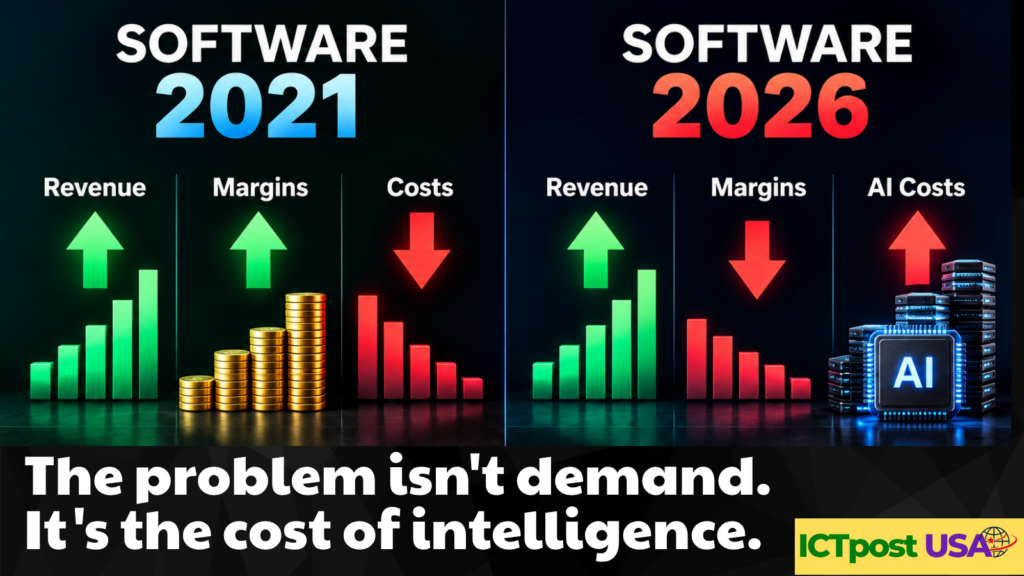
Revenue is growing, so the bears need a different target. They have one: the cost line.
ServiceNow is the clearest case. In results filed July 22, non-GAAP subscription gross margin fell to 80.5% from 83% — 250 basis points — and full-year guidance was cut. Figma’s Dylan Field told investors AI inference costs “remain a major expense and can be volatile as usage grows”; its gross margin ran about five points below the prior year.
This is the real mechanism, and it is quieter than the one the market priced. The marginal cost of another user rounded to zero. The marginal cost of another agent does not. Goldman Sachs estimates agentic requests consume 10 to 50 times the tokens of a chatbot query, even as cost per token falls 60% to 70% a year.
The plausible outcome is not extinction but a software industry that looks less like software: growing revenue, heavier cost of goods sold, lumpier billing, margins drifting out of the high 80s.
The invisible application
Satya Nadella has described the endgame for two years: Microsoft’s “end-user tools business will become essentially an infrastructure business in support of agents doing work” — and grow faster than the number of users. Not shrink with them.
That bet rests on what foundation models lack: context. A CRM holds a decade of relationships; an ERP the transactions; an HR system the org chart and its permissions. Agents need somewhere trusted to read and write, an identity to act under, an audit trail defensible to a regulator. That is what enterprise software spent twenty years building and nobody enjoys rebuilding.
Bain frames it as opportunity: agentic automation of cross-system coordination work is roughly a $100 billion US market, more than 90% uncaptured. “The strategic imperative isn’t to protect the legacy SaaS model from disruption,” its authors write. “It’s to capture the larger opportunity of converting labor costs into software spending.”
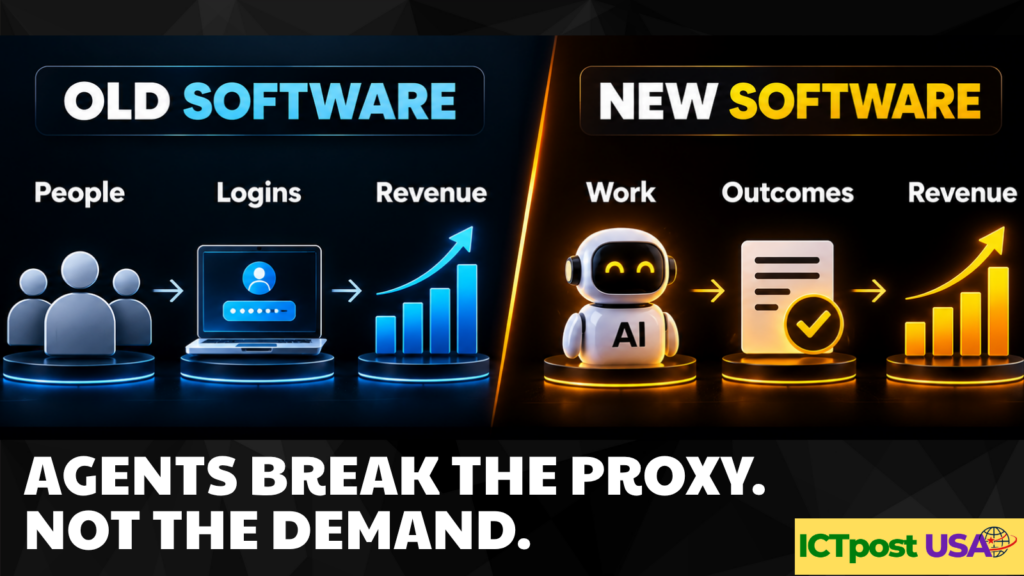
The seat was never the product. It was a proxy for how much work a company does — calibrated to a world where work required a person with a login. Agents break the proxy, not the demand.
Note who blinked. The market sold software down 28%, then bought it back roughly 40% off the April low when earnings refused to cooperate. “Predictions of the death of SaaS and enterprise applications are premature,” Wedbush’s Dan Ives has said throughout.
Premature is not the same as wrong.
The sentence to watch
Somebody has already run the arithmetic nobody wants to say on an earnings call. Aisling O’Reilly, Intercom’s head of pricing, said it in a Stripe case study about her own company’s switch to charging per outcome:
“If a company has 1,000 customer service employees and Fin works as well as we know it does, over time, those 1,000 seats might become only 200.”
That is the bear case, from someone with every incentive to deny it — offered as a reason to change the meter, not to mourn the business.
The seat is not dying this year. What is dying is the assumption that a login measures how much work a company does, and the twenty-year arrangement in which vendors were paid for presence rather than performance.
Wall Street has written the obituary twice and been wrong on timing both times. The industry is quietly rebuilding its invoices around a different question: not how many people you employ, but how much of your work our machines finished.
For now, Microsoft’s answer to the agentic workforce is the oldest one in the catalog — $15 a month, per user, not per agent.
The bill is still addressed to a person. The work increasingly isn’t.
editor@ictpost.com
Follow author on LinkedIn , YouTube and X.

The author Dhirendra Pratap Singh works at the intersection of Artificial Intelligence, the digital economy, public policy, and emerging technologies, exploring how technological revolutions are reshaping societies, governance systems, and global power structures. His work focuses on interpreting complex technological shifts—from AI and digital public infrastructure to technology geopolitics—and translating them into actionable insights for policymakers, institutions, and industry leaders navigating a rapidly evolving global technology landscape.