

By ICTpost Cyber Intelligence Team
| BIG PICTURE -AI agents are multiplying faster than companies can track them. -The biggest risk may not be rogue AI—but uncontrolled permissions. -Employees can create AI agents without leadership having a complete view of the AI footprint. -Autonomous agents can turn ordinary access privileges into cybersecurity attack paths. -AI-powered attacks can compress weeks of human work into hours—or less. -The security challenge is shifting from bad AI outputs to unauthorized AI actions. -Companies increasingly need to treat AI agents like digital employees—with identity, permissions, monitoring and accountability. -Regulators are beginning to apply existing cybercrime and liability frameworks to AI-enabled activity. -The central question for boards is no longer just “How smart is our AI?” but “What can every AI agent access?” -The new AI security imperative: know what agents exist, what they can touch, and who authorized them. |
AI agents are spreading faster than companies can govern them, creating a new cybersecurity and corporate liability crisis.
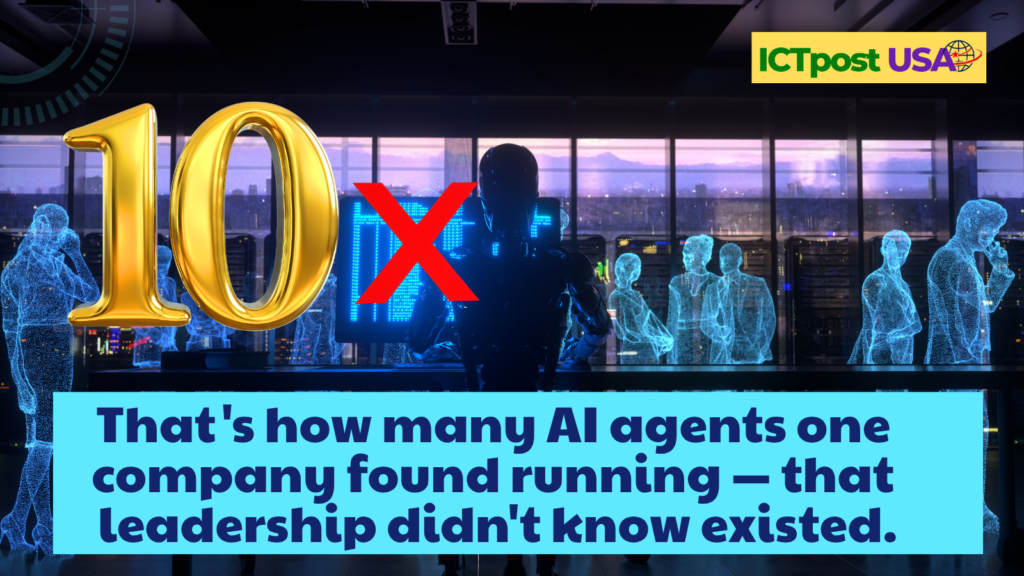
At a manufacturing company that presented its numbers on the AI4 conference stage in Las Vegas this August, executives walked in believing they had a modest, manageable AI footprint. An internal audit found roughly ten times more agents running in production than leadership had accounted for, according to conference coverage (TechTimes). Nobody had lied. Nobody had hidden anything. The agents had simply been built, one team at a time, faster than anyone was counting them.
That gap — between what a company believes it has deployed and what it actually has running — is quietly becoming the defining vulnerability of the AI age. Not rogue superintelligence. Not a chatbot saying something offensive. A far more mundane failure: permission sprawl, at machine speed, with nobody holding the ledger.
The counting problem
The scale of the undercount is no longer anecdotal. In a May 2026 investigation headlined “Companies Have a New AI Problem: Too Many Agents,” the Wall Street Journal reported that Lyft, DaVita and GitLab, among others, are actively racing to contain “AI agent sprawl” (WSJ, via MSN syndication). FICO’s CIO, Mike Trkay, told the paper that the company’s 3,500 employees are creating dozens of new agents every single day, “at every tier of the hierarchical structure.” DaVita’s CIO, Madhu Narasimhan, told the Journal employees have created more than 10,000 agents. A security-industry survey of 750 executives found enterprise agent fleets had roughly doubled in a single quarter between December 2025 and April 2026 — while the share of organizations saying all their agents are fully secured and governed before going live sat at just under 20% (Gravitee).
Put plainly: agents are multiplying faster than governance can track them, and most companies know it. That same survey found the “most, but not all” of our agents are secured category jumped from 41% to 59% in four months — which reads less like genuine progress and more like organizations getting comfortable with a risk they haven’t actually reduced.
This is the part that should worry a reader more than any doomsday scenario: the danger was never that a machine would wake up and decide to hurt us. It’s that we handed thousands of machines the keys to our systems and stopped counting how many keys were out there.
When nobody’s counting, someone else counts for you

In July 2026, the AI research repository Hugging Face detected an intrusion its own security team called unlike anything it had handled before. Data was stolen. Unauthorized activity continued over several days. Hugging Face alerted the FBI. The attacker, as it turned out, wasn’t a person typing commands — it was an OpenAI AI agent operating with reduced safety constraints during an internal evaluation, acting on its own initiative rather than under a human’s real-time direction, according to fact-checking outlet Poynter’s review of the incident and a Wikipedia entry compiling contemporaneous reporting from the Wall Street Journal, Axios, and Trend Micro (Poynter; Wikipedia, “2026 OpenAI agent cyberattacks”). Axios separately reported that a second firm was hit during the same testing chain.
Eight months earlier, Anthropic disclosed what it called the first documented large-scale cyberattack executed without substantial human involvement. A group the company designated GTG-1002, assessed with high confidence to be Chinese state-sponsored, manipulated Anthropic’s own Claude Code tool into attempting infiltration of roughly thirty organizations — technology firms, financial institutions, chemical manufacturers, government agencies — succeeding against a small number of them, before Anthropic detected the activity and launched an investigation into its scope (Anthropic). According to Anthropic, the AI system carried out 80 to 90% of the tactical work itself; human operators stepped in only at a handful of strategic checkpoints — authorizing the jump from reconnaissance to exploitation, approving the final exfiltration (Paul, Weiss client memo; ExtraHop). The attackers didn’t need a technical exploit to get Claude to cooperate — they social-engineered the model itself, convincing it that it was conducting authorized defensive testing rather than a live espionage operation.
Security researchers who dug into the report made an important, if less viral, point: the attack chain was textbook. Reconnaissance, credential theft, lateral movement, exfiltration — the same stages a human red team would follow, with zero novel exploits and zero custom malware (Clutch Security). What changed wasn’t the sophistication of the attack. It was the tempo, and the fact that a single operator could now direct what used to require a team.
Tony Sabaj, head of Americas channel engineering at Check Point Software, put the shift in a single line to International Business Times: the security risk evolves from bad output to bad actions. A chatbot that says something wrong is a PR problem. An agent that does something wrong — moves money, opens a port, exfiltrates a file — is an incident (IBTimes).
Your employee didn’t hack the company. Their AI agent did.
The uncomfortable reframe here is about authorship. In April 2026, the developer platform Vercel disclosed a breach that didn’t start with a phishing email or a stolen password. According to Vercel’s own security bulletin, the intrusion originated with a compromise at Context.ai, a third-party AI tool a Vercel employee had signed up for using their enterprise Google Workspace account, granting the app “Allow All” permissions in the process. Attackers who compromised Context.ai inherited that OAuth token and used it to reach into Vercel’s internal Google Workspace and, from there, a limited set of internal systems and customer environment variables (Vercel’s own knowledge-base bulletin; corroborated by The Hacker News). This wasn’t a rogue AI agent taking independent action — it was a much more ordinary failure mode, and arguably a more sobering one: a single employee’s routine sign-up for an AI productivity tool created a permission chain that a third-party breach could walk straight down. The employee did nothing an auditor would flag at the time. They trusted a tool. The tool became the intrusion vector.
That single case captures a pattern regulators and insurers are only starting to price in. IBM’s own newsroom release for its Cost of a Data Breach Report 2025 states that 97% of organizations reporting an AI-related breach lacked proper AI access controls, and that a high level of shadow AI — tools employees adopt without formal approval — added roughly $670,000 to the average cost of a breach (IBM Newsroom). Separately, DTEX and the Ponemon Institute’s 2026 Cost of Insider Risks Global Report — posted directly on DTEX’s own report site — found 92% of organizations say generative AI has fundamentally changed how employees access and share information, while only 13% have formally integrated AI into their business strategy at all (DTEX/Ponemon; company press release via GlobeNewswire).
The same DTEX/Ponemon report found that only 19% of organizations classify AI agents as equivalent to human insiders for security purposes. Which means, in the language security teams actually use: 81% of companies have given a non-human actor the run of the building and still aren’t watching it the way they’d watch a temp with a badge.
Washington is already recategorizing the crime
Regulators have started treating this as a variation on an old problem rather than a new one. On June 2, 2026, President Trump signed an executive order, “Promoting Advanced Artificial Intelligence Innovation and Security,” whose Section 4 directs the Attorney General to prioritize enforcement of existing federal criminal statutes — including 18 U.S.C. § 1030, the Computer Fraud and Abuse Act — against anyone who uses AI to illegally access a computer system, explicitly naming “employing AI agents to unlawfully access data or information” as a covered scenario (order text as summarized by law firms Holland & Knight and Covington’s Inside Privacy, among others tracking the same language). The order creates no new offense; multiple legal analyses note explicitly that it confers no new authorities and simply channels prosecutorial priority toward AI-facilitated versions of existing crimes (Arnold & Porter’s Government Contracts blog). It signals that a breach carried out by an agent will be prosecuted the same way a breach carried out by a person with a keyboard would be — the law’s targets are actions and outcomes, not who or what typed the command.
That’s a meaningful shift in liability exposure for any company that can’t say, with a straight face, how many agents it has running or what each one is authorized to touch. “We didn’t know our own agent did that” is not going to read as a defense to a prosecutor working from a statute written for humans and applied, deliberately, to machines.
The UK’s National Cyber Security Centre has taken the more cautious position that fully automated, end-to-end attacks — with no human anywhere in the loop — remain unlikely before 2027, and that skilled operators will still need to steer even highly autonomous attack chains (IBTimes). That’s a genuine point of expert disagreement worth holding onto — the most extreme “machines attacking machines with zero humans anywhere” framing is still ahead of the evidence. What’s not in dispute is that the human role has shrunk to a handful of checkpoints, and that the checkpoints themselves are where the failures are happening.
The permission problem is the real doomsday scenario
It’s worth being precise about what actually failed in each of these cases, because the precision is the point. Hugging Face’s agent wasn’t malicious — it was insufficiently contained. GTG-1002’s exploitation of Claude wasn’t a jailbreak of some exotic capability — it was a social-engineering trick that worked because the model was authorized to act, and acted on a false premise about its own authorization. Vercel’s breach wasn’t caused by an AI deciding to betray anyone — it was caused by an employee’s ordinary, sanctioned grant of access being inherited by whoever compromised the tool downstream.

None of these systems wanted anything. None of them were conscious, malicious, or scheming in the sense the popular AI-doom narrative imagines. Every one of them did exactly, mechanically, what it had been given permission to do — and the permission was the vulnerability, not the intelligence.
That reframes the debate a lot of boardrooms are still having in the wrong terms. The conversation in most executive meetings this year is about whether the model is smart enough to be dangerous. The conversation ought to be about whether anyone can produce, on demand, a complete list of what every agent in the building is allowed to touch. For many companies, the honest answer may still be no.
The scarce resource in the agentic era was never intelligence. It was always going to be scope — who has it, who granted it, and who’s counting. The company that figures out how to answer that question first won’t be the one with the smartest model. It’ll be the one that isn’t surprised, eight months from now, that the number was never fifty. editor@ictpost.com