
SpaceX now sits at the center of America’s satellite internet, military communications, launch industry and emerging AI infrastructure. Investors are starting to ask a question Washington cannot ignore: What happens when critical infrastructure depends on a single company?
By P. Madhavendra | ICTpost Global AI Intelligence | November 21, 2026
On Thursday afternoon, the incoming chairman of the House Intelligence Committee sent two letters. One, classified, went to Director of National Intelligence Jay Clayton. The other went to Elon Musk. Both asked the same question: who, in October, ordered the throttling of Ukraine’s military-grade Starshield satellite service — a change that disabled terminals moving faster than 100 miles per hour and blunted Kyiv’s ability to shoot down Russian drones (Kyiv Independent).
Rep. Jim Himes, who takes the gavel in January, attached a threat. His committee, he wrote, cannot keep authorizing money for government systems “that the government will not fully control” (CNN). The White House, the Pentagon, Musk and SpaceX’s own executives have given conflicting accounts of who gave the order. A Pentagon official said Defense Secretary Pete Hegseth had no advance knowledge. Musk says the government owns Starshield and sets its limits. Secretary of State Marco Rubio has said SpaceX made the call (Rolling Out).
That nobody in Washington can say who turned down the dial on a battlefield network is the story. And it is not, at bottom, a story about Ukraine. It is the first visible crack in something the United States built without ever deciding to: a national infrastructure stack that runs through one company — which, five months after the largest IPO in history, is also the fastest-growing AI business in the world.
Three things no company has ever owned at once
Every era of American capitalism has produced a firm that controlled one layer of the economy’s plumbing. The railroads of the 1880s controlled movement. Standard Oil controlled energy. AT&T, for half a century, controlled communications. Microsoft controlled the software layer of the 1990s; Google, the information layer of the 2000s.
Each was broken up, regulated into a utility, or eventually outgrown. None controlled more than one layer.
SpaceX now controls three.
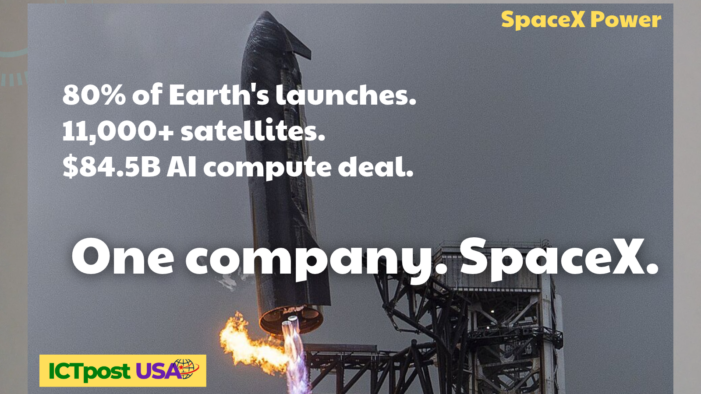
Access to orbit. By mass, SpaceX carried roughly 80% of everything humanity launched into orbit this year; the next seven launch providers combined lifted less than a quarter of its total (FourWeekMBA; Bitkub). Starship reached orbit in September and flew its first paying mission in the third quarter.
Connectivity. Starlink serves 13.6 million subscribers in 174 countries and operates about three-quarters of all active maneuverable satellites in Earth orbit (Broadband Breakfast; Wikipedia). Its hardened sibling, Starshield, carries the National Reconnaissance Office’s spy constellation and, after $6.45 billion in Space Force awards this May, the sensing and communications backbone of the Golden Dome missile shield (AeroMorning).
AI compute. In February, SpaceX absorbed Musk’s xAI. By the third quarter, the AI segment — renamed “Super Intelligence” after a White House executive order on AI terminology — generated $7.56 billion in revenue, up 830% in a year, and for the first time overtook Starlink as the company’s largest business (Teslarati).
Launch, network, compute. The railroads never owned the telegraph. AT&T never owned the power plants. SpaceX is the first company in history to hold the roads, the wires and the engines of a new economy simultaneously — and it did so without an antitrust lawyer in Washington noticing until the lights flickered over Ukraine.
Who is renting the engines
What drove the AI segment’s explosion was not Grok. It was the landlord business.
In May, Anthropic agreed to take every watt of Colossus 1, SpaceX’s Memphis data center — more than 300 megawatts, roughly 220,000 Nvidia GPUs — to serve its paying Claude customers. SpaceX’s IPO filing priced that contract at $1.25 billion a month through 2029; Anthropic’s own prospectus put its potential payments at up to $84.5 billion (Crypto Briefing). Google signed a similar deal in June. Cursor, the AI coding company, was simply bought outright in August.
Consider what that means. Two of the most important AI developers outside Musk’s orbit are now SpaceX tenants. Musk, announcing the Anthropic deal, said he reserved the right to reclaim the compute if Anthropic’s AI “engages in actions that harm humanity” (Yahoo Finance). It was said lightly. The clause in the contract, whatever it says, was not.
This is why the headline is not a provocation. OpenAI and Anthropic make the models. Nvidia makes the chips. SpaceX is becoming the thing the models run on, the thing that carries the sensors feeding them, and the thing that brings the signal back down. In the language of the industry, SpaceX is the substrate.
And it is pouring money into deepening that position: last quarter SpaceX spent $19.6 billion on capital projects — more than its entire revenue — with $16.4 billion of it going to AI infrastructure, funded by a war chest raised from public shareholders in June (NextGComm).
The utility nobody chartered
The Pentagon did not choose dependence. It arrived at it rationally.
In April, Reuters reported that a global Starlink outage in August 2025 had left two dozen U.S. Navy unmanned vessels — drones designed for a potential conflict with China — drifting off the California coast for nearly an hour. An earlier Navy safety report had already concluded that “Starlink reliance exposed limitations under multiple-vehicle load” (Military Times / Reuters). The Navy kept building on Starlink anyway. Bryan Clark of the Hudson Institute told Reuters the cost advantage outweighed the outage risk (Colorado Springs Gazette). He is probably right, which is the uncomfortable part. SpaceX won these markets fairly, and by a margin no rival has closed in fifteen years.
The Golden Dome contracts were awarded under Other Transaction Authorities — a procurement lane outside normal federal acquisition rules that the Government Accountability Office has flagged for thin oversight. And in July, Bloomberg reported SpaceX had begun turning away customers seeking Falcon 9 launches beyond 2028, to focus on Starship (Bloomberg Law). A company controlling most of the world’s access to orbit is telling customers the door closes in two years and the new one is not yet open.
Then there is governance. Musk holds about 82% of SpaceX’s voting power through super-voting shares. A $1.9 trillion public company carrying three layers of critical infrastructure and tens of billions in classified defense work is, in practice, controlled by one man who also runs Tesla and whose relationship with the administration has swung from alliance to feud and back within eighteen months. Shareholders bought into that with full disclosure. The Pentagon never got a prospectus.
What the market and Congress are each missing
On the same Thursday Himes sent his letters, SpaceX stock fell 7.7% to $127.79, below its $135 IPO price (Motley Fool). Wall Street’s worry is valuation and capital intensity: Morningstar pegged fair value at less than half the offering price (CNBC).
But that debate assumes the business model is the risk. Himes’s letter identifies a different one: the revenue is politically contingent. Roughly 40% of Starlink’s connectivity revenue now comes from enterprise and government customers, and the Golden Dome, NRO and military relay work is authorized annually by committees that now have a chairman asking whether SpaceX honored a contract or exercised an authority nobody told the government about.
Congress, for its part, is missing the opposite thing: the AI layer. The hearings will be about Starshield and Ukraine. They will not be about the fact that the company being questioned also hosts the compute behind two of America’s leading AI models — or that it has asked the FCC for permission to launch up to one million satellites as orbital data centers, with the first prototypes due in early 2027 (Latin Times; Globe and Mail). If space turns out to be the cheapest place to run AI, as Musk insists, then the company that owns the only road there owns the only place left to build.
The Standard Oil moment, upside down
The instinct in some quarters is to reach for the antitrust playbook; one Fortune commentary this month invoked Standard Oil directly (Fortune). It does not fit. Standard Oil was broken up because it was large and abusive. SpaceX is large because it is better. Breaking launch from network from compute would hand the pieces to a Chinese program explicitly trying to reverse-engineer SpaceX’s engines.
What is coming instead is the AT&T treatment: not a breakup but a charter. Who holds the kill switch. Who must be notified, and when. Whether a company that rents compute to its competitors can reclaim it on its own judgment. These are the questions one asks of a utility — and Washington has spent 2026 slowly admitting that is what SpaceX has become.
In the meantime, the Pentagon’s drones, the intelligence community’s satellites, Ukraine’s battlefield nets, 300 megawatts of Anthropic’s compute and most of the mass that leaves this planet route through one Nasdaq ticker, controlled by one man.
The AI race was supposed to be won with the best model. It may be won instead by whoever owns the ground the models stand on — and the ground, it turns out, is in orbit, and it has a landlord. editor@ictpost.com