
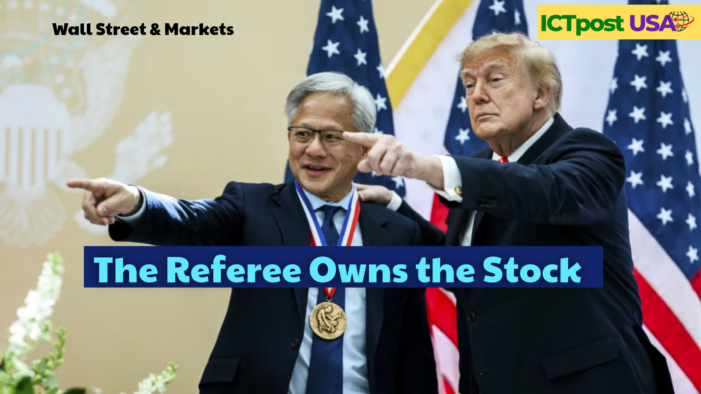
In one week, Nvidia lost its founder, Washington lost its pretence of neutrality, and the world learned the president’s stake in the AI chip giant had grown as much as 100-fold. The question for investors is no longer who wins the AI race. It is who is allowed to set the rules.
By P. Madhavendra
ICTpost USA, Global AI Intelligence
November 17, 2026
At about 1:20 p.m. Pacific time today, Colette Kress will walk investors through Nvidia’s third-quarter numbers. She has done it dozens of times as chief financial officer. She has never done it as chief executive. (Nvidia 8-K, Nov. 12)
Five days before the call, Nvidia’s board announced that Jensen Huang, the leather-jacketed founder who built a $4 trillion company out of a Denny’s booth in 1993, had resigned as president, CEO and director, effective immediately. The trigger was not a product failure or a missed quarter. It was an admitted affair with Alice Huang, a former executive at Singapore-based Megaspeed International, an official Nvidia cloud partner whom U.S. intelligence officials suspect of ties to Beijing. (CBS News; The Globe and Mail)
The stock fell more than 13% on the day of the announcement and closed Monday at $156.14, its lowest finish since July 2025. (Yahoo Finance; CNBC) Evercore cut its price target from $465 to $186. (Yahoo Finance) More than 190,000 people, Elon Musk among them, signed a petition demanding Huang’s return. The board, according to people who spoke to CNBC and Reuters, is not considering it.
That alone would have been the business story of the year. Then, on Sunday night, The Washington Post published what it found in President Donald Trump’s financial disclosures. His Nvidia holdings had grown from somewhere between $615,000 and $1.3 million at the end of 2024 to somewhere between $13 million and $62 million by the end of August 2026. (Reuters via U.S. News) The filings lag by two months, and the share price kept rising through September, so the real figure may have been higher still.
In the same 72 hours, the Treasury Secretary publicly blamed the Commerce Secretary for failing to blacklist Megaspeed; the Commerce Department rushed out a rule closing the loophole Megaspeed is accused of exploiting; and The Wall Street Journal reported that the administration is about to anoint Nvidia, scandal and all, as one of America’s official AI “national champions.”
Put the pieces side by side and a pattern emerges that should unsettle anyone with money in the AI trade. The United States is now running an explicit industrial policy for artificial intelligence. The people writing that policy, or sitting at the top of the chain of command that writes it, hold the equity. And the legal framework that is supposed to separate the two was written for a world in which the president did not personally own tens of millions of dollars of the single most policy-sensitive stock on earth.
A portfolio that moved with the policy
The White House’s defence is coherent and deserves to be stated plainly. The president, it says, does not pick stocks. His portfolio is managed through a trust overseen by his children and by third-party financial institutions that replicate broad market indexes. Nvidia is one of the largest weightings in any such index; a portfolio that tracks the market will hold a lot of it, and will have bought more as the stock rose. (Washington Post via dnyuz) Nothing in the public record establishes that Trump directed a single trade or altered a single policy to enrich himself.
The problem is the timeline, not the mechanism.
In May 2025 the administration rescinded the Biden-era “AI diffusion” rule that capped where advanced American chips could be sold. The anti-corruption group DeKleptocracy, reviewing the disclosures, found that Trump’s accounts bought between $1 million and $5 million of Nvidia in the days before the reversal. (Time News, citing The Guardian) (Note: this figure traces to a secondary report citing an advocacy group; worth confirming against the OGE filing before publication.)
In December 2025 Trump announced on social media that Nvidia could sell its H200 processor, its second-best AI chip, to approved Chinese customers, with the U.S. government taking a 25% cut. (Reuters via Investing.com) Disclosures show purchases of $250,001 to $500,000 in the days that followed.
On January 6, 2026, his accounts bought as much as $1 million more. A week later, on January 14, the Commerce Department’s Bureau of Industry and Security formalised the H200 policy, moving the chip from a presumption of denial to case-by-case review with a 25% levy and a cap holding China to half of U.S. volumes. (Introl summary of BIS rule) The stock rose.
That January trade is the one that reached the Senate. In June, Elizabeth Warren asked Treasury Secretary Scott Bessent at a Banking Committee hearing whether the SEC should investigate it. Bessent’s reply was that if Congress wanted to ban individual stock trading, it should start with lawmakers. (The New Republic)
It was a deflection, but not an empty one. Members of Congress have traded on far more granular information for decades, and the index-fund explanation may well be the whole story. An index tracker buys on the way up regardless of who is in the Oval Office. The trouble is that no outside party can verify that claim, because the disclosure regime gives the public only ranges, only twice a year, and only after a two-month lag. A mechanism that cannot be audited offers reassurance, not proof.
The statute that stops at the Oval Office door
Here the law is unambiguous, and that is the problem. Title 18, Section 208 of the U.S. Code makes it a crime for executive-branch officials to participate “personally and substantially” in a government matter in which they have a financial interest. Section 202(c) of the same chapter exempts the president and vice president from that prohibition. (18 U.S.C. §208; 18 U.S.C. §202)
The exemption was never an oversight. Congress reasoned that a president’s duties are so sweeping that nearly any decision touches some financial interest, and that the remedy is the ballot box rather than the courtroom. That logic held when presidents were expected to divest, use blind trusts, or hold Treasuries. Trump has rejected calls to divest. (Washington Post via dnyuz)
The result is a gap no other senior official enjoys. Commerce Secretary Howard Lutnick, for example, was required to sell his interests in Cantor Fitzgerald, and the disclosures show those sales closed in October 2025. Cantor still held about 1.8 million Nvidia shares, worth roughly $362 million, at the end of June. Lutnick’s exit from the firm is precisely what §208 is designed to force. The president faces no such requirement.
Democrats, who take control of both chambers of Congress in January, have signalled they intend to examine both men’s holdings. (NZ Herald, citing The Washington Post) What they cannot do, short of amending the criminal code, is make the president’s trades illegal. They can only make them visible.
“Commerce has the pen”
The second thread of this story runs through the Commerce Department, and it is in some ways more damaging than the first, because it concerns not a portfolio but a decision.
Megaspeed, the company at the heart of the Huang scandal, is a spin-off of the Chinese state-owned cloud firm 7Road. Senator Tom Cotton, a Republican, wrote to Lutnick on October 13, 2025, asking Commerce to investigate it after The New York Times reported that billions of dollars of export-controlled Nvidia chips had flowed to the company through shell entities in Singapore and Malaysia. (Cotton letter) Megaspeed has reportedly bought more than $4 billion of Nvidia hardware. (Broadband Breakfast)
For thirteen months, nothing happened.
Then, on November 13, Bessent went on CNBC and said something Cabinet secretaries almost never say about each other in public. Treasury, State, Defense and the U.S. Trade Representative, he said, had all supported adding Megaspeed to the entity list for months, but the decision belonged to Commerce. (CNBC) Axios had reported that Bessent confronted Lutnick directly in the White House Situation Room; Commerce said no such conversation took place. By Friday, Bessent was blunter still: other agencies wanted action, “but Commerce has the pen.” (Washington Post via dnyuz)
Nvidia, for its part, has said the Megaspeed diversion allegations were investigated and debunked last year. Megaspeed says Alice Huang left the company in 2025 and that it takes export compliance seriously.
Three days after Bessent’s broadside, Commerce issued the interim final rule it had resisted for a year. Data-centre operators in Singapore, Malaysia, Thailand, Indonesia and Brazil will now need a U.S. licence before receiving advanced AI chips, and any operator anywhere will need one before granting remote access to a China-headquartered company. Existing customers have 90 days to comply. U.S.-headquartered firms get a carve-out. (Bloomberg via Yahoo Singapore; Forbes)
The most telling line was buried in the department’s own statement. The rule, Commerce said, was written by and at the direction of the Treasury Department and the National Security Council. In other words: Commerce held the pen, and someone else finally moved its hand.
Champions and donors
Which brings us to Sunday’s other scoop. The Wall Street Journal reported that Lutnick is preparing to unveil a list of more than two dozen AI “national champions,” including Nvidia, Microsoft, Amazon, OpenAI and Anthropic. (Reuters via Yahoo) Designated firms would reportedly get faster export-licence approvals, federal financing and diplomatic backing to sell bundled American chips and models abroad. (Quartz)
Read that against the week’s other news. The same department accused of slow-walking enforcement against a Nvidia customer suspected of diverting chips to China is about to hand Nvidia a fast lane for export licences. The company whose founder just resigned over a suspected Chinese intelligence operation will carry the American flag into foreign markets.
There is a defensible logic here. The administration’s AI export strategy, launched last summer, rests on a bet that the way to beat China is not to wall off American technology but to make it the global default before Huawei can. “National champion” status is how Japan, Korea and France built their industrial giants. If Washington wants Gulf states and Southeast Asian governments to buy American stacks, Nvidia is the stack.
But industrial policy of this kind depends on the public believing that the favours flow to the national interest rather than to friends. That belief is harder to sustain when the favoured firm has also been writing cheques. Nvidia committed $25 million to Trump’s White House ballroom in October 2025, the same month its China chip deal was being negotiated, and asked that the gift remain anonymous. It was the largest corporate contribution on a leaked donor spreadsheet, tied with Apple. (Reuters via bdnews24; TheNextWeb) Nvidia says the donation was “independent of any business interests.” Warren and Representative Dave Min have written to the company asking whether it was.
Beijing holds the other key
There is one more player in this story, and it has been strangely absent from the Washington argument: the Chinese government, which has shown no interest in cooperating with the deal that supposedly benefits it.
Hours after Commerce formalised H200 exports in January, Chinese customs agents were told the chips were not permitted to enter the country. (Reuters via The Standard) Beijing later granted conditional approvals to a handful of firms, including DeepSeek, ByteDance, Alibaba and Tencent, but has told them to leave most of the hardware offshore. The result, Reuters reported on November 5, is that roughly 600,000 H200 chips, worth tens of billions of dollars, are sitting in Hong Kong warehouses waiting for an import approval that may never come. (Data Center Dynamics) Hong Kong lacks the data-centre capacity to switch most of them on.
This is the irony at the centre of the whole affair. The policy that drew a senator’s scrutiny of the president’s trades, that split the Cabinet and that gave Nvidia a 25% tax on its own exports has, so far, produced almost no revenue. Washington opened a door; Beijing kept it shut, because it would rather force its own companies onto Huawei silicon than depend on American supply it cannot control.
For investors, that means the China variable in Nvidia’s model is not one decision but two, made in two capitals, by two governments that each have reasons to prefer uncertainty. And it means that tonight’s earnings call, where Kress must defend a reported guide of about $108 billion against rising memory costs and a market already down roughly a third from its October peak, will be judged partly on numbers that depend on customs officers in Shenzhen and licence reviewers in Washington rather than on anything Nvidia can build. (Trading and Investment News; The Motley Fool) (The $108 billion figure is from a secondary source; check Nvidia’s August guidance before publishing.)
What a credible fix would look like
The temptation in a week like this is to treat the problem as a question of individuals: whether Huang was compromised, whether Lutnick was captured, whether Trump’s index fund is really an index fund. Those are legitimate questions, and the incoming Congress will ask them. But they miss the structural point.
The United States has decided, with bipartisan backing, that advanced AI chips are strategic infrastructure, to be allocated by the state rather than the market. That decision inevitably turns export policy into a lever that moves hundreds of billions of dollars of equity value. Once a government holds that lever, the people who hold it must be seen to have no stake in which way it moves.
Three changes would go most of the way. First, extend §208 to the president and vice president, or at minimum require that their assets be held in a blind trust with an independent trustee; the current exemption predates an era in which one stock can represent 8% of the S&P 500. Second, move presidential and Cabinet transaction reporting to the 30-day standard that already applies to members of Congress under the STOCK Act, rather than the semi-annual, two-month-lagged filings that produced Sunday’s story. Third, route entity-list and licensing decisions for strategically designated firms through an interagency process in which no single department “has the pen,” so that the next Megaspeed cannot sit untouched for thirteen months because one secretary preferred it that way.
None of this would have saved Jensen Huang. None of it would decide whether 600,000 chips ever leave Hong Kong. But it would restore something the AI trade now badly lacks: a reason to believe the rules are being written by referees rather than by players.
For three decades, Nvidia’s great insight was that the scarce resource in computing was not the chip but the ecosystem around it. Washington has now absorbed that lesson too thoroughly. It has built an ecosystem around the chip in which the regulator, the customer, the donor and the shareholder are increasingly the same people. The market priced Nvidia as a technology company. It is learning, at a cost of several hundred billion dollars, that it was also a political one. editor@ictpost.com