

By ICTpost Geopolitics Bureau
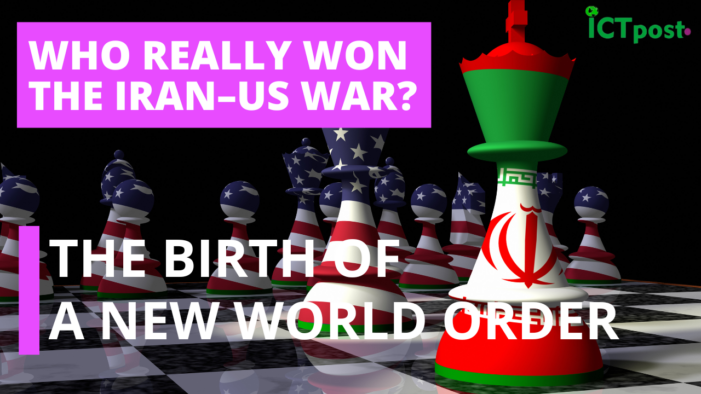
The 2026 Iran–US War may ultimately be remembered not for who won on the battlefield, but for what it revealed about power, deterrence, energy security, and the changing nature of global geopolitics.
What began on 28 February 2026 as a major U.S.–Israeli military campaign against Iranian targets evolved into a confrontation that disrupted energy markets, rattled global supply chains, tested alliance structures, and raised difficult questions about the relationship between military success and political outcomes.
Yet despite ceasefire arrangements and ongoing negotiations, one question continues to dominate strategic discussions:
Who actually won the war?
The answer depends entirely on how victory is measured.
If victory is defined by military damage inflicted, the United States and Israel can claim substantial success. If it is defined by political outcomes, economic leverage, strategic resilience, and long-term influence, the verdict becomes far less certain.
The Road to War
The conflict began when U.S. and Israeli forces launched extensive strikes against Iranian military infrastructure, missile facilities, air-defense networks, and leadership targets.
According to military assessments published during the conflict, the objective was to degrade Iran’s strategic capabilities and increase pressure on Tehran regarding its regional activities and nuclear program.
However, the conflict quickly evolved beyond conventional battlefield metrics.
Rather than relying solely on direct military confrontation, Iran responded through a combination of missile attacks, proxy networks, maritime pressure, economic disruption, and strategic signaling.
Within weeks, global markets reacted.
Shipping costs increased, insurance premiums rose, and major energy-importing economies began preparing for potential supply disruptions. The conflict evolved from a regional military confrontation into a global economic and strategic crisis.
The Strait of Hormuz: Geography as Power
Perhaps the most significant lesson of the conflict was that geography remains one of the most powerful instruments of statecraft.
The Strait of Hormuz is widely recognized as the world’s most important energy chokepoint. According to the International Energy Agency (IEA), approximately 20 million barrels of oil per day transit the strait, representing about one-quarter of global seaborne oil trade. China, India, Japan, and South Korea are among the largest consumers dependent on these flows. [iea.org], [eia.gov]
The U.S. Energy Information Administration (EIA) similarly notes that disruptions to Hormuz can rapidly affect global energy prices, shipping costs, and supply chains because alternative routes remain limited. [eia.gov], [eia.gov], [eia.gov]
This reality transformed the strategic equation.
While military analysts often focus on missiles, aircraft, and air-defense systems, the conflict demonstrated that control—or even the credible threat of disruption—over a critical maritime route can carry enormous geopolitical leverage.
As energy-security experts have repeatedly argued, strategic chokepoints remain among the most valuable sources of influence in international politics. [bakerinstitute.org], [iea.org]
The Ceasefire That Changed the Narrative
The ceasefire agreement reached in June 2026 altered the nature of the debate.
The agreement reportedly included provisions involving:
- Reopening of the Strait of Hormuz
- Suspension of offensive military operations
- Verification and inspection discussions
- Sanctions-related negotiations
- Regional de-escalation measures
- Follow-on diplomatic talks
Supporters described the agreement as evidence that military pressure had succeeded in bringing Iran to the negotiating table.
Critics argued the opposite.
They noted that despite months of military operations, Iran remained a functioning regional power and emerged as a participant in negotiations rather than a defeated adversary.
This distinction forms the central question of the entire conflict.
Was the objective military punishment?
Or was it political transformation?
The answer determines whether one views the war as a success, a failure, or something in between.
Three Competing Interpretations
Interpretation 1: The United States and Israel Won
Proponents of this view point to:
- Destruction of military infrastructure
- Degradation of missile and air-defense capabilities
- Demonstration of technological superiority
- Increased pressure on Iran’s strategic programs
- Restoration of deterrence credibility
Under this assessment, battlefield outcomes remain the most important measure of success.
Military objectives were substantially achieved, and therefore victory belongs to Washington and its allies.
Interpretation 2: Iran Achieved Strategic Success
Others reach a very different conclusion.
Their argument is that:
- The Iranian state survived.
- The government retained bargaining power.
- Strategic geography remained effective.
- Hormuz-related leverage influenced global calculations.
- Regional actors increasingly emphasized autonomy rather than dependence on external security guarantees.
Under this interpretation, Iran may have suffered military damage but avoided strategic defeat.
Interpretation 3: Nobody Truly Won
A growing number of analysts prefer a third interpretation.
According to this view:
- The United States incurred significant financial and political costs.
- Iran suffered substantial military and economic damage.
- Regional instability increased.
- Global markets experienced disruption.
- Strategic uncertainty remains unresolved.
The result is neither victory nor defeat, but a costly demonstration of the limits of military power in achieving political objectives.
What Strategic Thinkers Teach Us
John Mearsheimer: Military Power Has Limits
John Mearsheimer’s theory of offensive realism argues that states compete in an anarchic international system where power remains central to survival and influence. However, the theory also highlights that military capabilities alone cannot guarantee desired political outcomes. [britannica.com],
The key strategic question is therefore not:
“How much damage was inflicted?”
But rather:
“Were the original political objectives achieved?”
That question remains contested.
Thomas Schelling: The Power of Coercion
Thomas Schelling’s work on deterrence and coercive diplomacy emphasized that strategic influence often comes from the ability to shape the behavior of others rather than simply destroy military assets. [mwi.westpoint.edu]
During the conflict, threats of escalation, uncertainty regarding shipping routes, and concerns about regional instability became important bargaining tools.
This dynamic aligns closely with Schelling’s concept that risk itself can become a form of power. [mwi.westpoint.edu]
Henry Kissinger: Wars End Politically
Henry Kissinger consistently argued that military operations ultimately serve political objectives and that wars are judged by political outcomes rather than battlefield statistics alone. [history.state.gov], [britannica.com]
The Iran–US conflict appears to reinforce that lesson.
Military campaigns may alter facts on the ground. Lasting outcomes, however, are determined through diplomacy, negotiation, and the evolving balance of power.
Reference:
- https://history.state.gov/historicaldocuments/frus1969-76v01/d4
The Emerging Global Order
Beyond military outcomes, the conflict accelerated several important geopolitical trends.
Questions About Security Guarantees
Regional governments observed that even sophisticated military systems struggled to provide complete protection against missile and drone threats.
This has renewed discussions regarding strategic autonomy and diversified security partnerships.
Rise of Middle Powers
Countries such as India, Saudi Arabia, Türkiye, and the UAE increasingly pursue independent strategic paths rather than exclusive alignment with any single great power.
Energy Security Returns to the Forefront
The conflict reminded policymakers that energy security remains inseparable from national security.
The IEA and EIA continue to identify maritime energy chokepoints as critical vulnerabilities for the global economy. [iea.org], [eia.gov]
China’s Strategic Opportunity
Although not directly involved in combat, Beijing closely monitored developments while positioning itself as an economic and diplomatic partner for states seeking diversified relationships.
The conflict may accelerate broader multipolar trends in global politics.
Implications for India
For India, the conflict provides several important policy lessons.
India remains heavily dependent on Gulf energy imports, making uninterrupted access through the Strait of Hormuz critical for economic stability.
Any prolonged disruption affects:
- Energy prices
- Inflation
- Industrial production
- Fiscal planning
- Maritime security
The conflict reinforces the need for:
- Diversified energy sourcing
- Expanded strategic petroleum reserves
- Stronger maritime security capabilities
- Greater diplomatic engagement across West Asia
- Accelerated energy-transition investments
India’s policy of strategic autonomy appears increasingly relevant in an international environment characterized by uncertainty and competing power centers.
The most important lesson of the 2026 Iran–US War is that modern conflicts are no longer decided solely by battlefield outcomes.
They are shaped by:
- Military power
- Economic resilience
- Technology
- Energy security
- Maritime geography
- Information warfare
- Diplomacy
- Supply-chain stability
The conflict demonstrated that even the world’s most technologically advanced militaries may struggle to achieve clear political outcomes against resilient adversaries possessing strategic geography and asymmetric capabilities.
As negotiations continue, the final verdict of history remains unwritten.
However, one conclusion is already apparent:
The Iran–US War reshaped the strategic landscape of the Middle East, highlighted the enduring importance of energy security, and accelerated the emergence of a more complex multipolar international order.
The next chapter will not be written by missiles.
It will be written by diplomats, energy markets, technology, trade routes, and the evolving balance of power among competing global actors. editor@ictpost.com