
America’s Next Great Divide May Not Be Political. It May Be Artificial Intelligence.
By Dhirendra Pratap Singh | ICTpost USA | with ICTpost Research & Technology Desk
| The Big Picture: America’s next great divide may not be political. It may be technological. This ICTpost USA deep research report argues that artificial intelligence is creating a new economic gap between those who can effectively use AI and those who cannot. As AI rapidly boosts productivity across technology, finance, legal services, and other knowledge industries, the biggest benefits are increasingly flowing to workers, companies, and regions with access to advanced AI tools, capital, data, and digital skills. The article examines how AI adoption is concentrated in America’s innovation hubs such as Silicon Valley, Seattle, Boston, and New York, while many communities risk falling behind. It explores concerns from leading economists that AI could widen wealth inequality if productivity gains primarily benefit asset owners rather than workers. The report concludes that America’s future will depend on expanding AI literacy, investing in education, improving access to technology, and ensuring the benefits of the AI revolution are broadly shared across society. |
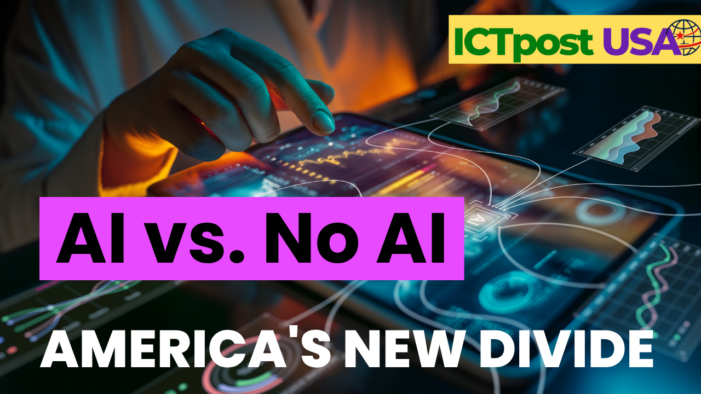
America has spent decades divided by politics: red versus blue, conservative versus liberal, Republican versus Democrat. But the most important divide of the next decade may be something entirely different: those who can harness AI and those who cannot. For millions of Americans, artificial intelligence is becoming a productivity superpower, enabling workers to accomplish in hours what once took days. For others, the AI revolution remains out of reach. As AI transforms industries, jobs, and wealth creation, access to intelligent tools is rapidly becoming a new source of economic advantage. This is no longer just a technology story. It is a story about opportunity, prosperity, and who gets to thrive in America’s next economic era. [hai.stanford.edu], [businessda….github.io]
The question is no longer whether AI will reshape America. The question is who will benefit from it.
The Birth of the AI Class
Every technological revolution has created winners and losers. Steam power enriched factory owners, electricity transformed industrial giants, and the internet created digital empires. Artificial intelligence may prove even more disruptive because it amplifies human intelligence itself. It can write, analyze, design, research, code, translate, and automate, dramatically increasing the productivity of those who know how to use it. Economists describe this as skill-biased technological change, where individuals with education, digital fluency, and access to advanced tools gain the greatest advantages. As AI spreads through the economy, opportunity is increasingly flowing toward people who can leverage these technologies and away from those who cannot.
Two Americas Are Emerging
For the purposes of this analysis, ICTpost USA uses the terms AI America and Non-AI America as descriptive categories rather than formal economic classifications. AI America includes workers, entrepreneurs, and investors who use AI daily, benefit from productivity gains, own financial and technology assets, and are concentrated in innovation-driven regions. Non-AI America consists of those with limited access to advanced AI tools, who rely primarily on wages, face slower technology adoption, and have fewer opportunities to participate in AI-driven wealth creation. The emerging divide is not primarily political. Increasingly, it is about access to intelligence amplification, and the economic advantages that come with it.
The AI Advantage in Real Life
Consider two workers experiencing the AI economy from opposite sides. In Austin, Texas, 29-year-old software consultant Michael Reynolds uses AI to write code, analyze data, summarize meetings, and prepare client proposals. Tasks that once required multiple employees can now be completed by a small team in a fraction of the time, boosting both productivity and income potential.
Meanwhile, in rural Ohio, Lisa Martinez, a customer service representative, faces a different reality. Her employer has begun deploying AI systems that can handle many of the routine inquiries she once managed. While she recognizes the technology’s potential, access to AI training and reskilling opportunities remains limited.
Their experiences reflect a broader shift taking place across America. The emerging divide is increasingly not between political parties or regions, but between those who have the tools and skills to leverage AI and those struggling to keep pace. As artificial intelligence becomes a powerful driver of economic growth, access to AI may become one of the most important determinants of opportunity in the decade ahead.
America’s AI Geography
One of the biggest myths of the digital age was that technology would erase geography. Artificial intelligence may be doing the opposite. Research from Anthropic’s Economic Index shows that AI adoption remains concentrated among specific occupations, firms, and regions, with usage disproportionately clustered in knowledge-intensive industries and high-income innovation centers. [Anthropic Economic Index] [Anthropic Research] The biggest beneficiaries are familiar innovation hubs such as Silicon Valley, Seattle, Boston, New York, and Washington, D.C., regions that already possess elite universities, deep venture-capital networks, thriving technology sectors, and highly skilled talent pools.
History suggests that transformative technologies rarely spread evenly in their early stages. Instead, they tend to reinforce existing centers of innovation before diffusing more broadly across the economy. The result is an emerging AI geography in which a person’s ZIP code may increasingly influence access to opportunity, investment, productivity gains, and long-term wealth creation.
Who Owns the AI Boom?
Perhaps the most important question surrounding artificial intelligence is not how much wealth it will create, but who will ultimately capture that wealth. The AI boom has already fueled hundreds of billions of dollars in investment and added trillions of dollars in market value to leading technology companies. Yet the rewards are flowing disproportionately to those who already own stocks, technology assets, venture capital investments, and intellectual property. Economists often describe this phenomenon as the wealth effect: when the value of assets rises, those who own them become wealthier. For many Americans, however, the AI revolution remains more tangible in headlines and market indices than in everyday household finances. This creates a growing contradiction at the heart of the new economy: Wall Street is already profiting from AI, while much of Main Street is still waiting for its share of the future.
The Return of Labor vs. Capital
For more than a century, economists have debated a fundamental question: Who benefits most from technological progress, workers or owners? Artificial intelligence has revived that debate. Today’s most powerful AI systems are controlled by companies that own the models, data, and computing infrastructure behind them. While workers use these tools, few own the assets generating the greatest returns.
MIT economist and Nobel laureate Daron Acemoglu argues that AI’s impact will depend largely on how its gains are distributed. The concern is not simply job displacement, but a future in which workers become more productive while a growing share of the rewards flows to the owners of capital, algorithms, and platforms. In the AI era, the defining economic tension may not be labor versus machines, but labor versus ownership.
The Productivity Paradox
There is little debate that artificial intelligence can boost productivity. Research highlighted in Stanford’s AI Index shows measurable gains across software development, customer service, business operations, scientific research, and other forms of knowledge work, with many studies reporting productivity improvements ranging from approximately 10% to 45% depending on the task and industry. [Stanford AI Index 2025] However, productivity and prosperity are not necessarily the same thing. For much of modern history, rising productivity helped support higher wages and the growth of the middle class. In the AI era, that relationship is no longer guaranteed. Workers may become significantly more productive while a disproportionate share of the economic gains flows to investors, shareholders, and owners of AI-driven assets. The critical question is no longer whether AI will create wealth. It is who will share in the wealth that AI creates. [hai.stanford.edu], [hai.stanford.edu]
America’s Invisible AI Elite
The emerging AI elite is not defined simply by income. It is increasingly defined by ownership and access. The biggest winners in the AI economy control five critical assets: computing power, advanced AI models, proprietary data, investment capital, and elite technical talent. Together, these assets create a powerful self-reinforcing cycle. More AI drives higher productivity, higher productivity generates larger profits, and those profits fund even more advanced AI systems and infrastructure. This dynamic helps explain why many economists believe AI is not creating entirely new forms of inequality so much as amplifying existing advantages. In the AI economy, access matters. Ownership may matter even more.
What Experts Are Saying About the AI Divide
Leading economists differ on the extent of AI’s impact, but they increasingly agree on one point: distribution matters. MIT economist Daron Acemoglu argues that AI’s benefits will depend on whether it complements workers or replaces middle-income tasks, while Erik Brynjolfsson believes AI can boost both productivity and opportunity when organizations invest in workforce adaptation. Brookings researchers, including Mark Muro, warn that AI may further concentrate economic activity in already prosperous innovation hubs. Anthropic’s research similarly finds that AI adoption remains uneven across occupations, firms, and regions. [Anthropic Research] [Anthropic Economic Index] The emerging consensus is clear: the biggest AI question is no longer whether wealth will be created, but whether its benefits can be broadly shared.
The Numbers Behind the AI Divide
Enterprise Adoption
- 78% of organizations reported using AI in at least one business function in 2024. [hai.stanford.edu]
- 71% reported using generative AI in at least one business function. [hai.stanford.edu]
Investment
- U.S. private AI investment reached approximately $109.1 billion in 2024, far exceeding most competing nations. [hai.stanford.edu]
Productivity
- Studies highlighted in Stanford’s AI Index found productivity gains ranging from approximately 10% to 45% across multiple occupations and use cases. [hai.stanford.edu]
Concentration
- Early AI adoption remains concentrated among specific firms, regions, and knowledge-intensive occupations. [arxiv.org], [anthropic.com]
The message behind the numbers is clear.
AI is spreading rapidly.
Its benefits are spreading less evenly.
The Rise of the One-Person Empire
There is another side to the AI story, and it is far more optimistic. By dramatically reducing the cost of starting and scaling a business, AI is giving individuals capabilities that once required entire teams. Today, a single entrepreneur can build software, create marketing campaigns, design digital products, conduct market research, generate content, and manage customer support with the assistance of AI tools. As a result, two seemingly contradictory trends may emerge at the same time: millions of workers could face growing pressure from automation, while millions of entrepreneurs gain unprecedented opportunities to launch and grow businesses. Both realities can coexist, making AI not only a force of disruption but also a powerful engine of entrepreneurship and economic opportunity.
How AI Is Creating a New Type of Entrepreneur
Three years ago, Sarah Kim, a former marketing manager in Denver, might have needed a team of designers, writers, analysts, and developers to launch an online business. Today, much of that support comes from AI. Using AI-powered tools, she creates marketing campaigns, conducts market research, designs product visuals, manages customer communications, and even assists with software development. Tasks that once required significant capital and a large team can increasingly be handled by a lean operation led by a single entrepreneur. Success is never guaranteed, and entrepreneurship remains inherently risky. Yet AI is lowering barriers to entry at a scale not seen since the rise of the internet. Ironically, the same technology that could widen economic inequality may also unleash one of the largest waves of small-scale entrepreneurship in modern history.
Education: America’s Most Important AI Investment
America does not need 330 million AI engineers. It needs 330 million citizens who can work effectively alongside AI. Just as computer literacy became essential during the internet age, AI literacy is rapidly emerging as a foundational workforce skill. Understanding how AI works, when to trust it, how to verify its outputs, and how to use it responsibly may soon become as important as reading, writing, and mathematics. Stanford’s Human-Centered AI (HAI) initiative has highlighted the growing importance of AI literacy as AI adoption expands across industries and occupations. [Stanford HAI] [hai.stanford.edu], [hai.stanford.edu]
The challenge extends well beyond schools. As millions of workers adapt to changing job requirements, community colleges, workforce-training programs, and employer-led initiatives could become the backbone of America’s reskilling effort. UNESCO has emphasized the importance of integrating AI understanding and ethical AI education into education systems worldwide, while organizations such as the OECD and the World Economic Forum warn that rapid technological change will require continuous learning and workforce adaptation throughout people’s careers. [UNESCO] [OECD AI] [World Economic Forum] [unesco.org], [oecd.ai], [weforum.org]
Ironically, the rise of artificial intelligence may increase the value of uniquely human capabilities. As machines become better at processing information and automating routine tasks, skills such as critical thinking, leadership, communication, creativity, collaboration, emotional intelligence, and ethical judgment are likely to become even more important. Ultimately, the countries that succeed in the AI century may not be those with the most powerful computers or algorithms. They may be the ones that build the most adaptable, resilient, and AI-literate workforce.
Can America Close the AI Gap?
Several policy ideas are gaining increasing attention as policymakers, educators, and industry leaders look for ways to ensure that the benefits of AI are more broadly shared. One approach is regional AI investment, which seeks to expand innovation ecosystems beyond traditional technology hubs and bring new opportunities to emerging regions across the country, a priority highlighted by research on AI’s geographic concentration. [Anthropic Research] [Stanford HAI] Another is the development of public compute infrastructure, giving universities, startups, researchers, and small businesses greater access to the advanced computing resources that increasingly determine AI competitiveness. [Stanford AI Index 2025]
Experts have also advocated for worker-centered AI deployment, encouraging organizations to use AI to augment human capabilities and enhance productivity rather than simply replace jobs, an approach supported by research showing that AI often delivers the greatest benefits when paired with human expertise. [Stanford AI Index 2025] Finally, some economists argue for broader ownership models that create more opportunities for employees and households to participate in technology-driven wealth creation, helping ensure that the gains generated by AI are distributed more widely across society. History suggests that major technological revolutions often widen inequality before institutions, markets, and education systems adapt. The challenge for America is ensuring that adaptation occurs quickly enough to prevent the AI revolution from becoming a new source of economic division while maximizing its potential to drive innovation, productivity, and shared prosperity.
Three Futures for America
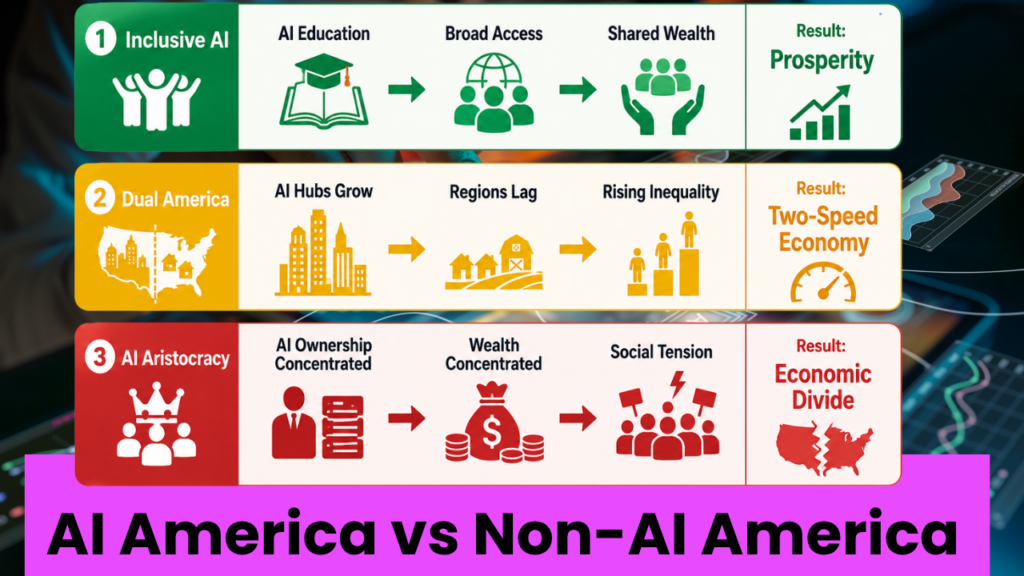
America now stands at a crossroads, with three very different AI futures ahead. In the most optimistic scenario, Inclusive AI, AI literacy becomes widespread, access to technology expands, and productivity gains are broadly shared across society, improving economic mobility and creating new opportunities for workers and entrepreneurs alike.
In a second scenario, Dual America, innovation hubs continue to pull ahead while many regions struggle to keep pace, resulting in a two-speed economy where access to opportunity increasingly depends on geography and digital readiness.
The third scenario, Concentrated AI Wealth, sees ownership of advanced AI systems, data, and computing infrastructure remain concentrated among a relatively small group of companies and investors, allowing capital to accumulate faster than labor income and widening the economic divide. Which path America ultimately follows will depend not only on technological progress, but also on decisions related to education, workforce development, investment, competition, and public policy.
According to Stanford’s AI Index, U.S. private AI investment surpassed $109 billion in 2024, highlighting the extraordinary speed of America’s AI expansion. The question is no longer whether AI will create wealth. It is whether that wealth will be widely shared or increasingly concentrated in the hands of a few.
The Choice Ahead
America now faces a defining choice. Artificial intelligence could become one of the greatest engines of entrepreneurship, productivity, and prosperity in modern history, unlocking new opportunities for individuals, businesses, and communities across the country. Or it could reinforce economic divides that already exist beneath the surface of the economy, concentrating wealth and opportunity among those with the greatest access to technology, capital, and skills.
The outcome is not predetermined. Technology alone does not decide who benefits. People, institutions, markets, and public policy will play an equally important role in shaping the future. The story of AI is still being written, but one reality is becoming increasingly difficult to ignore: the defining divide of the next decade may not be Red America versus Blue America. It may be the gap between those empowered by AI and those left behind by it. Those who understand AI will gain productivity. Those who build AI will gain influence. Those who own AI may gain extraordinary wealth. The challenge for America is to ensure that the opportunities created by artificial intelligence are broad enough to strengthen the nation, expand economic mobility, and drive shared prosperity rather than deepen existing divides.
Key Takeaways
✅ AI is emerging as a powerful driver of both opportunity and inequality.
✅ AI adoption remains concentrated in leading regions and knowledge-intensive industries.
✅ Ownership may become more important than employment in determining who benefits from AI.
✅ Education and AI literacy could be America’s most important long-term AI investment.
✅ The future of the AI economy will depend on access, skills, ownership, and shared prosperity.
Sources
- Stanford AI Index 2025: https://hai.stanford.edu/ai-index/2025-ai-index-report
- Stanford Human-Centered AI (HAI): https://hai.stanford.edu/ai-index
- Anthropic Economic Index: https://www.anthropic.com/economic-index
- Anthropic Economic Index Research: https://arxiv.org/abs/2511.15080
- UNESCO Artificial Intelligence in Education: https://www.unesco.org/en/digital-education/artificial-intelligence
- UNESCO Recommendation on the Ethics of Artificial Intelligence: https://www.unesco.org/en/artificial-intelligence
- OECD AI Policy Observatory: https://oecd.ai/
- World Economic Forum Future of Jobs Report 2025: https://www.weforum.org/publications/the-future-of-jobs-report-2025/
editor@ictpost.com
Follow author on LinkedIn , YouTube and X.

The author Dhirendra Pratap Singh works at the intersection of Artificial Intelligence, the digital economy, public policy, and emerging technologies, exploring how technological revolutions are reshaping societies, governance systems, and global power structures. His work focuses on interpreting complex technological shifts—from AI and digital public infrastructure to technology geopolitics—and translating them into actionable insights for policymakers, institutions, and industry leaders navigating a rapidly evolving global technology landscape.