
By ICTpost Futurecast Bureau
A Workforce That Doesn’t Exist—Yet Is Already Here
By 2030, your most productive colleague may not be human—or even physical. It could be an autonomous AI agent working 24/7: negotiating contracts, managing supply chains, responding to customers, and optimizing decisions in real time.
What began as automation is evolving into something far more profound: Digital Workers-as-a-Service (DWaaS)—AI systems that don’t assist humans but increasingly perform entire roles.
As futurist Bernard Marr puts it:
“Rather than subscribing to tools, businesses can now subscribe to autonomous AI agents that do work for us.” [forbes.com]
This marks the transition from the software era to the agentic economy—where intelligence itself becomes a rentable resource.
From SaaS to AI Labor Markets
For two decades, the dominant model was Software-as-a-Service (SaaS). Now, a new paradigm is emerging: AI-as-a-Service → Digital Workers-as-a-Service.
Agentic AI differs fundamentally from traditional automation:
- It can reason and plan, not just execute
- It can operate autonomously across systems
- It can collaborate with other AI agents
- It improves continuously with minimal human input
In effect, companies are no longer buying tools—they are hiring non-human labor.
The Numbers Behind the Shift
This transformation is not speculative—it is already being quantified:
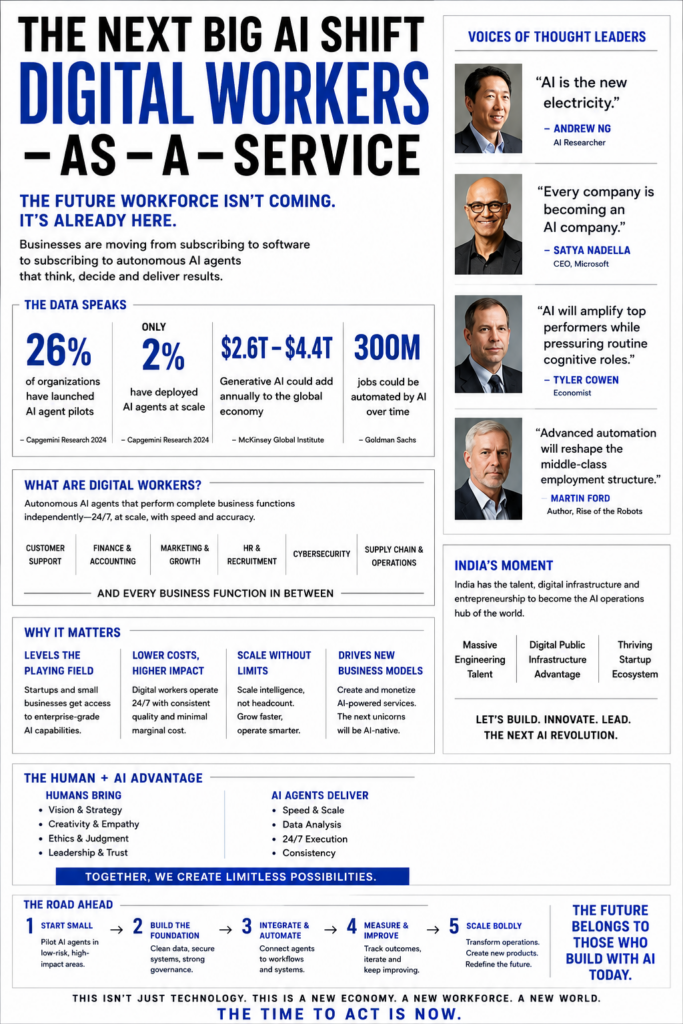
- $2.6–$4.4 trillion: Annual economic value generative AI could add globally [mckinsey.com]
- $15.7 trillion by 2030: Potential total contribution of AI to global GDP [pwc.co.nz]
- 300 million jobs: Roles exposed to AI-driven automation globally [firstpost.com]
Yet adoption remains early:
- Only 2% of organizations have fully scaled AI agents, while roughly a quarter remain in pilot stages [capgemini.com]
This gap between potential and deployment defines the current moment—and the opportunity.
The Emergence of AI Labor Marketplaces
The real disruption is not automation—it is modular intelligence.
Instead of hiring teams, companies are beginning to assemble on-demand AI workforces:
- Legal AI drafting contracts and compliance filings
- Finance AI managing audits, tax, and forecasting
- Marketing AI running campaigns autonomously
- Procurement AI negotiating supplier terms
- Cybersecurity AI monitoring threats in real time
This signals the rise of AI labor marketplaces, where intelligence is:
- Scalable
- On-demand
- Globally accessible
A startup can now deploy capabilities that once required entire departments.
The New Competitive Divide
The next global divide will not be geography—it will be AI integration.
Organizations are entering a new competitive phase:
Humans + AI vs Humans Alone
AI-first companies are already resolving customer queries end-to-end, generating code at scale, predicting financial outcomes, and running autonomous supply chains with minimal human intervention. And the advantage compounds. Every interaction generates new data, every workflow improves the model, and every automated decision increases speed, efficiency, and profitability. Organizations that embed AI deeply into their operations are not just reducing costs—they are creating self-learning enterprises capable of adapting in real time. This shift is redefining competition across industries, where the gap between AI-native firms and traditional businesses is widening rapidly. In the coming decade, the real differentiator will not simply be access to AI tools, but how effectively companies redesign their culture, processes, and decision-making around intelligent systems.
According to PwC, AI could boost global GDP by 14% by 2030, reshaping productivity at a macroeconomic level. [pwc.com.au]
India: At a Strategic Inflection Point
For India, this transformation could rival the IT outsourcing boom.
Key advantages:
- Deep engineering talent pool
- World-leading digital public infrastructure
- Rapidly scaling startup ecosystem
But the strategic question is critical:
Will India build AI—or merely consume it?
If the country relies on foreign AI platforms, it risks losing control of value creation.
If it builds sovereign AI ecosystems, it could become the global orchestration hub for digital labor.
The next Infosys or TCS may not deliver software services—but manage millions of AI agents worldwide.
Why Most Organizations Will Fail
Technology is not the biggest barrier—culture is. Most enterprises are still attempting to deploy AI agents on fragmented legacy systems, poor-quality data, and weak governance structures that were never designed for autonomous decision-making. But autonomous AI cannot function effectively in disconnected environments. It requires clean and structured data pipelines, real-time system integration, transparent audit trails for every decision, and robust cybersecurity frameworks to ensure trust and accountability. The challenge is no longer about accessing AI tools; it is about transforming organizational foundations to support intelligent, continuously operating systems.
Capgemini notes that over 80% of organizations lack mature AI infrastructure, limiting scalability. [capgemini.com]
As Microsoft CEO Satya Nadella has emphasized:
“Every company is becoming an AI company.”
But becoming one requires reinvention—not adoption.
The Human Question
The rise of digital workers raises deeper questions than technology:
- What happens to entry-level jobs?
- How do workers build experience in automated industries?
- Will AI concentrate wealth further?
- Can education systems adapt in time?
Economists increasingly argue that AI will not eliminate work—but reshape it unevenly, amplifying top performers while compressing routine roles.
This is not just a tech shift—it is a civilizational transition.
The Most Valuable Skill: Managing Intelligence
In the industrial era, humans operated machines.
In the AI era, humans may need to manage intelligence itself.
Future-ready professionals will:
- Direct AI agents strategically
- Validate outputs critically
- Combine machine insights with human judgment
- Build trust, ethics, and creativity into systems
Paradoxically, as machines advance, human traits become more valuable:
Creativity. Judgment. Empathy. Vision.
These remain difficult to automate—at least for now.
A Trillion-Dollar Window Still Open
History suggests that early movers define technological eras:
- Cloud computing → AWS, Salesforce
- Mobile internet → Apple, Google
- Social platforms → Meta, Tencent
AI could be bigger than all of them combined.
And the window is still open.
Most systems today are experimental—meaning the rules of the AI economy are still being written.
The Defining Question of the 21st Century
The rise of Digital Workers-as-a-Service is not just another tech wave.
It is a restructuring of how value, labor, and intelligence are organized globally.
Which leads to a fundamental question:
Will nations and companies own AI systems—or simply rent intelligence from those who do?
Because in the age of digital workers,
ownership of intelligence may become the ultimate source of power.