
By Dhirendra Pratap Singh and ICTpost Cyber Intelligence Bureau
AI swarm attacks are no longer confined to the realm of science fiction. As generative AI and autonomous agents rapidly evolve, cybersecurity experts are warning that the next wave of cyber warfare could be driven by coordinated AI systems capable of launching highly adaptive, machine-speed attacks with minimal or no human intervention. Unlike conventional cyberattacks, these AI-powered swarms can independently perform reconnaissance, identify vulnerabilities, craft phishing campaigns, evade detection systems, and execute data theft operations continuously across multiple targets simultaneously.
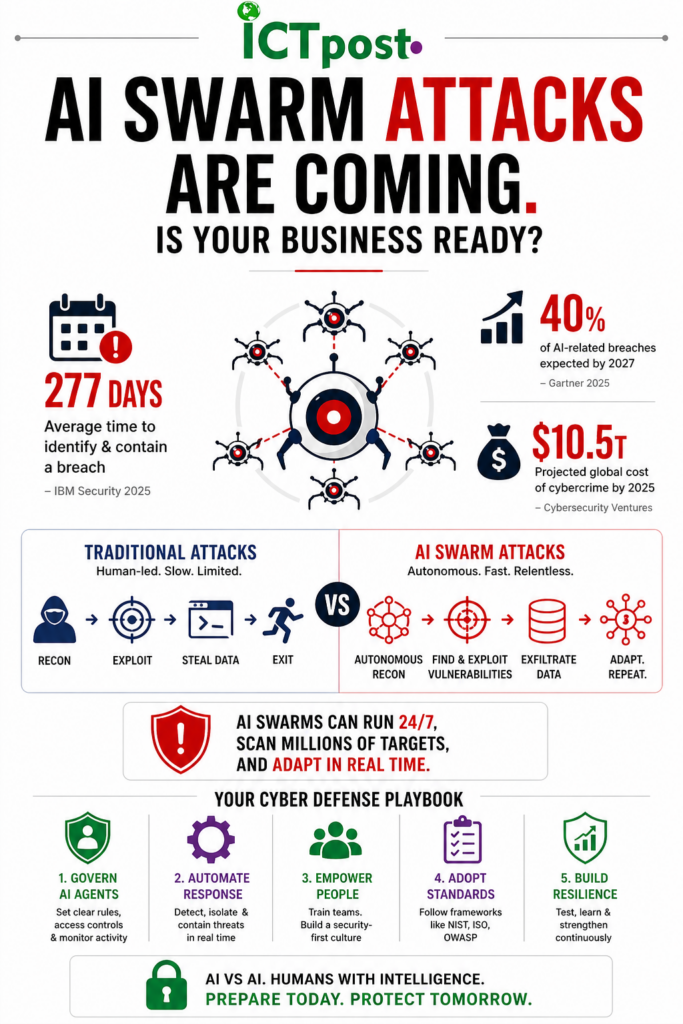
The scale of the threat is becoming increasingly alarming. According to global cybersecurity reports, AI-assisted cyberattacks surged significantly in 2025, with automated phishing, deepfake-enabled fraud, and AI-generated malware becoming more sophisticated and accessible. Industry analysts estimate that cybercrime could cost the global economy over $10 trillion annually, while security firms are already witnessing early forms of coordinated autonomous attack systems capable of learning and adapting in real time. Although fully mature “AI swarms” are still emerging rather than universally deployed, the trajectory is clear: cyber threats are becoming faster, smarter, more automated, and massively scalable. This shift is forcing governments, enterprises, and security researchers worldwide to rethink traditional defense mechanisms in an era where machines may soon battle machines in cyberspace.
How Cyberattacks Are Quietly Changing
For years, cyberattacks were largely human‑driven. Hackers worked in teams, scanned systems manually, and adjusted methods slowly. Artificial intelligence reduces these limitations.
Security researchers and vendors now observe AI being used to automate vulnerability scanning, generate malware variants, test attacks, and adjust tactics when defenses change. Tools analyzed by IBM, Check Point, and others already show AI assisting attackers across multiple stages of an operation.
Bernard Marr notes that AI agents can work “constantly, at machine speed, and at massive scale”—a sharp contrast to human‑paced attacks (Forbes).
This does not mean millions of fully autonomous bots are already everywhere. It means the direction of travel is clear.
Why Speed, Not Sophistication, Is the Biggest Risk
One reason AI‑enabled threats matter is the widening gap between attacker speed and defender response.
According to IBM’s long‑running Cost of a Data Breach Report, organizations still take an average of 277 days to identify and contain a breach (IBM Security). That delay made sense when attackers also moved slowly.
AI changes that balance. Automated tools can test thousands of possibilities in minutes. Even if many attempts fail, only one successful path is needed.
Cybersecurity expert Bruce Schneier has repeatedly emphasized that attackers increasingly operate at computer speed, while defenders are often limited by human processes and approval chains (Schneier.com).
AI Has Become a New Attack Surface
AI is not just a weapon used by attackers—it is increasingly a weak point inside organizations.
Companies worldwide are deploying AI assistants, coding copilots, customer chatbots, and agentic systems that can act autonomously. These tools often have access to internal data and systems.
Research firm Gartner warns that by 2027, over 40% of AI‑related data breaches will result from the improper use or compromise of generative AI systems, not from traditional hacks (Gartner).
In simple terms, AI was adopted faster than it was secured.
Deepfakes Have Turned Trust Into a Vulnerability
The most visible example of AI‑driven cybercrime is deepfake fraud.
In one well‑documented case, a multinational company’s Hong Kong office transferred about $25 million after an employee joined a video call where every participant—including the CFO—was an AI‑generated fake (McAfee).
This incident mattered not only because of the money involved, but because it showed how AI attacks bypass technology entirely and target human trust.
Security teams increasingly remind employees that seeing and hearing are no longer reliable forms of verification.
India’s Digital Scale Raises Both Opportunity and Risk
India illustrates how digital success also expands exposure.
The country’s digital public infrastructure—including Aadhaar, UPI, and large‑scale data platforms—serves hundreds of millions of people. These systems have driven financial inclusion and efficiency, a process heavily shaped by technologist Nandan Nilekani (Stanford Doerr School).
But scale cuts both ways. Systems that touch nearly everyone also attract adversaries looking for leverage. AI‑enabled fraud or disruption does not need to succeed often to cause meaningful harm.
India is not uniquely vulnerable—it is simply ahead of the curve many economies are approaching.
Separating Reality From Hype
It is important to be precise.
Today’s threats are mostly AI‑assisted, not fully autonomous swarms acting independently. Many concepts around self‑learning malware or massive agent coordination are still emerging, tested in research or limited deployments.
At the same time, dismissing the trend would be risky. As Sundar Pichai has said, AI amplifies human intent—for good or bad (QuotesX). Even modest automation can dramatically lower the cost of cybercrime.
Why Traditional Defenses Need Updating
Traditional cybersecurity assumes time for investigation and escalation. AI reduces that margin.
Experts increasingly argue for systems where automation supports human decision‑making, not replaces it—allowing immediate containment while preserving accountability.
Microsoft CEO Satya Nadella has repeatedly emphasized that trust is built through security‑by‑design and responsible deployment, not speed alone (Microsoft Blog).
What Organizations Should Focus On Now
Most organizations do not need exotic new tools. They need basics executed well.
AI systems require clear ownership, access limits, and monitoring. Automated detection and response should be used to shorten reaction times. Employees must be trained to verify unusual requests, especially involving money or credentials.
Frameworks such as zero‑trust architectures and emerging AI risk management standards provide structure without prescribing one solution.
A Leadership Question That Cannot Be Avoided
The hardest decisions are not technical.
If an AI system detects serious compromise, should it act autonomously? Who is accountable if automated defense disrupts operations?
Bernard Marr argues that AI adoption forces leadership teams to define trust and control explicitly, before crises occur (Forbes).
Less Fear, More Preparedness
AI swarm attacks are best understood as a trajectory, not a sudden war. The technologies enabling faster, cheaper, and more scalable attacks already exist. Their impact will depend on how quickly defenses evolve.
The core message is measured but urgent:
As threats accelerate, defenses must adapt thoughtfully—not react in panic.
The future of cybersecurity will be shaped not by hype, but by governance, realism, and intelligent cooperation between humans and machines. editor@ictpost.com