
The Future of Medicine Is Here: AI Can Predict Cancer Years Before Symptoms Appear
ICTpost BioFrontiers Bureau
In the long history of medicine, humanity has fought many diseases. Few battles, however, have been as relentless—or as devastating—as the fight against cancer.
For decades, the frontline defenders were radiologists, pathologists, microscopes, and imaging machines. Diagnosis relied on human expertise—often limited by time, fatigue, and the complexity of medical data.
Today, a new force has entered this battlefield. Artificial Intelligence.
From deep-learning algorithms analyzing mammograms to AI systems predicting cancer risk years before symptoms appear, medicine is witnessing one of the most transformative technological revolutions in its history.
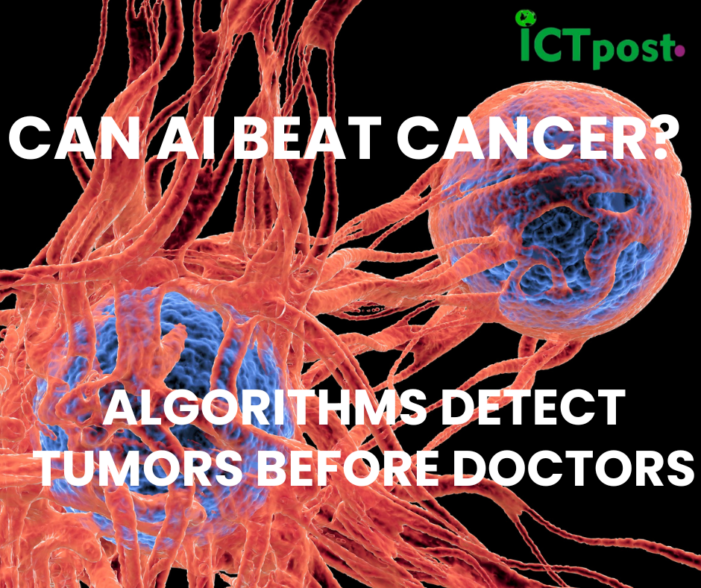
In multiple studies across the world, AI systems are already detecting cancer earlier than doctors—identifying microscopic patterns invisible to the human eye.
This is no longer experimental technology. It is already entering hospitals, cancer screening programs, and diagnostic laboratories worldwide. And it could redefine the future of healthcare.
Scientists Reveal AI That Can Detect 50 Types of Cancer from a Single Blood Test
Cancer remains one of the greatest public health challenges of the 21st century.
According to global health data: Over 19 million new cancer cases are diagnosed every year .More than 10 million people die annually from cancer. Breast cancer alone affects over 2.3 million women globally
But the tragedy is not just the disease itself. It is late detection.
When cancer is identified early, survival rates improve dramatically.
Stage of Detection Survival Rate
Early-stage cancer… 90%+ survival
Late-stage cancer…Often below 30%
Early detection saves lives. And this is exactly where Artificial Intelligence is changing the equation.
How AI Could Save Millions of Lives by Detecting Cancer Before It Starts
Artificial Intelligence excels at recognizing patterns in enormous datasets. Modern cancer detection systems combine:
- Deep learning neural networks
- Medical imaging analysis
- Genomic data processing
- Predictive risk modeling
AI algorithms are trained on millions of medical scans.
Over time, they learn to detect subtle abnormalities—tiny lesions, cellular distortions, or molecular signals—that human doctors may overlook.
AI Cancer Detection Workflow
Medical Imaging (MRI / CT / Mammography)
↓
AI Deep Learning Models
↓
Pattern Recognition
↓
Suspicious Lesion Identification
↓
Risk Scoring for Doctors
Rather than replacing doctors, AI acts as a powerful second pair of eyes.
Landmark Research: AI vs Radiologists
Scientific evidence supporting AI-driven cancer detection is rapidly accumulating.
One of the largest trials in the world involved 100,000 women in Sweden.
Researchers found that AI-assisted screening significantly improved early cancer detection.
Outcomes:
- More cancers detected during screening
- 12% reduction in late-stage cancer diagnoses
- AI successfully flagged suspicious regions for radiologists
The findings demonstrate that AI can significantly enhance national cancer screening programs.
Another large-scale analysis involving 463,094 women revealed that AI-assisted screening increased detection rates.
Results showed:
- 17.6% higher cancer detection rate with AI support
- Detection increased from 5.7 to 6.7 cases per 1,000 screenings
At population scale, even small improvements can translate into thousands of lives saved every year.
AI vs Doctors: Who Performs Better?
In one clinical evaluation involving 101 radiologists, researchers compared human diagnosis with AI systems.
Results were striking. The AI system:
- Matched the average diagnostic accuracy of radiologists
- Outperformed more than 60% of doctors individually
However, the most experienced radiologists still slightly outperformed AI. The conclusion from researchers was clear:
The future of medicine is not AI versus doctors.
It is AI plus doctors.
What Experts Say About AI in Cancer Detection
Leading scientists and medical experts believe AI will fundamentally transform healthcare.
Eric Topol Executive Vice President, Scripps Research says, “Artificial intelligence will transform medicine by improving diagnosis and enabling earlier disease detection.”
Dr. Kristina Lång, Lead researcher, MASAI Trial says, “AI can function as a second set of eyes for radiologists.”
Fei-Fei Li, AI Scientist from Stanford University says, “Healthcare will be the biggest beneficiary of artificial intelligence.”
Dr. Daniel Rueckert, Professor of AI in Medicine, Imperial College London says, “AI allows us to analyze medical images at a scale impossible for humans.”
Predicting Cancer Years Before It Appears
Perhaps the most powerful capability of AI is not just detection. It is prediction.
Researchers are now building AI systems capable of predicting cancer risk years before symptoms appear.
A deep-learning model trained on 161,753 mammography scans demonstrated strong ability to predict breast cancer risk within five years using imaging data alone.
Imagine a future where AI tells doctors: “This patient has a 70% probability of developing cancer within five years.”
Doctors could intervene long before tumors become dangerous. This emerging field is known as Predictive Oncology.
AI Diagnostic Accuracy Is Rising Rapidly
Recent research demonstrates astonishing levels of AI diagnostic performance.
AI System Accuracy
Endometrial cancer detection AI 99.26% accuracy
Breast cancer AI detection Up to 99% accuracy in some studies
Prostate cancer AI diagnosis 98% accuracy
Such performance levels rival—and sometimes exceed—many traditional diagnostic methods.
The Rise of Multi-Cancer Blood Tests
One of the most revolutionary developments is the emergence of AI-powered blood tests capable of detecting multiple cancers simultaneously.
A technology known as the Galleri multi-cancer early detection test can identify more than 50 types of cancer from a single blood sample.
In a clinical study involving 23,000 participants:
- Cancer signals were detected in 216 individuals
- 133 cancer cases were confirmed
- The tissue of origin was identified with 92% accuracy
Even more significant:
More than 50% of detected cancers were early-stage.
And nearly 75% of these cancers currently have no routine screening tests.
This could redefine population-scale cancer screening.
The Next Wave of AI Cancer Technologies
Several breakthrough technologies are now emerging across the healthcare ecosystem.
- AI Radiology
Automated analysis of CT scans, MRIs, and mammograms.
- AI Pathology
Deep-learning models scanning tissue samples to identify tumor cells.
- Liquid Biopsy AI
Machine learning analyzing circulating tumor DNA (ctDNA) in blood.
- Genomic AI
Algorithms studying DNA mutations to identify cancer risk.
- AI Biosensors
Next-generation molecular sensors capable of detecting early cancer biomarkers.
Together, these technologies are forming a new AI-driven diagnostic infrastructure.
Why AI Matters for India
For countries like India, AI-powered diagnostics could be transformational. India faces:
- Severe shortage of radiologists
- A rapidly growing cancer burden
- Limited screening programs
AI could enable mass-scale cancer screening across the country.
Possible applications include:
- AI mammography vans for rural areas
- Smartphone-based skin cancer detection
- AI-powered pathology labs
- Low-cost blood-based screening tests
For a country with 1.4 billion people, such systems could save millions of lives.
India has already begun investing in this space.
The IndiaAI initiative and the National Cancer Grid are funding AI-driven cancer diagnostics under the CATCH grant program.
Meanwhile, researchers at IIT-BHU have developed portable biosensors capable of detecting bone cancer biomarkers.
The Risks and Challenges
Despite the promise, AI medicine also raises important questions.
Over-Reliance on AI
Doctors may risk losing diagnostic skills if they rely too heavily on algorithms.
Data Bias
AI systems trained on Western populations may not perform equally well globally.
Regulation
Healthcare regulators must validate AI systems before clinical deployment.
Explainability
Doctors must understand why AI made a prediction. This is why Explainable AI (XAI) is becoming a critical research area in healthcare.
The Future: Predictive Medicine
Experts believe the next decade will transform oncology. AI systems may soon be able to:
- Predict cancer risk years in advance
- Monitor tumor growth through blood tests
- Personalize treatments using genomic data
- Design targeted therapies using machine learning
This shift toward precision oncology will enable treatments tailored to each patient’s genetic profile.
A New Era in the War Against Cancer
Artificial Intelligence is not just another technology entering healthcare. It represents a civilizational shift in medicine. AI will transform healthcare in three fundamental ways:
-Early detection
-Predictive medicine
-Personalized treatment
For decades, cancer diagnosis depended largely on the trained eyes of doctors. In the coming decade, the most powerful diagnostic tool may not be a microscope or imaging machine.
It may be an algorithm. And in humanity’s long war against cancer, AI could become our most powerful weapon yet. editor@ictpost.com