
The semiconductor chokepoint, the three-theater challenge, and the ultimate stress test of American power
By Dhirendra Pratap Singh, ICTpost USA | with team Strategic Affairs & Technology
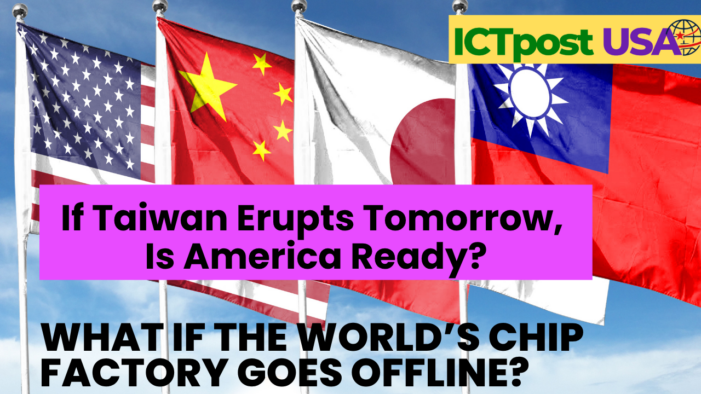
Imagine waking up one morning to a rapidly escalating crisis in the Taiwan Strait. Chinese military aircraft are moving across the region, warships are approaching Taiwan’s major ports, missile units are on alert, and cyberattacks are disrupting communications and financial networks across Asia.
Beijing does not announce an invasion. Instead, it declares exclusion zones around Taiwan and begins inspecting, delaying or restricting commercial shipping. Within hours, financial markets fall, shipping insurers reassess routes, technology companies begin emergency meetings, and the White House convenes the National Security Council.
Japan raises its military readiness. Across Silicon Valley, Seoul and other technology hubs, one question suddenly becomes urgent: What happens if Taiwan’s semiconductor factories can no longer supply the world?
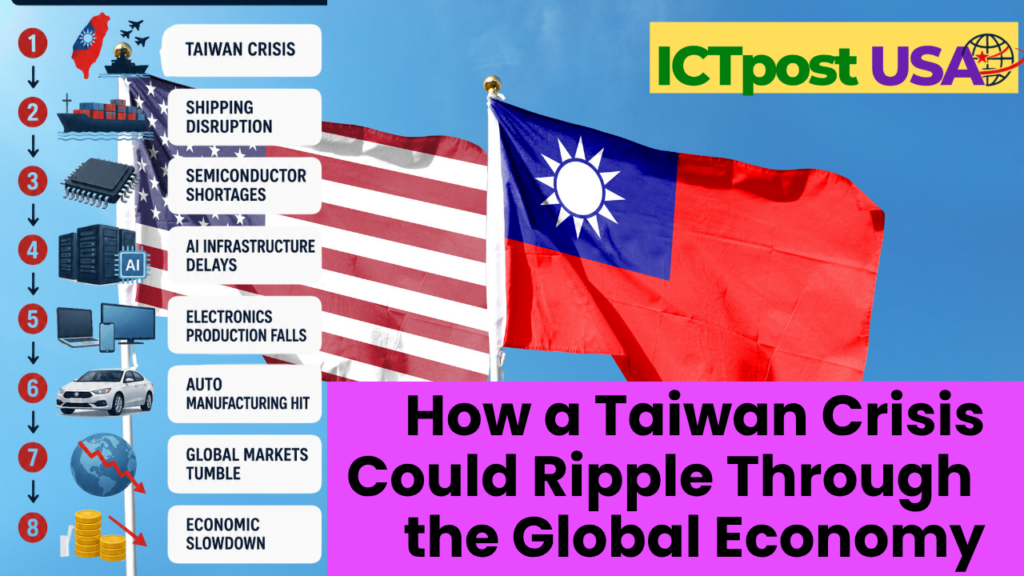
This is not a prediction of war. It is a strategic stress test—and in 2026, it is becoming one of the most important questions facing the United States and the global economy.
The End of America’s Strategic Luxury
For decades after the Cold War, the United States had an important advantage: it could focus most of its military power on one major challenge at a time. That advantage is now fading. The war in Ukraine continues to put pressure on Europe, while conflicts in the Middle East have consumed large quantities of American weapons and missile-defense systems. At the same time, the Indo-Pacific has become the main arena of America’s long-term competition with China. y
This raises a much bigger question than Taiwan alone: Can America handle major crises in Europe, the Middle East and Asia at the same time? The answer is not just about aircraft carriers, fighter jets or defense spending. It is also about weapons stocks, factories, supply chains, shipyards, logistics, skilled workers, allies—and time. America may still be capable of winning a war. The bigger question is whether it can keep enough military strength in reserve to deter the next one.
Taiwan Is Different from Ukraine
A Taiwan conflict would be fundamentally different from the war in Ukraine. Ukraine can be supplied through extensive overland routes across Europe, but Taiwan is an island just 100 miles from mainland China and thousands of miles from the continental United States. That geography changes everything. Resupply would be far more difficult, bases could come under attack, shipping lanes could be contested, and air and maritime logistics would become critical to the outcome. In such a conflict, basic military capabilities would matter enormously—from fuel supplies and runway survivability to missile inventories, naval logistics, submarine operations, repair capacity, access to bases and the ability of industry to keep producing weapons. Above all, one factor could prove decisive: stockpiles.
The Wargames Carry a Warning
One of the most influential public studies of a potential Taiwan conflict was conducted by the Center for Strategic and International Studies (CSIS), which ran multiple simulations of a Chinese invasion. In many scenarios, Taiwan survived and Chinese forces failed to achieve their objectives, but the results were far from reassuring. The simulations projected heavy losses on all sides, including large numbers of ships, aircraft and military personnel.
More importantly, they revealed a less visible vulnerability: the rapid consumption of advanced weapons. Modern warfare can burn through precision-guided missiles at an extraordinary pace. Weapons that take months or even years to manufacture can be used within minutes. A country may spend hundreds of billions of dollars on military preparedness, but still face a serious ammunition shortage if its industrial base cannot replace weapons fast enough. The lesson is simple: in modern warfare, military strength increasingly depends on manufacturing strength.
Factories Are Strategy Now
Recent conflicts have shown how quickly sophisticated weapons can be consumed. Missile-defense systems, interceptors and precision-guided munitions are highly effective, but they are also expensive and difficult to replace. This has created a strategic challenge for the United States. Its defense industry must support Ukraine and European security, replenish weapons used in the Middle East, and at the same time prepare for a potential conflict in the Indo-Pacific.
Congress can approve billions of dollars in funding quickly, but factories cannot be expanded overnight. Skilled workers take years to train, rocket-motor production cannot be scaled up instantly, and complex supply chains cannot suddenly double their output. This is why defense planners are increasingly treating industrial capacity as a national-security asset. In the 21st century, factories may be becoming as strategically important as military bases..
The Semiconductor Dependency
At the center of the Taiwan question sits a piece of silicon smaller than a fingernail. Yet its importance is enormous.
Taiwan Semiconductor Manufacturing Company (TSMC) manufactures more than 90% of the world’s leading-edge logic chips, making Taiwan one of the most critical links in the global technology ecosystem. [nist.gov], [trade.gov]
These advanced semiconductors are the foundation of the modern digital economy and increasingly of national security. They power artificial intelligence systems, high-performance computing, cloud data centers, smartphones, telecommunications infrastructure, industrial automation, medical technologies and sophisticated military platforms.
The United States remains the global leader in semiconductor design, AI innovation and many of the technologies built around advanced chips. Yet a significant share of the world’s most advanced semiconductor manufacturing capacity is concentrated in Taiwan.
That creates a strategic paradox. America leads the AI revolution, but a strategically vulnerable island remains essential to manufacturing many of the chips that power it.
The issue is therefore no longer simply about technology or trade. It is about economic resilience, national security and the future balance of technological power.olution, while a strategically vulnerable island remains essential to manufacturing many of the chips that power it.
Why a Taiwan Disruption Would Shock the World
A Taiwan crisis would not require a full-scale invasion to cause serious damage to the global economy. Even a partial blockade or prolonged disruption of shipping could interrupt the flow of semiconductors and quickly affect industries around the world, including artificial intelligence, consumer electronics, automobiles, aerospace, telecommunications and defense. Advanced semiconductor manufacturing is particularly difficult to replace because production cannot simply be moved to another country or factory.
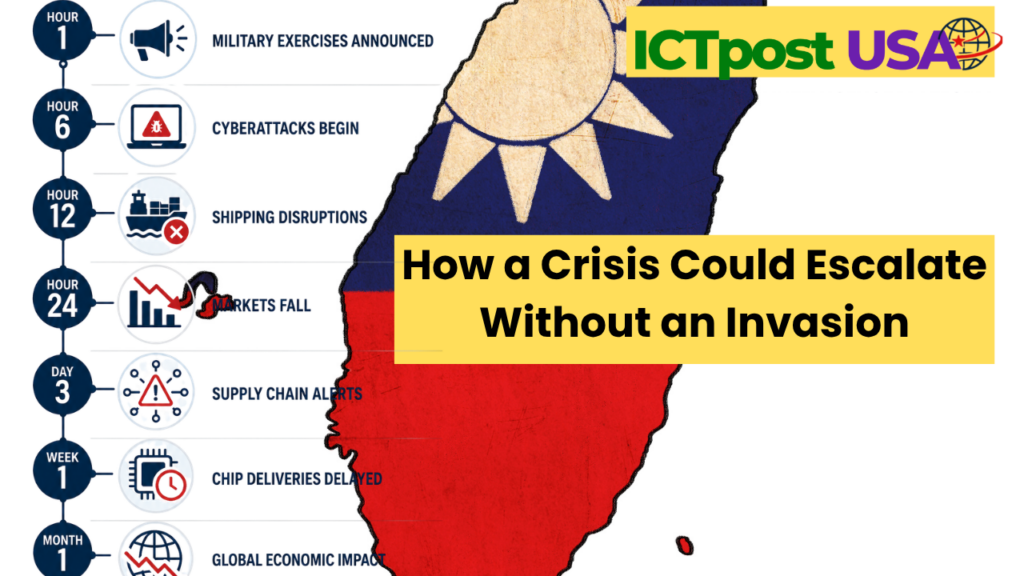
Modern chip fabrication plants are among the most complex industrial facilities ever built, requiring tens of billions of dollars in investment, highly specialized equipment, advanced infrastructure and highly skilled engineers. Taiwan’s semiconductor ecosystem was not created overnight—it was built over decades. That is what makes Taiwan’s role in the global technology economy so difficult to replace.
There is no instant replacement. [nist.gov], [content.go…livery.com]
The world learned lessons from pandemic-era chip shortages.A Taiwan disruption could create a far larger shock because it would affect the most advanced technologies underpinning the AI economy.
America’s Semiconductor Insurance Policy
Washington understands the danger.
The United States has launched a major effort to rebuild domestic semiconductor capacity through public and private investment.
TSMC’s Arizona expansion is among the most significant examples. The company is investing tens of billions of dollars to bring advanced manufacturing capabilities into the United States, supported by CHIPS Act incentives and federal investment programs. [content.go…livery.com], [nist.gov]
The goal is not to replace Taiwan entirely.
That is unrealistic in the foreseeable future.
The goal is resilience.
The United States wants to ensure that a disruption in the Taiwan Strait does not immediately become a disruption to the American economy, defense sector, or AI industry.
What Would It Take for America to Be Ready?
Taiwan represents the ultimate strategic test. Preparing for a potential crisis requires far more than modernizing the military. The United States would need to strengthen the industrial, technological, economic and alliance systems that support military power.
1. Accelerate Domestic Semiconductor Production
The most urgent challenge is reducing America’s dependence on overseas semiconductor manufacturing. That means expanding advanced chip fabrication, building domestic packaging and testing capabilities, developing a skilled workforce and creating more resilient supply chains. Semiconductor resilience is becoming national-security resilience.
2. Expand Munitions Production
Recent conflicts have demonstrated a simple lesson: weapons can be consumed far faster than they can be replaced. The Pentagon needs larger missile inventories, faster production cycles, additional manufacturing lines and greater surge capacity. Deterrence depends not only on how many weapons a country has today, but also on how quickly it can produce more tomorrow.
3. Harden Indo-Pacific Bases
Military facilities across Japan, Guam and the wider Pacific would need to remain operational even under sustained missile and cyberattacks. That means investing in hardened facilities, protected fuel supplies, stronger air defenses, rapid runway repair and more distributed military operations. Survivability could become as important as firepower.
4. Deepen Alliance Integration
America’s greatest strategic advantage may not be geography or industrial scale—it is its network of alliances. Japan, Australia, South Korea, the Philippines and European partners could all play important roles in a Taiwan contingency. Stronger coordination, shared logistics, intelligence and interoperability would make the alliance network far more resilient in a crisis.
5. Build Strategic Technology Reserves
The idea of strategic reserves may eventually extend beyond oil and critical minerals to technology. Governments and industries could explore reserves of critical semiconductors and other essential components. Such stockpiles would not solve a prolonged disruption, but they could buy valuable time during the first weeks or months of a crisis.
6. Strengthen Economic Resilience
A Taiwan crisis would not be fought only with missiles and aircraft. It could also disrupt critical minerals, energy supplies, cybersecurity, shipping, logistics and manufacturing. Building redundancy across these systems is therefore becoming a core national-security priority. In the next great-power crisis, economic resilience may be as important as military strength.
The AI Economy Has a Taiwan Problem
Five years ago, Taiwan was primarily viewed through the lens of regional security. Today, artificial intelligence has changed the equation. The world’s AI leaders remain concentrated in the United States.
The manufacturing foundation supporting many of those technologies remains heavily linked to Taiwan. [trade.gov], [nist.gov]
That means Silicon Valley’s supply-chain challenge is increasingly a national-security challenge. And America’s national-security challenge is increasingly a semiconductor challenge. The two are becoming inseparable.
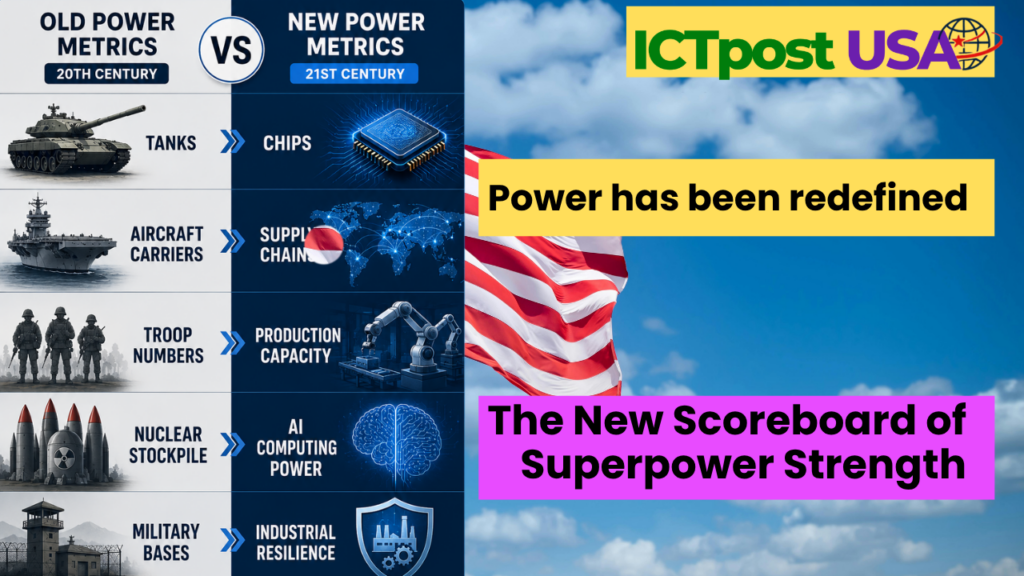
The New Measure of Superpower Strength
For much of the 20th century, national power was measured in military hardware—aircraft carriers, bombers, nuclear arsenals and tank divisions. But the 21st century requires a different scoreboard. How many missiles can a country manufacture each month? How quickly can damaged ships be repaired? How many advanced chips can be produced outside potential conflict zones? How resilient are its energy grids and communication networks? How quickly can factories shift from peacetime production to crisis output? And how long can allies remain politically united under pressure? These are no longer secondary questions. They are becoming the foundation of modern deterrence—and the true measure of whether a nation is ready for a major-power conflict.
So, Is America Ready?
The answer depends on what “ready” really means. The United States can project extraordinary military power into the Pacific, and China cannot assume that taking Taiwan would be easy. Deterrence remains a powerful force. But the harder question is whether America can sustain a prolonged confrontation with a peer competitor while simultaneously meeting its commitments in Europe and the Middle East and protecting the technological foundations of the AI economy.
That answer is far less certain. Missile inventories matter. Factory output matters. Semiconductor resilience matters. Alliance cohesion matters. Political endurance matters. The purpose of preparing for a Taiwan conflict is not to fight one. It is to make such a conflict so costly, uncertain and strategically irrational that it never begins. The real victory is the war that never happens. And that is why Taiwan matters far beyond Taiwan itself. It is not simply a regional security challenge—it is a test of America’s military readiness, industrial capacity, technological resilience and ability to sustain global leadership.
It is the ultimate stress test of American military power, industrial capacity, technological leadership, alliance strength, and economic resilience in the twenty-first century. editor@ictpost.com
Follow author on LinkedIn , YouTube and X.

The author Dhirendra Pratap Singh works at the intersection of Artificial Intelligence, the digital economy, public policy, and emerging technologies, exploring how technological revolutions are reshaping societies, governance systems, and global power structures. His work focuses on interpreting complex technological shifts—from AI and digital public infrastructure to technology geopolitics—and translating them into actionable insights for policymakers, institutions, and industry leaders navigating a rapidly evolving global technology landscape.