
Rising tensions in the Gulf highlight why India must rethink energy governance in an age of geopolitical energy shocks.
By ICTpost Intelligence Unit
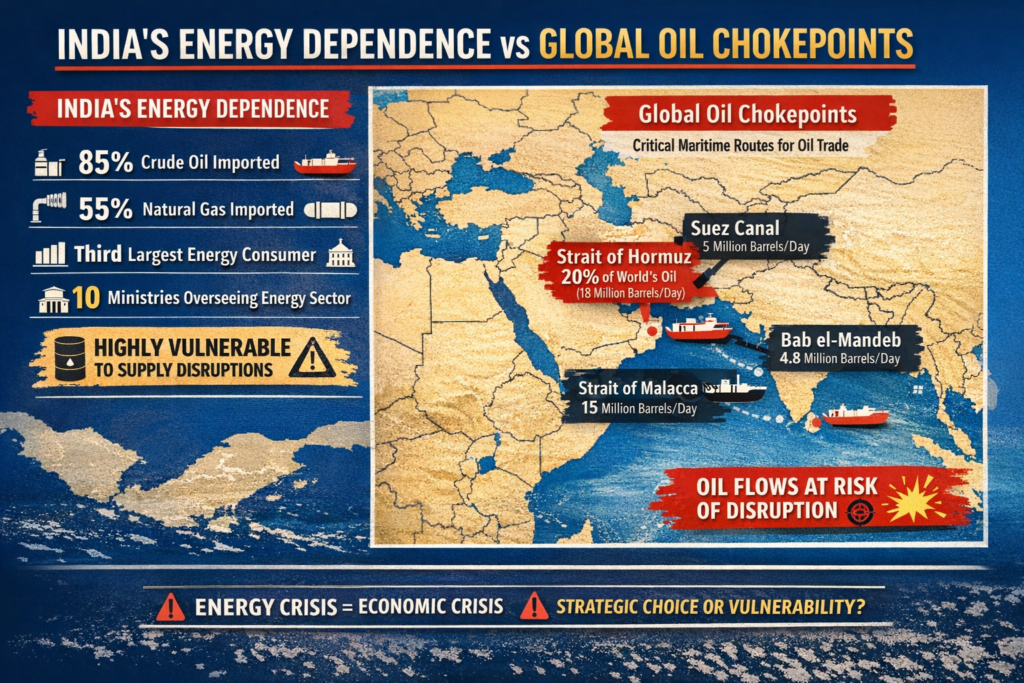
The narrow Strait of Hormuz — barely 39 kilometres wide at its narrowest point — has once again become a focal point of global anxiety.
Nearly 20–21% of the world’s petroleum liquids consumption, roughly 20 million barrels per day, passes through this corridor connecting the Persian Gulf with global markets. Few maritime passages carry such immense economic significance.
For India, the implications are particularly stark.
India imports around 85% of its crude oil and nearly 50% of its natural gas, making it one of the most import-dependent major economies in the world. A large share of those supplies originates in the Middle East and must transit through the Strait of Hormuz.
In an era where energy supply chains are increasingly shaped by geopolitics rather than purely by markets, the growing tensions around Iran are a reminder that energy security is inseparable from national security.
The Hormuz chokepoint and India’s vulnerability
According to the International Energy Agency (IEA) and the U.S. Energy Information Administration, the Strait of Hormuz is the single most critical oil transit chokepoint in the world.
Each day, it carries: ~20 million barrels of oil; About one-third of global seaborne crude trade, and roughly 25–30% of global LNG shipments.
Much of Asia’s energy lifeline passes through this corridor. China, Japan, South Korea and India are among the largest beneficiaries.
India’s dependence is particularly notable:
Over 60% of India’s crude imports come from the Middle East
Major suppliers include Iraq, Saudi Arabia, UAE and Kuwait
A large share of LNG imports from Qatar also transit the same route.
Even a partial disruption — tanker seizures, insurance withdrawal, naval escalation or sanctions enforcement — could ripple rapidly across the global energy system.
Shipping insurers have historically reacted quickly to Gulf tensions. During previous escalations, war-risk insurance premiums for tankers rose by 200–300%, dramatically increasing the cost of energy transport.
For an import-dependent economy like India, the consequences would be immediate.
Lessons from past energy shocks
History shows how geopolitical disruptions in energy markets can reshape the global economy.
The 1973 Arab oil embargo triggered by the Yom Kippur War caused oil prices to quadruple within months, plunging many Western economies into recession and fundamentally altering global energy policies.
More recently, the 2022 Russia–Ukraine war demonstrated how energy can be weaponized at scale. When Russian gas flows to Europe were curtailed, gas prices in Europe surged more than 10-fold at peak levels, forcing factories to shut down and governments to spend hundreds of billions of euros on energy subsidies.
The lesson is clear: energy shocks rarely remain confined to the energy sector.
They quickly translate into: inflation, currency pressure, fiscal strain and slower economic growth.
For India, analysts estimate that every $10 increase in crude oil prices can widen the current account deficit by roughly 0.3–0.4% of GDP.
Some economists estimate that a sustained disruption in Hormuz pushing oil prices above $110–120 per barrel could raise India’s inflation by 1–2 percentage points and significantly strain government finances.
As Fatih Birol, Executive Director of the International Energy Agency, has repeatedly warned:
“Energy security remains the foundation of economic security. Countries that rely heavily on imports must continuously diversify and build resilience.”
The deeper issue: fragmented energy governance
Beyond supply risks, the Hormuz crisis highlights a structural issue within India’s policy framework: the fragmentation of energy governance.
India’s energy ecosystem is administered by multiple ministries and agencies, including:
Ministry of Petroleum and Natural Gas, Ministry of Power, Ministry of Coal, Ministry of New and Renewable Energy, Department of Atomic Energy, Ministry of Environment, Forest and Climate Change.
Alongside several regulators and state-level authorities.
Strategic affairs scholar Brahma Chellaney has long argued that such fragmentation weakens strategic coordination.
In a world where energy flows are increasingly shaped by geopolitics, he suggests, energy governance must be treated as part of national security architecture, not merely as sectoral economic policy.
Without a unified command structure, responding to sudden disruptions becomes far more complex.
Energy as a geopolitical weapon
The global energy landscape has undergone a profound transformation over the past decade.
Energy is increasingly used as a geopolitical lever.
The Russia–Ukraine conflict demonstrated how supply restrictions can influence geopolitical bargaining power. Similarly, tensions in the Middle East repeatedly highlight the vulnerability of maritime chokepoints.
According to Daniel Yergin, Pulitzer Prize-winning historian of energy and author of The New Map:
“Energy security today is inseparable from geopolitics. Supply chains, chokepoints and technology are reshaping the strategic balance between nations.”
In such a world, managing energy flows requires coordination across diplomacy, defence, shipping, finance and technology.
That coordination becomes difficult when governance is divided across multiple bureaucratic silos.
India’s counter-measures: progress but unfinished
It would be misleading, however, to portray India as entirely unprepared.
Over the past decade, the country has taken several steps to strengthen its energy resilience.
Strategic petroleum reserves
India has built strategic petroleum reserves (SPR) in locations such as Visakhapatnam, Mangaluru and Padur with a capacity of roughly 5.3 million tonnes, equivalent to about 9–10 days of national demand.
Additional reserve capacity is being planned.
Diversification of suppliers
India has significantly diversified crude sources in recent years. Following the Russia–Ukraine war, Russia emerged as India’s largest crude supplier, accounting for more than 35% of imports in 2023–24, reducing dependence on the Gulf.
India also imports oil from: the United States, West Africa and Latin America.
Energy transition investments
India is simultaneously accelerating investments in solar power, green hydrogen, battery storage and electric mobility, aiming to reduce long-term fossil-fuel dependence.
Renewables now account for over 40% of India’s installed power capacity, though fossil fuels still dominate overall energy consumption.
Diplomatic energy partnerships
India has also strengthened energy ties with the UAE, Saudi Arabia and the United States, including joint investments in refining, petrochemicals and strategic reserves.
These steps have improved resilience — but they do not eliminate the fundamental structural risk posed by maritime chokepoints.
Why institutional reform may be the next step
Many analysts believe that India’s next phase of energy security reforms may require institutional integration.
Several experts have proposed the creation of a National Energy Commission or Unified Energy Authority that could coordinate long-term strategy across fuels and technologies.
Such a body could perform four critical roles:
Integrated planning
Align oil, gas, coal, nuclear and renewable strategies within a single national framework.
Crisis response
Coordinate rapid action during supply disruptions or geopolitical shocks.
Energy transition management
Ensure climate goals are balanced with affordability and reliability.
Technology and infrastructure strategy
Guide investments in hydrogen, grid resilience, critical minerals and battery supply chains.
Countries like the United States and China already operate highly centralized energy policy structures that integrate strategy, technology and security considerations.
India’s fragmented model may increasingly struggle to keep pace with the geopolitical complexity of the global energy system.
The next energy era: AI, climate and geopolitics
India’s energy challenge is becoming even more complex as three major trends converge:
Rising geopolitical disruptions in energy markets
Explosive electricity demand from digital infrastructure, AI and data centres
The global transition toward low-carbon energy systems
The International Energy Agency projects that India will account for the largest share of global energy demand growth over the next two decades.
Managing that growth while ensuring resilience will require long-term planning and institutional coordination on an unprecedented scale.
As Daniel Yergin notes: “Energy transitions take decades — but geopolitical shocks can reshape them overnight.”
A strategic warning
The tensions around Iran and the Strait of Hormuz should therefore be seen as more than a regional crisis. They are a strategic stress test for India’s energy architecture.
India has made meaningful progress in diversification, renewable expansion and strategic reserves. Yet governance structures remain fragmented in a world where energy flows are deeply intertwined with geopolitics.
If energy security is truly a pillar of national security, it may require a governance system capable of acting with the speed, coordination and foresight demanded by the 21st century.
Because in the coming decades, the nations that master energy security will not merely secure their economic future. They will secure their strategic future as well.editor@ictpost.com