


Artificial Intelligence (AI) holds immense promise for India, with the potential to transform sectors such as healthcare, agriculture, education, and governance. Recognizing this, the Government of India launched the “AI for All” strategy under NITI Aayog’s National Strategy for Artificial Intelligence (NSAI). The aim is to leverage AI for inclusive growth and solve societal challenges. However, realizing the vision of “AI for All” in India comes with significant challenges—ranging from data gaps and infrastructure deficits to regulatory uncertainties and ethical concerns.
Lack of Digital and AI Infrastructure
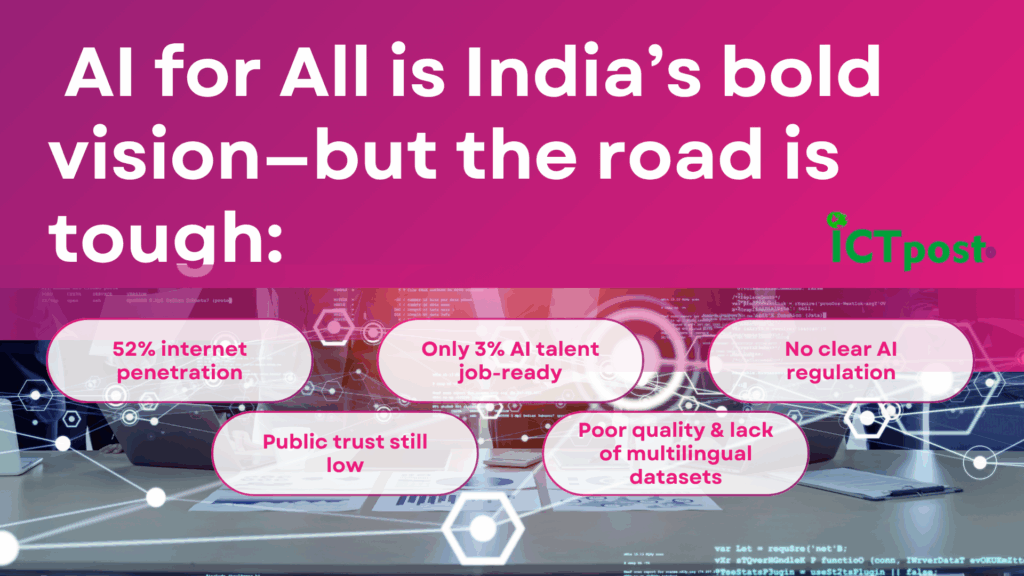
India’s digital divide poses a major hurdle. According to the Internet and Mobile Association of India (IAMAI), as of 2023, only 52% of the population had internet access, and rural areas significantly lag behind urban regions in terms of digital penetration. AI requires vast computational power, high-speed internet, and cloud infrastructure. Yet, India’s AI computing infrastructure ranks low compared to countries like the US and China. For example, China had over 70 exascale computing facilities by 2023, while India is still building foundational capabilities like the National AI Computing Infrastructure (NAIC).
Moreover, only a few Indian institutions possess the GPUs and data centers needed to train large language models. This scarcity limits experimentation, innovation, and capacity-building among startups, students, and researchers outside major metros.
Shortage of Skilled Talent
India produces a large number of engineering graduates, yet the skill gap in AI remains stark. According to the India AI Report 2023 by Nasscom and BCG, only 3% of the AI talent pool in India is considered “job ready” for advanced roles in machine learning, deep learning, and data science. The report also mentions that over 51% of Indian companies cite a lack of skilled professionals as their biggest barrier to AI adoption.
While premier institutes like IITs and IISc are ramping up AI courses, the absence of strong AI curricula in tier-2 and tier-3 institutions hinders democratization. Upskilling rural and underserved populations in AI is still in its infancy.
Data Quality and Accessibility
AI systems depend on high-quality, representative, and labeled datasets. In India, data is often fragmented, unstructured, and difficult to access. Public datasets, particularly in domains like agriculture and healthcare, are either outdated or lack granularity. Additionally, linguistic diversity adds complexity—India has 22 official languages and over 120 dialects. Training inclusive AI models demands massive multi-lingual datasets, which are still under development.
Projects like Bhashini—India’s national language translation mission—aim to bridge this gap, but progress is slow. Without robust and inclusive data, AI systems risk amplifying biases and leaving out marginalized communities.
Ethical, Regulatory, and Privacy Concerns
The absence of a dedicated AI regulatory framework in India creates uncertainty. While the Digital Personal Data Protection Act (DPDPA) 2023 lays the groundwork for data governance, specific guidelines for AI usage, accountability, and risk management are missing.
AI systems raise serious ethical concerns around surveillance, algorithmic bias, and decision-making transparency. A 2021 study by the Center for Internet and Society (CIS) found that facial recognition systems used by Indian police exhibited high rates of false positives and lacked legal safeguards. Without a rights-based framework, the deployment of AI in governance can exacerbate inequalities.
Low Corporate and MSME AI Adoption
While large IT companies and startups are experimenting with AI, adoption across micro, small, and medium enterprises (MSMEs) remains low. According to Microsoft India’s AI & Future of Work report, only 22% of Indian businesses had integrated AI into their core operations as of 2022. MSMEs struggle with affordability, awareness, and access to AI tools.
This limits AI’s potential to uplift sectors like handicrafts, small-scale manufacturing, and rural enterprises, which form the backbone of India’s economy.
Social Acceptance and Trust Deficit
The trust gap between AI systems and users—especially in rural India—is often overlooked. A survey by People Research on India’s Consumer Economy (PRICE) found that only 18% of rural respondents were comfortable with AI-based decision-making in sectors like banking or healthcare.
Trust-building through transparency, explainability, and human oversight is crucial to ensure social acceptability of AI solutions.
While India has made commendable strides in AI innovation, the road to “AI for All” is riddled with structural and societal challenges. Bridging the digital divide, developing inclusive datasets, upskilling the workforce, and creating robust governance frameworks are critical steps. With the right mix of public policy, private investment, and grassroots innovation, India can turn these challenges into opportunities and lead the way in human-centric AI development. editor@ictpost.com