
By ICTpost Futurecast Bureau
Quantum computing is no longer a distant laboratory experiment—it is rapidly becoming one of the most strategically important technologies of the decade. In 2026, global investment in quantum technologies has crossed tens of billions of dollars, Big Tech firms like IBM and Google are reporting measurable breakthroughs in error correction, and governments from the United States to China and India are racing to secure quantum advantage. Yet alongside the hype, critical questions remain: What can quantum computers actually do today? How close are fault‑tolerant systems? And is the projected $1 trillion economic impact by 2035 realistic—or overstated?
This article cuts through the noise to explain the real state of quantum computing in 2026, drawing on expert insights, verified data, and recent breakthroughs to separate momentum from marketing.
From Scientific Promise to Strategic Reality
For most of its history, quantum computing lived in the realm of scientific promise rather than economic consequence. It was discussed in superlatives—exponential speed‑ups, unbreakable encryption, chemistry beyond classical imagination—but rarely in boardrooms or national budgets.
That is changing.
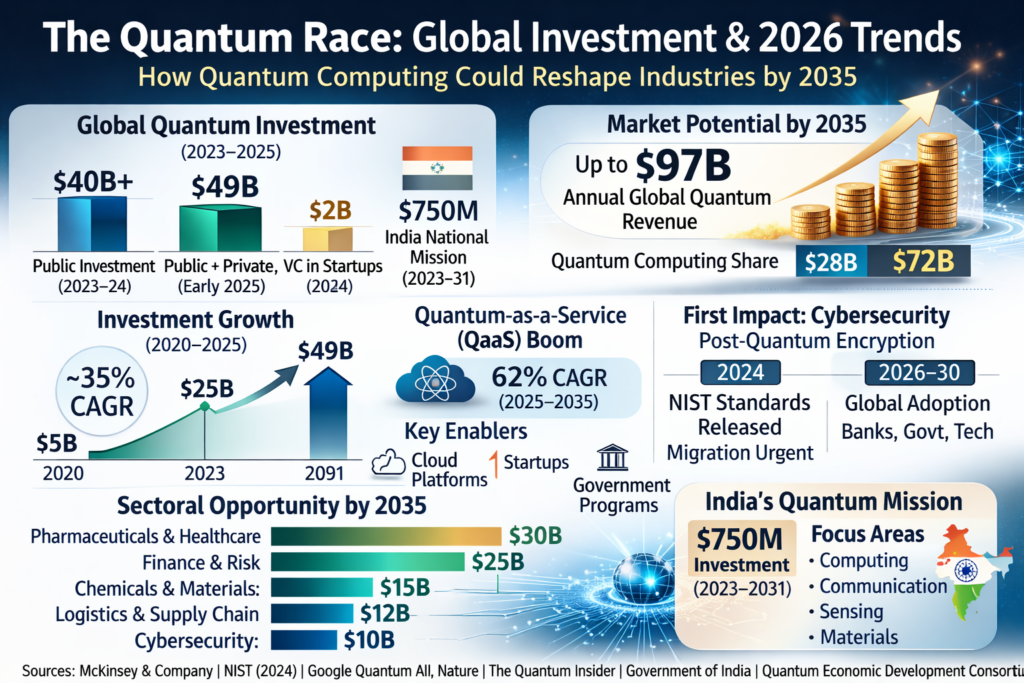
Cumulative global public and private investment in quantum technologies has now exceeded $40–50 billion, according to McKinsey, the Quantum Economic Development Consortium, and The Quantum Insider. Governments from Washington to Beijing, Brussels to New Delhi have elevated quantum science to a strategic national capability, alongside AI and semiconductors.
The motivation is clear. Classical computers process information as bits—either 0 or 1. Quantum computers use qubits, which exploit superposition and entanglement to represent many states simultaneously. In principle, this enables quantum systems to explore vast solution spaces in parallel, tackling problems that overwhelm even the most powerful classical supercomputers.
After decades of theory, 2026 marks the point where engineering progress, geopolitics, and early economics intersect.
1. From Laboratory Breakthroughs to Early Economic Use
The quantum discourse has shifted from physics to productivity.
McKinsey estimates that quantum computing could generate up to $1 trillion in economic value by 2035, particularly in pharmaceuticals, chemicals, finance, logistics, and energy—sectors dominated by simulation and optimisation bottlenecks.
Early 2026 pilots include:
- Molecular simulations for drug discovery and catalyst design
- Risk modelling and portfolio optimisation in finance
- Combinatorial optimisation in logistics and supply‑chain routing
As IBM’s Dario Gil has summarized:
“The question isn’t whether quantum computing will matter anymore — it’s where and when it will deliver value first. The shift now is toward quantum systems doing real scientific work.”
Importantly, these are narrow, domain‑specific workloads, not general‑purpose computing. That distinction matters.
2. Qubit Counts: Why Raw Numbers No Longer Tell the Story
By 2026, the industry has largely moved past qubit‑count hype.
- IBM’s latest processors now support thousands of high‑fidelity quantum gates per circuit, meaning deeper, more useful computations—even with fewer qubits.
- Google’s Willow processor (~100 physical qubits) demonstrated something far more important than scale: exponential error reduction as system size increases.
In quantum computing, this distinction is critical:
- Physical qubits are the actual hardware units—fragile and error‑prone.
- Logical qubits are error‑corrected qubits, formed by encoding many physical qubits together.
Today, hundreds or thousands of physical qubits may be required to create a single reliable logical qubit. As a result, a 100‑qubit system with strong error correction can be more powerful than a 1,000‑qubit system without it.
This is why qubit count alone is no longer a meaningful benchmark.
3. Error Correction Reaches a Turning Point
Error correction is quantum computing’s hardest problem—and its biggest 2026 breakthrough.
In early 2026, Google’s Willow processor crossed the long‑theorised surface‑code threshold, meaning that:
- Adding more physical qubits reduced, rather than increased, overall error rates
- Logical qubits became more stable as system size grew
Julian Kelly, Director of Quantum Hardware at Google, explained the milestone bluntly:
“We are now below the error‑correction threshold. For the first time, as we add more qubits, the system actually gets more reliable instead of less.”
Simultaneously, companies like Riverlane demonstrated real‑time quantum error decoding, enabling systems to correct billions of errors while computations are running, not afterward—an essential requirement for commercial usefulness.
These surface‑code and real‑time decoherence‑mitigation demos represent one of the most important moments in quantum computing history.
4. Hybrid Quantum‑Centric Computing Becomes the Default
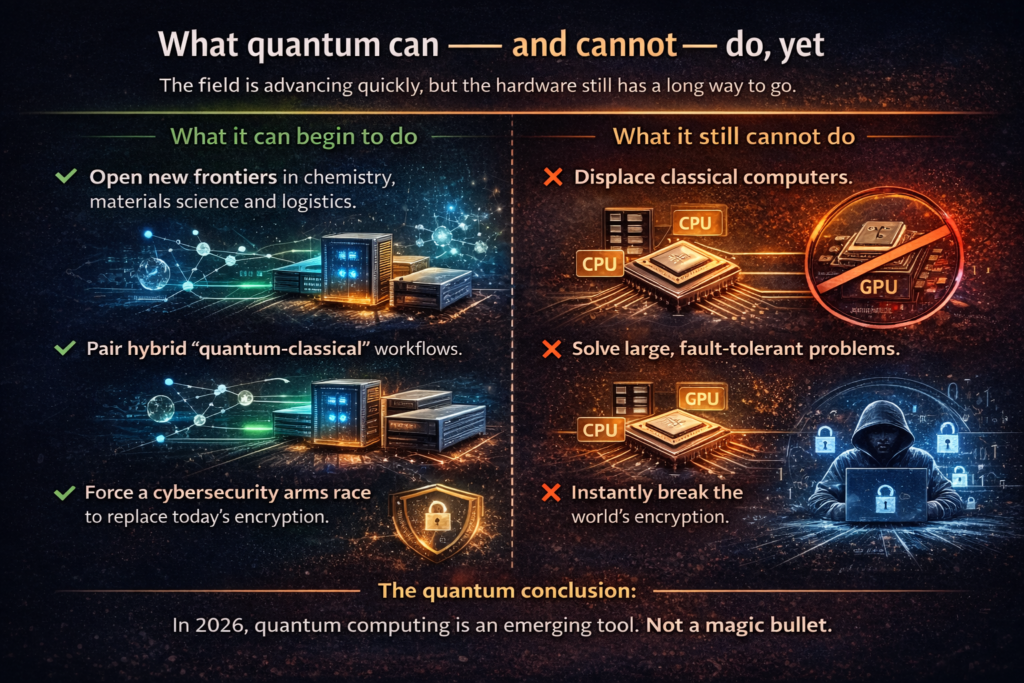
Despite popular imagination, quantum computers are not replacing classical systems.
Instead, the future is hybrid.
In March 2026, IBM released the industry’s first quantum‑centric supercomputing blueprint, showing how:
- CPUs and GPUs manage memory, control, and orchestration
- Quantum processors handle specific optimisation or simulation kernels
- Workflows dynamically shift tasks between classical and quantum hardware
Jay Gambetta, Director of IBM Quantum, described it clearly:
“The future lies in quantum‑centric supercomputing, where quantum processors work together with CPUs and GPUs to solve problems that were previously out of reach.”
This hybrid model now defines all serious enterprise roadmaps.
5. Moving Beyond the Deep‑Freeze Problem
Most superconducting quantum machines still operate near absolute zero, requiring complex cryogenic systems that raise cost, energy use, and operational complexity.
To address this, 2026 research momentum is accelerating in:
- Cryogenic CMOS control electronics (placing controllers inside the cryostat)
- Trapped‑ion platforms
- Photonic and neutral‑atom quantum computers, some capable of near room‑temperature operation
These approaches could dramatically reduce infrastructure demands and enable scalable deployment.
6. Quantum‑as‑a‑Service Lowers the Entry Barrier
Building a quantum computer can cost $50 million or more, putting ownership beyond most organisations.
As a result, Quantum‑as‑a‑Service (QaaS) has become the dominant access model.
Platforms such as IBM Quantum, Amazon Braket, and Azure Quantum allow researchers and enterprises to experiment with real hardware through the cloud—mirroring the early evolution of classical cloud computing.
7. Post‑Quantum Cybersecurity Becomes Urgent
The first large‑scale impact of quantum computing may be cryptographic, not computational.
Public‑key systems such as RSA and ECC are theoretically breakable by future fault‑tolerant quantum machines. Consequently, NIST has finalised post‑quantum cryptography standards, urging organisations to migrate now.
The threat is “harvest now, decrypt later”—data stolen today could be unlocked decades later.
India and the Geopolitics of Quantum Power
India has formally elevated quantum technologies to strategic priority status.
The National Quantum Mission, with an outlay of ₹6,003.65 crore, targets:
- 50–100 physical qubits within five years
- Up to 1,000 qubits by year eight
- Four national thematic hubs led by IISc Bengaluru and major IITs
While India’s funding remains smaller than China’s estimated $17–18 billion public quantum investment, the intention is clear: technological sovereignty in next‑generation computing.
A Realistic Quantum Roadmap
| Period | Expected Reality |
|---|---|
| 2026–2028 | Hybrid quantum advantage in niche workloads |
| 2029–2032 | Early fault‑tolerant logical qubits |
| 2033–2035 | Broad economic impact, ~$1T value |
Reality Check: Risks and Constraints
Quantum computing still faces hard limits:
- Extreme hardware costs
- Cryogenic energy demands
- Severe global talent shortages
- Enormous physical‑to‑logical qubit overhead
Over‑promising remains the industry’s biggest danger.
A Strategic Technology Under Construction
Technological revolutions do not arrive overnight.
Artificial intelligence required decades before commercial dominance. Cloud computing reshaped IT only after gradual adoption.
Quantum computing will follow the same arc.
If the last decade proved quantum theory in laboratories, the coming decade will determine whether it becomes industrial infrastructure.
editor@ictpost.com