
The Next Internet Will Be Built for AI — And the Race Has Already Begun
By ICTpost Global Tech Bureau
Artificial intelligence is forcing the world to rethink the internet itself.
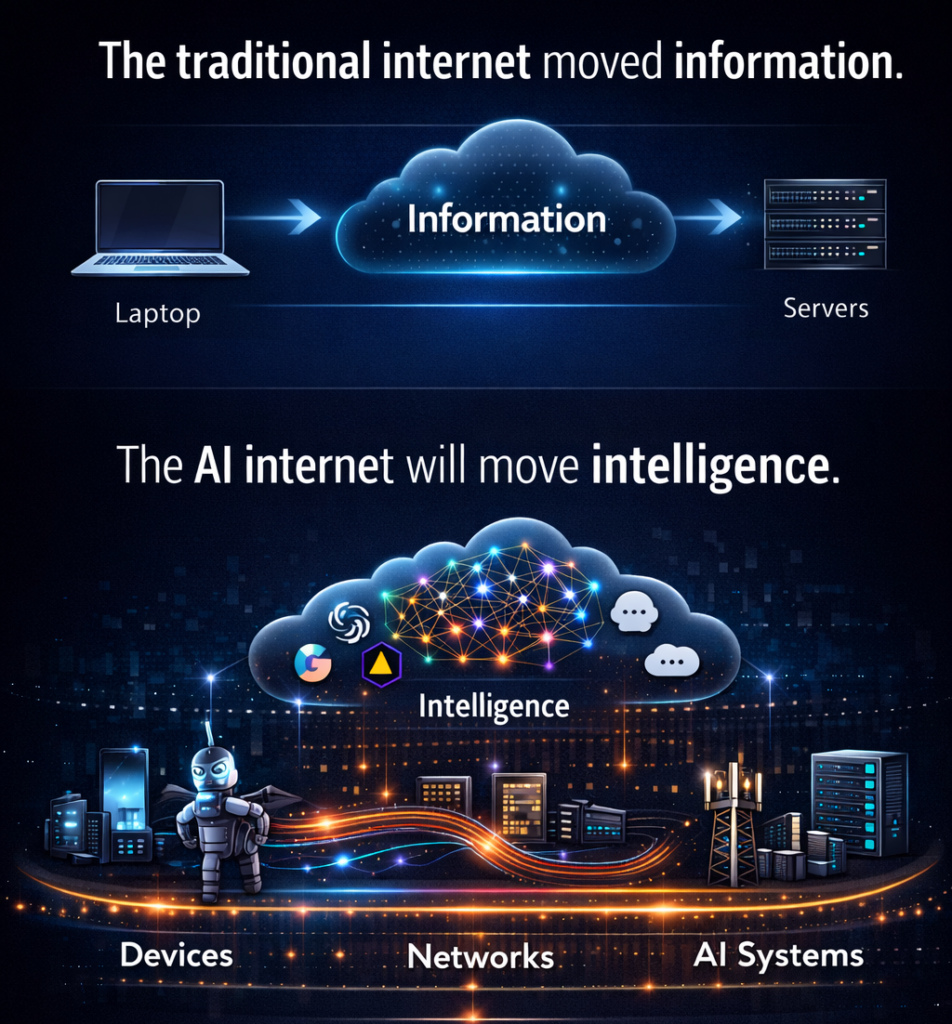
For decades, digital infrastructure evolved around a simple principle: delivering content to users. From websites and emails to video streaming and social media, the internet functioned primarily as a global distribution system for information.
That model is now being disrupted.
Artificial intelligence is transforming the internet from a content delivery network into a global intelligence infrastructure—one where machines, AI models, sensors, robots and humans continuously exchange data, decisions and commands.
The scale of this transformation is enormous. According to McKinsey Global Institute, artificial intelligence could contribute $13 trillion to the global economy by 2030, making AI one of the most powerful economic drivers of the digital era.
As Microsoft CEO Satya Nadella recently observed while discussing the future of computing:
“AI is the next computing platform. Every layer of the technology stack—from chips to software to networks—will have to evolve.”
And nowhere will that evolution be more dramatic than in the networks that power the internet.
The Hidden Infrastructure Crisis of the AI Era
The public conversation around artificial intelligence has largely focused on AI models such as ChatGPT, Gemini or Claude.
But behind the scenes, a far more fundamental transformation is unfolding: the infrastructure required to run AI at global scale.
AI systems generate enormous volumes of data as they train, learn and interact with users. Unlike traditional internet applications, these systems rely on continuous exchanges between users, data centers, AI models and edge devices.
According to ICTpost Global Networking Trends Report, global internet traffic is expected to exceed 5 zettabytes per year by the end of the decade, compared with less than 1 zettabyte a decade ago.
Meanwhile, Nokia’s Global Network Traffic Forecast suggests that wide-area network traffic could grow between three and seven times by 2034, reaching thousands of exabytes every month.
A significant portion of this growth will be driven by artificial intelligence workloads.
Yet the real challenge is not simply the volume of traffic.
It is the structure of internet traffic itself that is changing.
The Internet Is Becoming a Machine Network
Historically, internet traffic followed a predictable pattern: people downloading information from servers.
Artificial intelligence is reversing that model.
Today’s AI applications require massive amounts of input data—text prompts, images, voice commands, sensor streams and contextual signals. Instead of simply receiving information, users constantly upload data for AI systems to analyze.
More importantly, AI systems increasingly communicate with each other.
Autonomous AI agents retrieve information from databases, interact with other models, trigger workflows and coordinate actions without human intervention.
As per ICTpost study, by 2027 nearly 60 percent of internet traffic could be machine-to-machine communication, driven by AI systems, IoT devices and automated digital platforms.
This marks a major transition.
The internet is no longer just a network connecting people.
It is rapidly becoming a network connecting machines and intelligence.
AI Factories and the Rise of the Data Center Economy
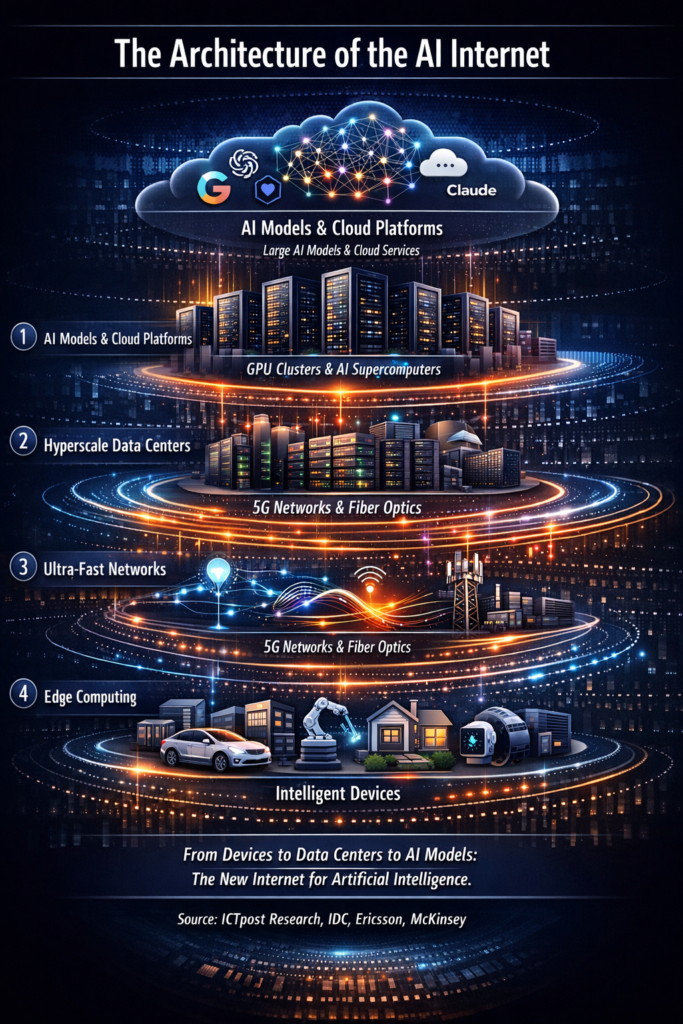
The infrastructure powering this new AI internet is concentrated in massive clusters of computing power often referred to as AI factories.
These facilities contain thousands of GPUs and specialized chips designed to train and run AI models at scale.
Nvidia CEO Jensen Huang has described these facilities in striking terms:
“AI factories produce tokens the way power plants produce electricity.”
The scale of these facilities is growing rapidly.
According to Synergy Research Group, global spending on hyperscale data centers is expected to exceed $1 trillion over the next decade.
Meanwhile, the International Energy Agency (IEA) estimates that data centers could consume more than 1000 terawatt-hours of electricity annually by 2030, roughly equivalent to the current power consumption of Japan.
Each AI query processed inside these factories triggers complex data flows across multiple systems. Requests travel between user devices, cloud platforms, data centers and specialized computing clusters before returning a response.
As a result, traffic moving between data centers is expected to grow even faster than user-generated traffic.
In the AI era, the internet increasingly resembles a global nervous system connecting AI factories across continents.
The Geopolitics of AI Infrastructure
This transformation has enormous geopolitical implications.
Over the past decade, competition between major powers has increasingly centered on semiconductor manufacturing and supply chains.
The next phase of that competition may revolve around AI infrastructure and digital networks.
Countries that control the fastest data centers, fiber networks, and cloud infrastructure will gain enormous strategic advantages in the AI economy.
Technology analyst Benedict Evans has often emphasized that computing revolutions reshape global infrastructure:
“Every computing platform shift rewrites the infrastructure beneath it.”
The rise of AI is doing exactly that.
Massive investments are now flowing into fiber networks, hyperscale data centers, subsea cables and edge computing systems across the United States, Europe and Asia.
The global AI race is no longer just about algorithms.
It is about who builds the infrastructure that powers those algorithms.
Why Networks Must Become Intelligent
Traditional internet networks were designed to carry predictable traffic flows such as video streams and file downloads.
AI workloads behave very differently.
They are bursty, dynamic and extremely latency-sensitive. A single AI interaction may trigger multiple processes across distributed computing systems within milliseconds.
To handle this complexity, networks must become far more intelligent.
Future infrastructure will rely heavily on software-defined networking (SDN), AI-driven traffic optimization and autonomous network management systems capable of adapting in real time to changing workloads.
In other words, the internet itself must become partially AI-managed.
As Google CEO Sundar Pichai recently noted:
“AI is driving one of the largest computing platform shifts in history.”
That shift extends far beyond software.
It requires rebuilding the underlying digital infrastructure of the internet.
India’s Opportunity in the AI Infrastructure Race
For India, this transformation presents both challenges and opportunities.
India already has one of the world’s largest digital ecosystems, with over 850 million internet users, making it the second-largest internet market globally.
According to Ericsson Mobility Report, India’s mobile data traffic is expected to grow threefold by 2030, reaching more than 60 GB per smartphone per month.
At the same time, India’s data center market is expanding rapidly.
According to industry estimates, India’s data center capacity could exceed 1.7 gigawatts by 2030, driven by hyperscale investments from global cloud companies.
Government initiatives such as the IndiaAI Mission, rapid 5G deployment, and expansion of hyperscale data centers are positioning India to play a larger role in the global AI ecosystem.
Indian telecom operators are investing heavily in fiber networks, edge computing and AI-enabled network management systems.
If these investments continue, India could emerge not just as a major consumer of AI services but as a critical hub in the global AI infrastructure network.
The Internet Is Entering Its Intelligence Phase
The internet has evolved through several technological eras.
First it connected computers.
Then it connected people.
Now it is beginning to connect intelligence itself.
In the coming decade, billions of AI systems, robots, sensors and digital agents will interact continuously across global networks.
The internet will no longer simply move information.
It will move decisions, predictions and autonomous actions.
This transformation will reshape everything—from telecommunications and cloud computing to geopolitics and economic power.
The networks that powered the last digital revolution will not be enough for the next one.
The AI era will require a new kind of internet: faster, more intelligent, more distributed and far more resilient than anything built before.
And the race to build it has already begun. editor@ictpost.com