
By ICTpost Intelligence Unit
Artificial intelligence (AI) is transitioning from technological novelty to a core driver of global economic change, reshaping labor markets, productivity, and economies. The debate now centers on employment, inequality, and the future of work: How many jobs will AI displace, and are governments ready?
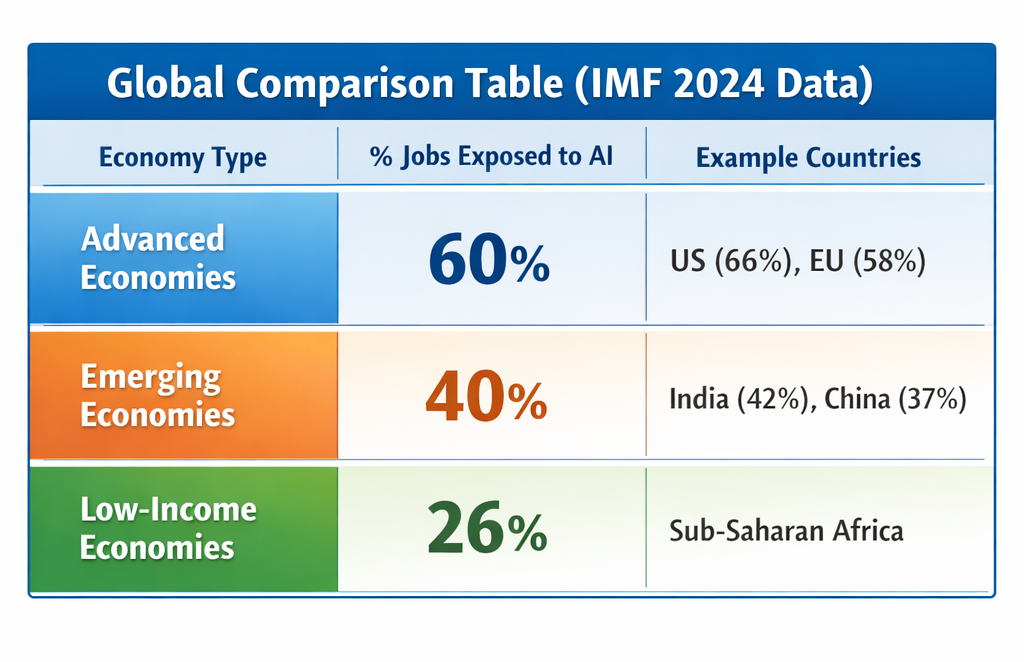
The International Monetary Fund (IMF, 2024) estimates 40% of global employment is exposed to AI, rising to 60% in advanced economies (e.g., US, EU) and 40% in emerging markets (e.g., India, China). Low-income countries face ~26% exposure but higher vulnerability due to weaker safety nets.
This shift rivals the Industrial Revolution in scale, per IMF analysis.
The Scale of AI’s Economic Transformation
McKinsey Global Institute (2023) projects generative AI adding $2.6–$4.4 trillion annually to global GDP by 2040, equivalent to Germany’s economy.
Labor Projections (World Economic Forum, 2023)
• 85 million jobs displaced by 2027 due to AI/automation.
• 97 million new jobs created in AI ethics, data science, green tech.
• Net gain: +12 million jobs, but with massive reconfiguration.
• PwC (2024): AI could boost global GDP by 15.7% ($15.7 trillion) by 2030, with 38% of US jobs at high automation risk.
• OECD (2023): 27% of jobs in OECD countries at high AI risk; routine cognitive tasks most vulnerable.
Transitions are disruptive. Brookings Institution (2024) notes historical precedents (e.g., 1980s manufacturing automation caused 5–10 years of regional unemployment spikes).
White-Collar Jobs Are Now at Risk
Unlike past automation targeting manual labor, AI excels at cognitive tasks:
• Code writing: GitHub Copilot boosts developer productivity by 55% (GitHub, 2023).
• Legal analysis: Harvey AI reviews contracts 10x faster (Stanford study, 2024).
• Medical diagnostics: AI matches radiologists (Nature Medicine, 2023).
• Content creation: GPT-4 generates marketing copy rivaling humans (Anthropic benchmarks, 2024).
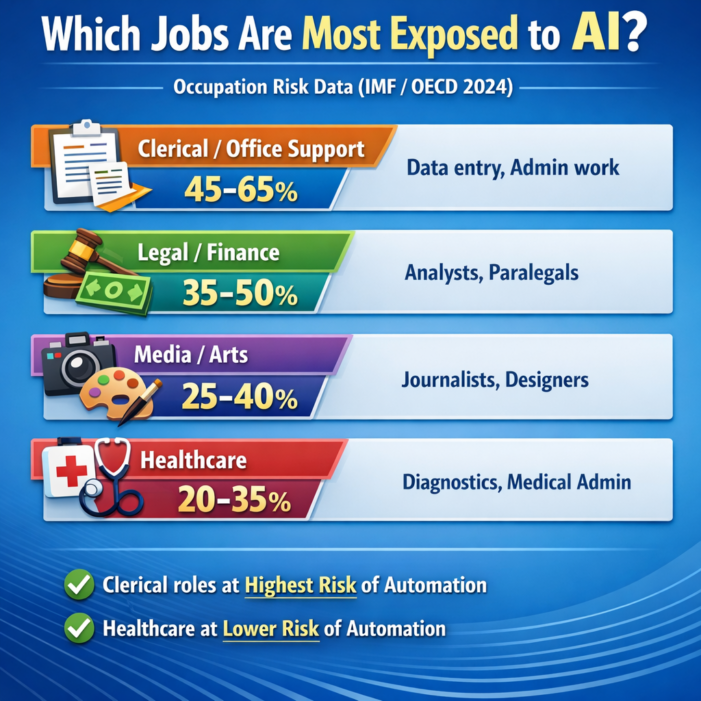
Occupation Risk Data (IMF/OECD 2024):
| Sector/Role | % Tasks Automatable | Examples |
| Clerical/Office Support | 45–65% | Data entry, admin |
| Legal/Finance | 35–50% | Analysts, paralegals |
| Media/Arts | 25–40% | Journalists, designers |
| Healthcare | 20–35% | Diagnostics, admin |
White-collar disruption echoes 20th-century factory automation, per Goldman Sachs (2023): 300 million full-time jobs globally at risk.
Productivity Boom vs. Employment Shock
The debate around artificial intelligence and employment is sharply divided between optimism and caution. On the optimistic side, institutions such as McKinsey argue that AI could trigger a productivity surge comparable to the transformative impact of electricity in the 1880s or the internet in the 1990s. According to this view, AI will not simply replace jobs but will create entirely new industries, business models, and categories of work that do not yet exist.
However, IMF warn that the transition may be painful in the short term. AI-driven automation could lead to temporary unemployment and widen income inequality, particularly because technological change tends to be skill-biased. Highly educated workers who can work alongside advanced technologies may see significant income gains—some estimates suggest the top 10 percent of workers could experience income growth of around 20 percent—while the bottom half of the workforce risks stagnating wages and reduced opportunities.
Early evidence reflects this complex reality. A 2024 study by MIT found that companies adopting AI tools experienced productivity gains of around 14 percent, but also reported initial job reductions of roughly 2 to 5 percent as workflows were restructured. Meanwhile, the World Bank has cautioned that many developing and emerging economies could face an “AI divide” if governments fail to invest rapidly in large-scale reskilling and digital education programs.
Governments Are Lagging
Most nations lack readiness:
• Education: UNESCO (2023) – 70% of curricula emphasize rote learning over AI-era skills (critical thinking, digital literacy).
• Labor Policies: ILO (2024) – Only 20% of countries have AI-specific upskilling mandates.
Recommended Reforms (IMF/OECD Consensus)
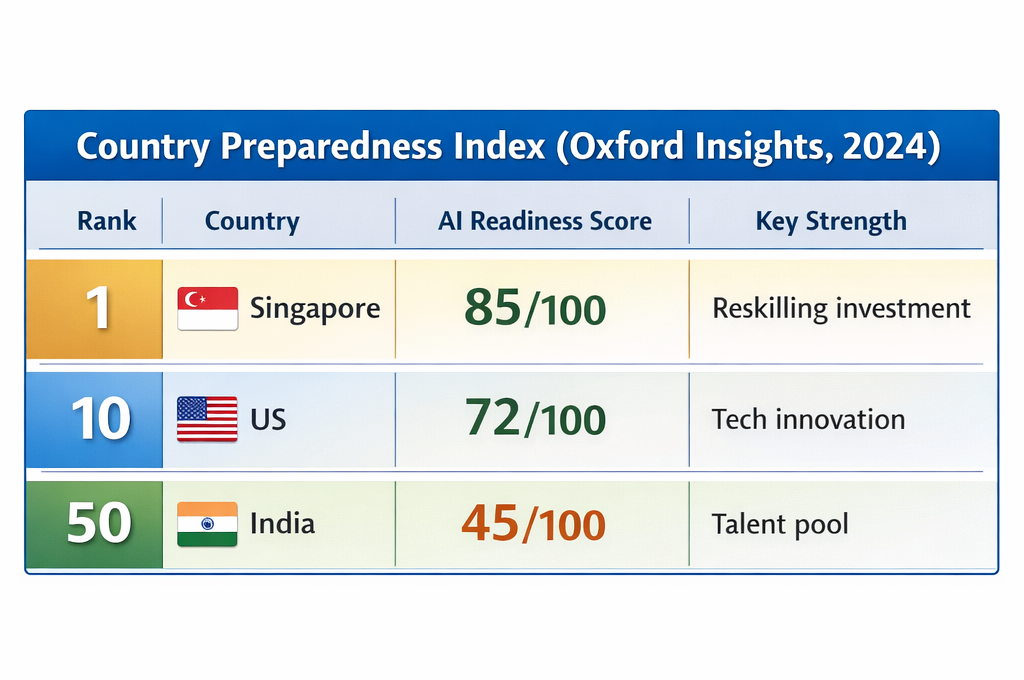
- Reskilling: Scale programs like Singapore’s SkillsFuture (trained 700k workers, 2024).
- Education Overhaul: Emphasize STEM + soft skills (e.g., Finland’s model).
- Social Safety Nets: Universal basic income pilots (e.g., Finland 2017–2018 reduced stress, no work disincentive); portable benefits.
India’s Unique Opportunity and Challenges
India’s 1.4 billion population (65% working-age) positions it well:
• Strengths: 5 million STEM grads/year; $10B AI investments (2024); Digital India covers 1.2B people.
• Projections: NASSCOM (2024) – AI to add $500B to GDP by 2025, creating 20 million jobs.
Challenges: 80% workforce informal/low-skill (World Bank, 2024).
Need: Train 400 million in digital skills by 2030 (NITI Aayog).
Success stories: Google’s AI skilling 1 million Indians (2024 partnership).
A Global Turning Point
Artificial intelligence promises a new wave of productivity and economic transformation, but realizing its benefits will require decisive policy action from governments. Around the world, a few forward-looking nations are already moving ahead with structured AI strategies and governance frameworks. Countries such as Estonia have introduced advanced AI governance laws to ensure responsible innovation, while the United Arab Emirates has launched an ambitious national roadmap through its AI Strategy 2031, aiming to embed artificial intelligence across sectors of the economy.
However, many nations still remain underprepared, raising the risk that AI could amplify existing inequalities rather than reduce them. The central question facing policymakers today is whether governments will invest sufficiently in human capital—through education, reskilling, and digital infrastructure—to help societies adapt to this technological shift. Evidence increasingly suggests that countries that prepare early and build strong human-capital foundations are more likely to convert AI disruption into long-term prosperity, while those that delay action may struggle with widening economic and social gaps. editor@ictpost.com